🔄 Updated 21 Jun 2026
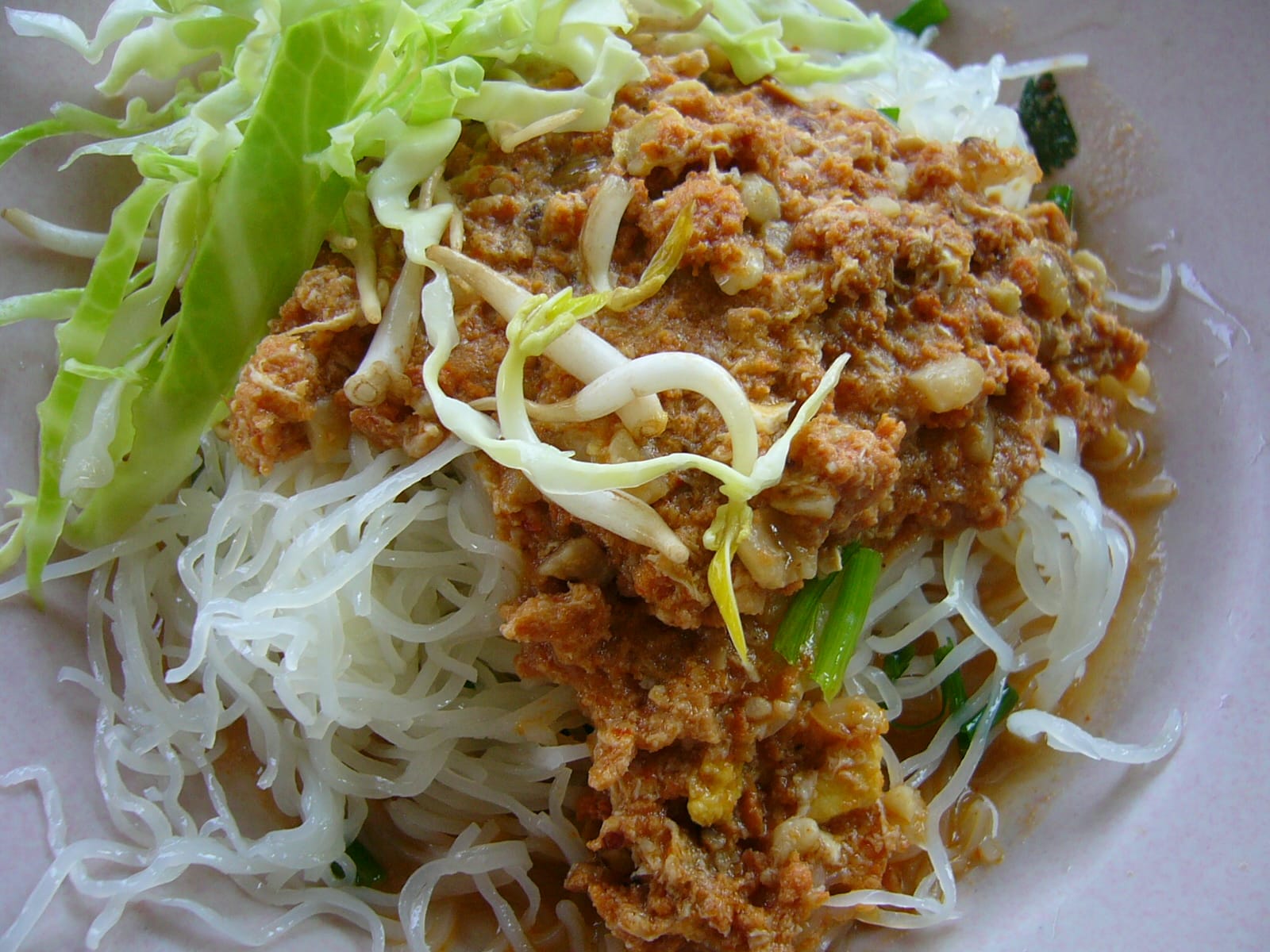
If you've only ever had khanom jeen with coconut nam ya or northern nam ngiao, the version around Prakhon Chai will give you a new picture. Here people like to ladle two things over the noodles at once in a single bowl: nam ya, a curry paste pounded with boiled fish until it's deep and rich, and nam phrik, a sweeter sauce made with ground peanuts and coconut milk. Pour them on top of each other and you get salty, spicy and sweet cutting against each other in one mouthful. This is how southern Isan folks around Buriram, Surin and Sisaket have eaten it for ages.
The other clear difference is the fresh veg. Stalls here really do give you a pile of it: sliced yardlong beans, lemon basil, morning glory, shredded cabbage, bean sprouts, and at some places banana blossom and pennywort too. Eating khanom jeen here isn't just noodles and broth, it's a bowl where you're crunching fresh raw veg right alongside it. Locals treat plenty of veg as the standard, not a freebie on the side.
What makes southern Isan khanom jeen different
- Nam ya — the Buriram style leans rich, salty and savoury from fish and shrimp paste. Some stalls make a coconut-free 'jungle' nam ya, others offer a coconut version to choose from.
- Nam phrik — a sweeter sauce with ground peanuts and coconut milk, a bit like the southern-Thai khanom jeen sauce but not as fierce, meant to be ladled alongside the nam ya so the flavours cut against each other.
- The noodles — mostly fresh khanom jeen strands, soft and not easily mushy. Many stalls order their noodles from a local noodle maker, delivered every morning.
- Fresh veg — served by the plateful: yardlong beans, morning glory, lemon basil, cabbage, bean sprouts, refilled freely at many places.
- Things to add — there's often boiled egg, fried fish or fried pork sold alongside, which you can add on to make it a heavier meal.
How to eat it right
Try ladling on half nam ya and half nam phrik over each other first, then adjust. If you like it salty and spicy, add more nam ya; if you want it sweeter and softer, add more nam phrik. Then pile on the fresh veg, squeeze in a little lime and mix it all together in one go. That's how the locals eat it.
Want to taste deeper? Try a Buriram food tour or cooking class
Half a day with a local who knows the lanes — or cooking a dish yourself — teaches you more than just eating. Book ahead on Klook or GetYourGuide.
Khanom jeen stalls Buriram locals actually eat at
We've ordered these by their reputation among locals and how consistent the flavour is, not by how fancy they are. Most khanom jeen stalls around here are pushcarts or small lean-tos that open early and sell out fast. To be honest, plenty of them have no English menu and take cash only, so come prepared for that.
Khanom Jeen Yai Loi (in front of Buriram bus terminal)
An old pushcart stall in front of the bus terminal in Buriram town, one of the most talked-about. You can choose coconut nam ya or jungle nam ya, at 20 THB a set. It's known to sell out within a few hours on some days, so show up late and you risk missing out. There's also a dessert cart selling alongside it.
Khanom Jeen Yai Long / Pa Long
A legendary stall in town that's been passed down for over thirty years. The nam ya is excellent and well-rounded, with chicken nam ya, fish nam ya and nam phrik on offer, plus a generous pile of fresh veg. There's a steady stream of customers, and a lot of people are hooked on the nam ya that's simmered until thick.
Khanom Jeen Je Daeng
Another Buriram legend. The selling point is the broth's deep, savoury punch, the kind you slurp and feel satisfied. People who like bold flavours often hand this one the crown. There are several nam ya to ladle on together, and the fresh veg comes loaded southern Isan style.
Khanom Jeen Pa On
A khanom jeen stall in central Buriram that reviewers say has nam ya with just the right savouriness, not so intense it's hard to eat. Good for anyone who wants to try the Buriram flavour but isn't ready for the full-on spicy end. Fresh veg refills are available and it's a comfortable spot to sit and eat.
Som Tam Yai Thip (Prakhon Chai)
A busy som tam stall in Prakhon Chai that sells khanom jeen with nam ya alongside its papaya salad, at easy prices, opening from around midday. Good for grabbing khanom jeen and a tray of som tam in one meal, and the locals around there genuinely eat here.
Lao Fun Prakhon Chai
A comfortable sit-down spot on Maharat Road near the Prakhon Chai bus terminal, known for its spicy yam khanom jeen (a tangy noodle salad). It's a different way to eat khanom jeen, tossed with sour-spicy salad dressing, good for anyone who wants to try a modern take in a cool spot out of the heat. There are desserts and cake too.
Nom Prakhon Cafe (Prakhon Chai)
A cafe in Prakhon Chai whose standout is a spicy yam khanom jeen. Good for anyone who wants khanom jeen in a lighter form with a drink, rather than the traditional nam ya version, and a handy option for travellers passing through the district town.
Khanom jeen in Prakhon Chai municipal fresh market
Inside the Prakhon Chai fresh market there's a khanom jeen nam ya vendor in the mornings who's a regular for people in the district. It's cheap, the fresh veg comes straight from the market, and it's about as local as khanom jeen gets. The market is open every day from before dawn until evening.
Before you go
The old-school stalls like Yai Loi and Yai Long are a breakfast thing and sell out fast, sometimes open only a few hours. If you're set on a famous one, going before late morning is the surer bet. The Prakhon Chai spots like Lao Fun and Nom Prakhon Cafe are more the sit-and-linger type and open later, so allow about 40 minutes to get there from Buriram town.
Which area to eat khanom jeen in
In Buriram town
Home to the legends — Yai Loi in front of the bus terminal, Yai Long and Je Daeng. A good breakfast before heading out, with several stalls to find in one area.
Prakhon Chai district town
You've got khanom jeen nam ya in the fresh market, Som Tam Yai Thip, and chill yam-khanom-jeen spots like Lao Fun. Good to stop by before or after visiting Prasat Muang Tam.
Prakhon Chai municipal fresh market
Open 05:00–19:00 daily, with early-morning khanom jeen, fresh raw veg and local desserts all in one place.
Honestly, khanom jeen around here isn't rare or fancy. Most of it is pushcarts and market lean-tos that people eat at every morning. The charm is in the freshness: noodles delivered daily, a heaping pile of veg, and nam ya and nam phrik you can ladle on together. If you've come to Buriram and want to eat the way locals really do, get up a little early and join the queue with them. It's worth the wake-up.
Plan a full eat-and-explore trip around Buriram
See the Buriram travel guide →