🔄 Updated 21 Jun 2026
What makes Sakon Nakhon fun is that each type of attraction sits in its own zone. The main temples and the stupa are right in the city center and walkable from one another, Nong Han hugs the southern edge of town, while Phu Phan and the mountain temples mean driving out to the south and east. If you've only got one day, you can cover the city center and Nong Han comfortably; with two days you can head up into Phu Phan and out to Wat Tham Pha Daen. We've split everything into five groups to make it easy to picture: the twin-city stupas, Nong Han, the indigo villages, Phu Phan National Park, and the forest-meditation temples.
Stupas and the City's Sacred Temples
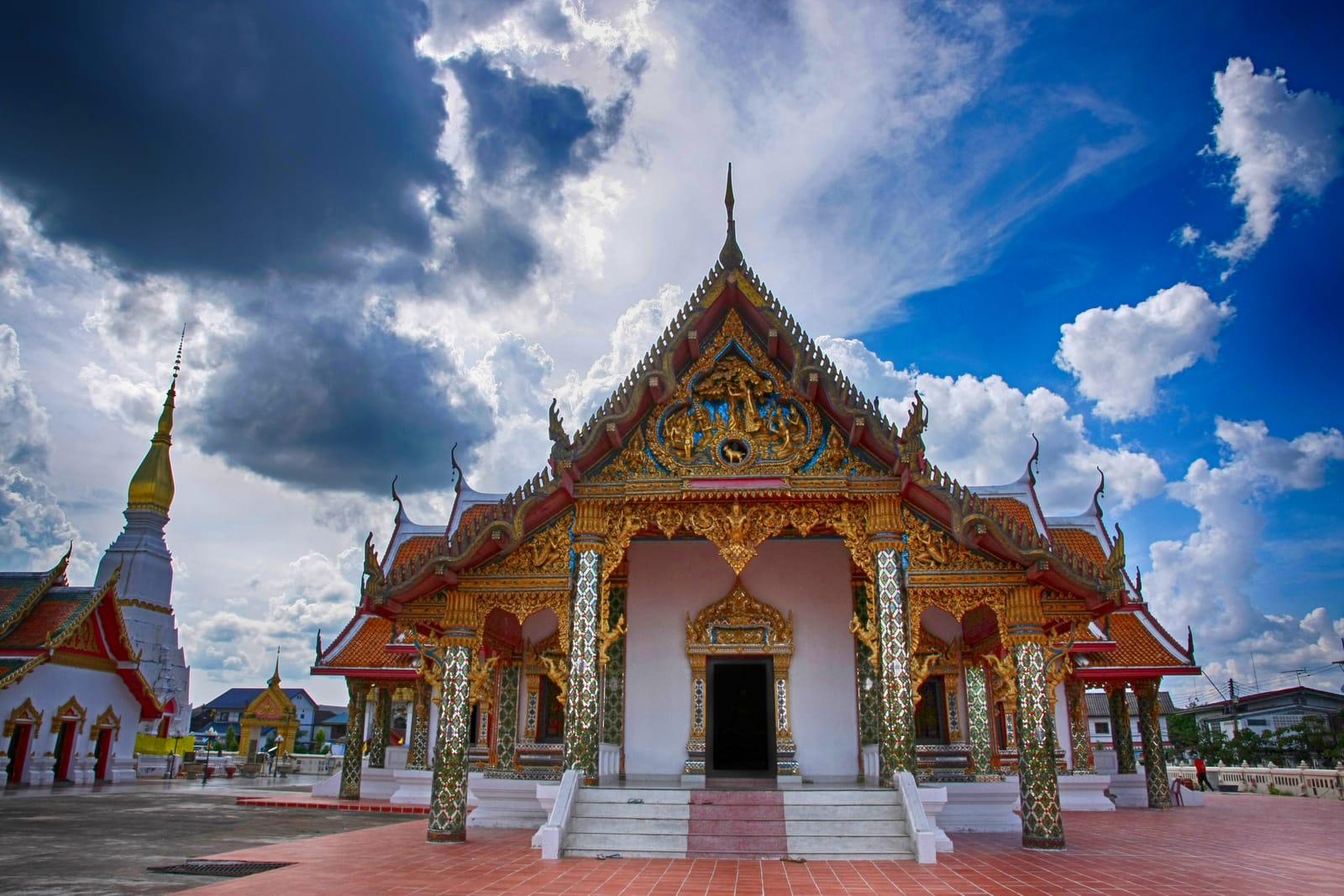
Mention Sakon Nakhon to a local and Phra That Choeng Chum is the first thing that comes to mind. It's the city's guardian stupa, sitting right in the center, and you can easily walk to it from the morning market or the walking street. Phra That Phu Phek, on the other hand, is up on a hill — you have to make a point of driving out and then climbing a fair number of steps to reach it — but the view pays you back for the effort.
Wat Phra That Choeng Chum — the city's twin stupa
Sakon Nakhon's most revered landmark. The stupa is a square Lan Xang–meets–Lanna chedi, white trimmed with gold, built to enshrine a set of Buddha footprints, with a solid gold finial at the top. Locals treat it as the place to come and make a wish for the city. It sits in the center of town on the edge of Nong Han, with a parking lot out front, so it slots in perfectly before or after a stroll through the market.
Phra That Phu Phek — a stone sanctuary on the hilltop
A Khmer-era sandstone sanctuary on top of Phu Phek hill in the Phu Phan range. It's a viewpoint that looks out over the city of Sakon and the wide expanse of Nong Han lake. The sanctuary was never finished, so only the frame remains, but the atmosphere up top and the 360-degree views are well worth the 400-plus steps up. Good for anyone who likes a climb and a good photo.
Wat Pa Suthawat — an in-town forest-lineage temple
A forest temple in the middle of the city where Luang Pu Mun Bhuridatto passed away in 1949. Inside you'll find the Ajahn Mun Museum and the museum chedi of Luang Pu Lui. It's shaded and peaceful despite being right in town, and makes a good first stop before heading out to the other forest temples around the province.
A note on what to wear
For temples and stupas, cover your shoulders and knees, especially at forest temples where restraint is the whole point. Take your shoes off before stepping into the hall, and keep your voice down — many of these temples still have monks genuinely practicing meditation, they're not just tourist sites.
Want more out of Sakon Nakhon? Book tours & activities
Booking online ahead on Klook or GetYourGuide is usually cheaper than the gate and skips the queue. Pick only the experiences you actually want — prices and availability are shown live on each site.
Nong Han, the Largest Lake in Isan
Nong Han is the largest natural freshwater lake in the Isan region, spreading across several sub-districts around the city. It's both a fishing ground for locals and a waterside spot for townsfolk to relax. Early morning and evening are when it's at its best — you'll see fishing boats heading out and the light catching the water.
Somdet Phra Sri Nakarin Park (Sra Phang Thong)
A public park on the edge of Nong Han in the city center, with a red-lotus pond that's beautiful in the early morning. Locals come here to walk for exercise and sit by the water. Free to enter, and a good stop in the early morning before the sun gets harsh, or in the evening to catch the breeze. It's not far from Wat Phra That Choeng Chum.
Ban Tha Wat raft dining
A village on the edge of Nong Han with floating rafts you can sit out on and eat over the water, with an open view across the wide lake. Order fresh Nong Han fish and have it right there on the raft. It's laid-back and good for lunch or late afternoon. The village does indigo dyeing too, so you can roll two things into one stop.
Straight talk
Nong Han isn't a flashy mountain-backdrop kind of lake — it's a wide, flat one, and its charm is in the calm, the fishing boats, and the fresh freshwater fish. If you come for dramatic scenery you might find it underwhelming, but if you come for the easy atmosphere, watching the boats, and good fish, you'll like it.
Indigo Villages and Craft
Sakon Nakhon is the capital of natural indigo-dyed cloth, with several villages that grow their own indigo plants and ferment their own dye vats. Some local brands here dye cloth that ships as far as Japan. Going all the way to the village lets you see the whole process — from growing the indigo to building the vat to dyeing the finished cloth — and buy the real thing straight from the makers at a better price than in town.
Ban Nong Khrong / indigo-dyeing groups around the city
Several villages around Sakon have organized women's groups making indigo-dyed cloth. They're open for visits, and you can try dyeing a small piece to take home. A dyeing workshop for a handkerchief or a tote bag starts at around ฿150–300 per piece. Good for anyone who wants the hands-on experience, not just to buy.
Indigo shops in town
If you don't have time to head out to a village, there are several indigo shops lined up in the city center, with everything from scarves and shirts to lengths of cloth — easy to browse in one place. An indigo scarf starts at around ฿250, and an indigo-dyed shirt from around ฿500 depending on the fabric and pattern.
How to tell real indigo
Real natural indigo cloth has a faint indigo smell, a deep blue that reads a little muted rather than the harsh punch of chemical dye, and it may bleed a little in the first few washes — which is normal for natural dye. Buying from the women's groups in the villages usually gets you the genuine article at a better price.
Phu Phan National Park and the Mountain Nature
The Phu Phan range runs across the south of the province — a watershed forest with waterfalls, viewpoints, and the royal residence of King Rama IX. Drive about 20–30 minutes south of the city and you're already entering the mountains. Good for anyone who likes nature and air that's cooler than down in town.
Phu Phan National Park — waterfalls and viewpoints
A park that covers the Phu Phan range and stretches all the way into Kalasin. It has several waterfalls that are at their best in late rainy season into early cool season, plus viewpoints and caves to stop at. The air up on the mountain is cooler and more comfortable than in town. Good for a half-day to full-day drive.
Kham Hom Waterfall — a waterfall near the city
An easy-to-reach waterfall within the Phu Phan area, not far from town. The flow is strongest and prettiest in late rainy season, around September to November; in the dry season the water is low. Good for a quick dip to cool off or a rest stop on the way up the mountain.
Phu Phan Rachaniwet Palace — a palace in the forest
The residence of King Rama IX and the royal family during their visits to the people of Isan. When no royals are in residence, the grounds open for visitors to walk through the beautifully landscaped, shaded gardens. Dress modestly and check the opening days before you go, as it closes at certain times for royal visits.
Forest-Meditation Temples
Sakon Nakhon is the home ground of the forest-meditation lineage that Luang Pu Mun laid the foundations for, with forest temples and disciples of this lineage spread across the province. People who follow the path of merit and meditation come here specifically. Some of the temples are beautiful enough that they've become photo spots too.
Wat Tham Pha Daen — rock carvings on the cliff face
A temple in the Phu Phan range with bas-relief images carved into a huge rock cliff, depicting the life of the Buddha and Isan ways of life. It's rare craftsmanship, and there's a viewpoint looking down over the city of Sakon. It's about 17 km from town; for the final stretch up the mountain you park at the bottom and take a community songthaew up, about 20 THB. Open 8am–4:30pm.
Ajahn Mun Bhuridatto Museum
Inside Wat Pa Suthawat in the city center. It displays a cast statue of Luang Pu Mun seated in meditation, his relics that crystallized into clear crystals, and his monastic requisites along with his life story from birth to death. Free to enter, and good for anyone who wants to understand the origins of the forest lineage before visiting the other temples. Open roughly 8am–5pm.
When to go up to Wat Tham Pha Daen
The final stretch up to Wat Tham Pha Daen is a narrow, steep mountain road, and the temple doesn't let you drive up yourself — you park at the bottom and take a community songthaew up, about 20 THB. Go in the morning when the sun isn't harsh and visibility is good, and avoid going up in the rain because the road gets slippery.
Planning a Sakon Nakhon Trip That Works
City center + Nong Han
Up into Phu Phan + the cliff temple
Following the forest lineage + souvenirs
- Only one day — cover the city center: Phra That Choeng Chum, the lakeside park on Nong Han, Wat Pa Suthawat, then shop for indigo cloth in town. That's a full, unhurried day.
- Two days — first day in the city center and Nong Han, second day up into Phu Phan for Wat Tham Pha Daen, the waterfalls, and the palace.
- Getting there — fly into Sakon Nakhon Airport from Bangkok, or take a coach. Around town, renting a car or motorbike is easiest since the attractions are spread out.
- When to go — late rainy season into early cool season (October–December) is best: cool air, pretty waterfalls, and it lines up with the Wax Castle Procession around the end of Buddhist Lent.
See accommodation and the full Sakon Nakhon travel guide before you set off
See the Sakon Nakhon guide →