🔄 Updated 21 Jun 2026
The temple-and-culture sights in Samut Prakan are spread along both banks of the Chao Phraya. The town and Bang Pu side has a cluster of temples and chedis close to the city center, while across the river the Phra Pradaeng side holds old royal temples and the Mon community. We've grouped everything by zone so you can pin spots near each other and avoid criss-crossing the river. Everything on this page is real and open to visitors right now.
Chedis & temples of the old town (city side)
If you start from Pak Nam town, these three are the heart of the city side — close together and long tied to the history of defending the river mouth.
Phra Samut Chedi (the Mid-River Chedi)
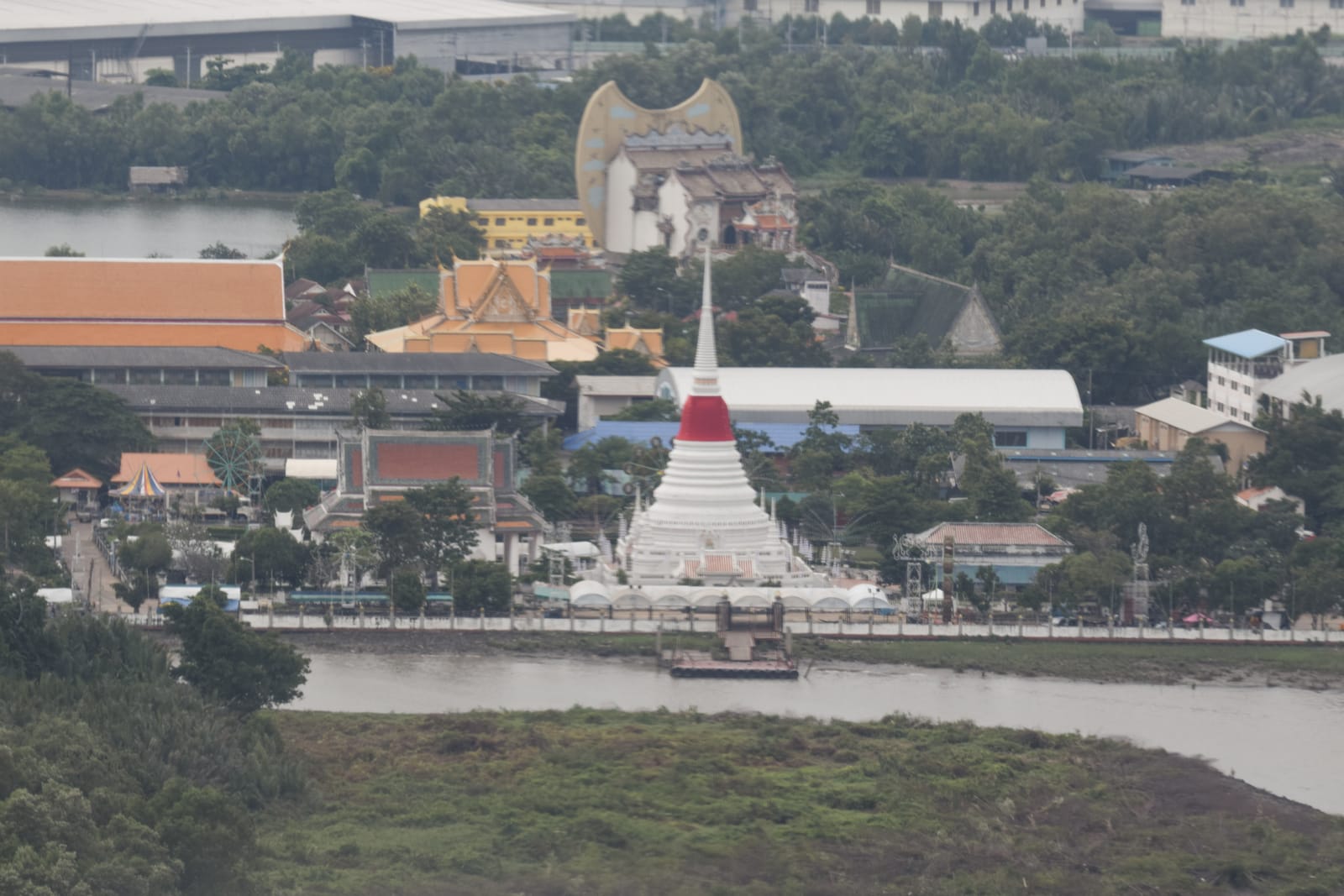
The white chedi that's the symbol of the province, begun under King Rama II and completed under Rama III. It originally stood on an island in the middle of the river, which is why it's known as the Mid-River Chedi; silt later built up and joined it to the bank. The riverside setting is quiet and calm, and you can reach it by a short ferry from Pak Nam market in just a few minutes. Every November there's a worship fair around the chedi that locals in Pak Nam look forward to all year.
Wat Asokaram + Phra Thutangka Chedi
A quiet meditation temple beside the mangroves around Bang Pu, founded by Luang Por Lee Dhammadharo. The highlight is the Phra Thutangka Chedi — a cluster of 13 white chedis on a single base, symbolizing the 13 ascetic practices (dhutanga), with relics of the Buddha enshrined inside. It's photogenic and peaceful, good for sitting and meditating, and it's on the same route as the Ancient City so you can combine the two.
Wat Klang Worawihan
An old temple in central Pak Nam with roots in the Mon community that migrated and settled here. Its old name refers to a canalside temple, and it's the town's main temple where Pak Nam locals come to make merit and hold important events. It sits right in the center, walkable from Pak Nam market, and is a good quick stop to pay respects while you wander the old town.
Ferry tip
Phra Samut Chedi is on the opposite bank from Pak Nam town. The way locals do it is to take the ferry across from the Pak Nam market pier — the fare is just a few baht and the crossing takes only a few minutes. It's more fun than driving the long way around, and you get a view of the Chao Phraya near the river mouth into the bargain.
Want more out of Samut Prakan? Book tours & activities
Booking online ahead on Klook or GetYourGuide is usually cheaper than the gate and skips the queue. Pick only the experiences you actually want — prices and availability are shown live on each site.
Riverside forts
Samut Prakan literally means "sea wall," and this town's original main job was to defend the mouth of the Chao Phraya, so there are old gun forts left to explore. Good for anyone into military history and big, real artifacts.
Phra Chulachomklao Fort + HTMS Maeklong
A Western-style riverside gun fort at Laem Fa Pha, built under King Rama V to defend the river mouth, with a role in the Paknam Incident of R.S. 112 (1893) when French warships forced their way in. Inside you'll find a monument to King Rama V, the disappearing guns still sitting in their pits, and the highlight — the decommissioned warship HTMS Maeklong, moored so you can actually go aboard and walk the decks. There's a mangrove nature trail too.
Wat Phichai Songkhram
An old riverside temple tied to the building of the town's defensive forts in the early Rattanakosin era. It got the name Phichai Songkhram ("victory in war") after King Rama II came to present royal kathina robes here. It suits travelers who want to keep the military-history theme going after the forts, with a quiet riverside temple feel.
Inside the fort
Phra Chulachomklao Fort is free to visit, but you'll need to leave an ID card with the guard post at the gate first, since it's still navy land. Allow at least 1–2 hours of walking if you want to board HTMS Maeklong and finish the mangrove trail. Early morning or evening is more comfortable than midday, when the sun is harsh.
Royal temples & Mon culture (Phra Pradaeng side)
Cross the river to the Phra Pradaeng side (formerly Mueang Nakhon Khuean Khan) and you'll find another world. This is a community of Thai people of Mon descent (Thai Raman) who settled here in the early Rattanakosin era, with both old royal temples and their own living traditions.
Wat Phaichayon Phonlasep Ratchaworawihan
A second-class royal temple in Bang Phueng subdistrict, Phra Pradaeng district, built under King Rama II alongside the founding of Mueang Nakhon Khuean Khan. Locals call it Wat Wang Na. The architecture mixes in Chinese art, and the name Phaichayon comes from the prang-topped throne canopy in the ordination hall.
Phra Pradaeng Mon community
The old-town quarter on the Phra Pradaeng side still has wooden houses, markets and Mon temples to stroll through. If you're lucky enough to catch a merit-making festival, you'll see Mon-style khao chae (rice in chilled jasmine water) and traditional hand-stirred kalamae candy.
Phra Pradaeng Songkran
A tradition originally called Songkran Pak Lat, over 180 years old, held about a week later than the usual Songkran (in 2026, around 24–26 April). It features a Miss Songkran procession, flower floats, the "Num Loi Chai – Sao Sabai" pageant, and Mon-style saba (a traditional throwing game).
Crossing over to Phra Pradaeng
From the Bangkok or Bang Krachao side there are several ferry piers heading into Phra Pradaeng. The short crossing has plenty of atmosphere before you head off to explore the temples and old-town markets.
To see Mon culture in full
Phra Pradaeng is at its liveliest during the Songkran festival in late April, when the whole town comes out for the processions and folk games. If you visit outside that window you can still walk the royal temples and old houses, but it'll be quieter — better for travelers who want a relaxed, uncrowded trip.
The Ancient City — Thai craftsmanship in one place
If you want to see temples, chedis and Thai architecture from several regions in one place, the Ancient City (Muang Boran) is the most time-efficient answer in the province. It's an open-air museum of recreations, but many buildings are modeled on the real thing and some are genuine old structures relocated here for preservation.
- A vast site of roughly 800 rai — a shrunken map of Thailand, laying out temples, palaces, royal residences and Thai houses by their real region
- A mix of replicas and preserved originals — some buildings are modeled on monuments that are now damaged or lost, so you get to see their original forms
- Too much to walk in a single day — renting a bicycle or taking the tram is easier; allow half a day to a full day
- Entry for Thai adults around ฿350, children around ฿175 — open daily roughly 09:00–19:00 (check the latest closing time before you go)
Combo ticket with Erawan Museum
The Ancient City and the Erawan Museum share the same owner, and there's a combo ticket for both. If you plan to visit both on one trip, compare the combo price against buying separately first — sometimes it's the better deal. The Erawan Museum (a three-headed copper elephant about 16 stories tall) is near BTS Chang Erawan, so it's easy to reach by skytrain.
How to plan a temple-and-culture trip that works
Because the sights sit on opposite banks of the river, planning by zone saves the most time. Here's a rough two-day plan split by side — adjust it to the time you have.
City & Bang Pu side (chedi + temples + Ancient City)
Phra Pradaeng & Laem Fa Pha side (fort + royal temple + Mon community)
Getting around
On the city side, the green-line BTS runs all the way to the end of the line; get off at Chang Erawan for the museum. But to cover Wat Asokaram, Phra Chulachomklao Fort and Phra Pradaeng, your own vehicle is the most flexible since they're off the skytrain line. For crossing the river, locals favor the ferries — fast and full of atmosphere.
Want a full trip plan with where to eat and stay in Samut Prakan?
See the Samut Prakan travel guide →