🔄 Updated 21 Jun 2026
Samut Sakhon sits just about 30 km from Bangkok — easy to reach by car or on the Mae Klong railway line. Most people come to eat seafood and head straight back, but if you have half a day to a full day, the town has temples and shrines that tell its history well: the Ayutthaya era, the reign of King Rama V, and the wave of Chinese settlers who put down roots along the Tha Chin River. Follow the route below and you'll see Mahachai is about more than just shellfish and seafood.
Old temples along the Tha Chin River
The Tha Chin River has been this town's lifeline since the Ayutthaya period, so many of its important temples line the water. Some are old enough to be registered historic sites; others hold artwork you rarely see elsewhere. We've picked the ones most worth a stop.
Wat Yai Chom Prasat
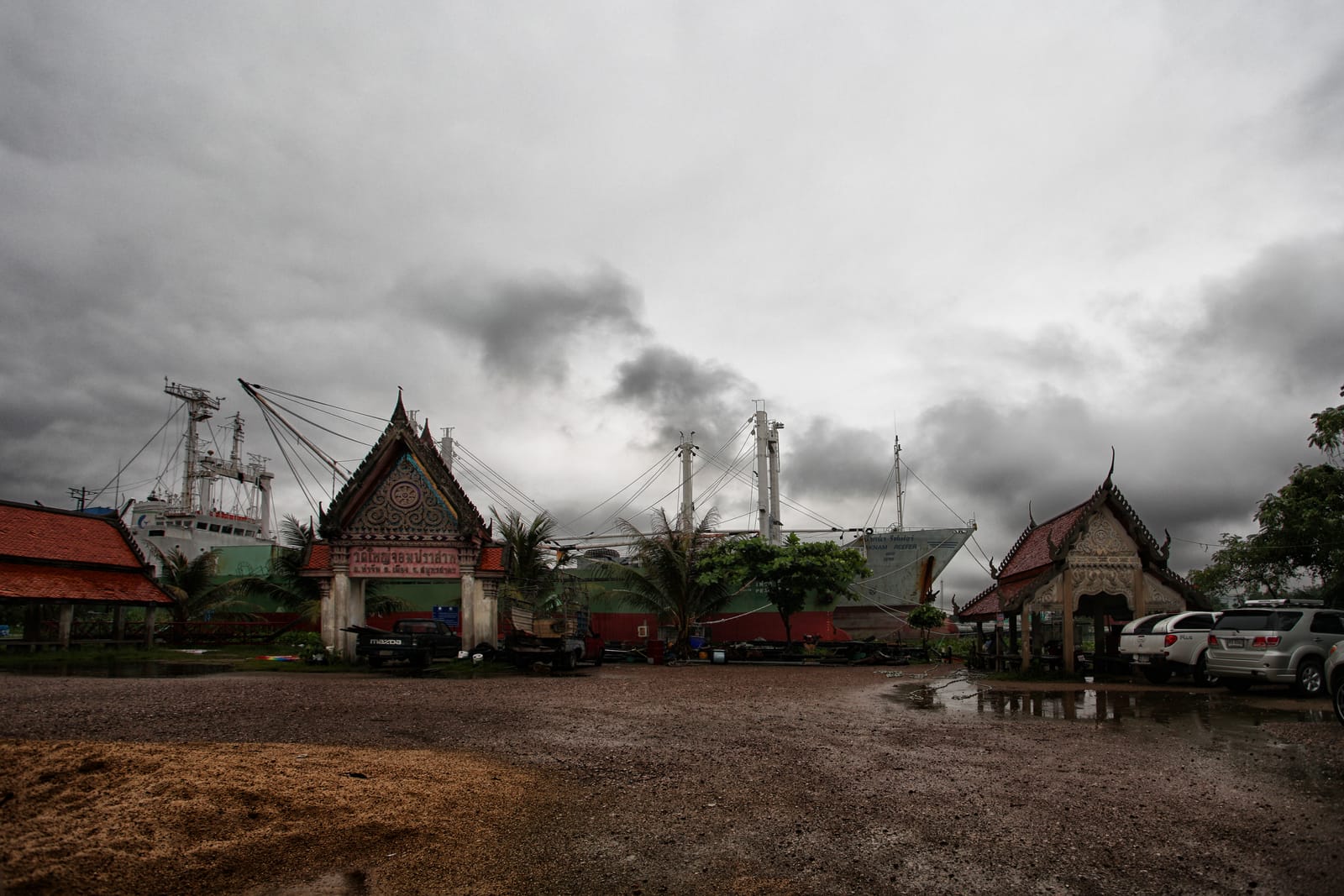
A temple on the Tha Chin River in Tha Chin sub-district, thought to date to the Ayutthaya era during the reign of King Maha Chakkraphat — close to 500 years old. What people come to see is the carved wooden door of the ordination hall, cut deep into the timber in several layers to form three-dimensional scenes of forests, mountains, trees and animals in a Chinese style. The Fine Arts Department has registered it as a historic site and preserved the doors as a national treasure. King Rama V once bestowed on it the name Wat Yai Sakhon Buri and raised it to royal temple status.
Wat Sutthiwat Wararam (Wat Chong Lom)
A royal temple right at the mouth of the Samut Sakhon estuary on the Tha Chalom side. The highlight is the monument to King Rama V, commemorating his visit to open the dedicated road in Tha Chalom. The temple is nicely decorated and shaded, with riverside spots for photos — a good pairing with a walk around the Tha Chalom community.
Wat Laem Suwannaram
An old temple on the Tha Chalom side, right next to Tha Chalom railway station and the Tha Chin River. Built around the early Rattanakosin period, it has unusually shaped roof finials and gable decorations. It's an easy walk from the station, so it's a good stop while exploring the community.
Wat Pa Chai Rangsi
A temple on the Tha Chin River in Ban Ko sub-district, Mueang district. The architecture features detailed stucco work and intricate patterns. It's a favorite stop for those who like making merit, thanks to its quiet atmosphere and the care put into the stucco.
A tip on timing
Most temples in Samut Sakhon keep regular temple hours — morning to evening. But if you're set on seeing the ordination hall or the carved doors at Wat Yai Chom Prasat, go during the day and ask at the temple first, since the hall is sometimes closed. Dress modestly — covering your shoulders and knees makes it easy to enter anywhere.
Want more out of Samut Sakhon? Book tours & activities
Booking online ahead on Klook or GetYourGuide is usually cheaper than the gate and skips the queue. Pick only the experiences you actually want — prices and availability are shown live on each site.
The fishing town's Chinese shrines
Samut Sakhon has a long-established Chinese community, especially on the Tha Chalom side. The shrines here aren't just places of worship — they're the heart of a fishing community whose lives have been tied to the sea for generations. Several are more than a hundred years old.
Samut Sakhon City Pillar Shrine
A revered shrine in the center of Mahachai, built in Chinese pavilion style. Inside is the gilded image of Chao Pho Wichian Chot, carved from wood. Fishermen come to pay respects and light firecrackers before setting out to sea. Behind the shrine stands the city pillar, said to be the largest in the country. Each year there's a lively procession festival honoring the city pillar deity.
Pun Thao Kong Shrine (Central Shrine)
Said to be the oldest shrine in Samut Sakhon. It originally stood beside Wat Yai Chom Prasat before moving to the Tha Chin River on the Tha Chalom side. It began as a teak shrine with a thatched roof, later rebuilt in masonry, and remains an important place of worship for Tha Chalom's Chinese community.
Chao Mae Chui Buay Nia Shrine (Goddess Thapthim)
A shrine on the Tha Chin River on the Tha Chalom side. The Chinese settlers who built the goddess's image decorated it with red gemstones, so people came to call her Chao Mae Thapthim (the Ruby Goddess). It's another stop on Tha Chalom's shrine-hopping route.
The legend of Phan Thai Norasing at Khok Kham
If you've ever watched a historical drama, the name Phan Thai Norasing may ring a bell — the boat steersman who accepted execution to uphold royal tradition after failing to swing the royal barge's prow in time on the winding Khok Kham canal during the reign of King Suea. This story really happened in Samut Sakhon, and there's a shrine where you can stop to remember it.
- Phan Thai Norasing Shrine (Wat Khok Kham) — the original shrine, at the mouth of the Khok Kham canal in Phan Thai Norasing sub-district, in front of the old ordination hall of Wat Khok Kham. It's registered as a national historic site, and inside is a statue of Phan Thai Norasing in ancient soldier's dress, holding a paddle.
- Khok Kham canal — the winding canal at the heart of the legend. Today it's a quiet natural stretch along the water, good for sitting and watching riverside life.
- Getting there — it's on the side bordering Bangkok's Bang Khun Thian district, about 20–30 minutes by car from central Mahachai, and easy to combine with a trip to the Khok Kham mangroves.
Pair it with nature
The Phan Thai Norasing and Khok Kham area is near the mangroves and salt flats. Come in the late afternoon and you'll catch riverside life and a lovely sunset. Plan to stop at the shrine first, then head out to the nature spots in the evening — the timing works out just right.
Tha Chalom, an old riverside community that's still alive
Tha Chalom is on the other side of the Tha Chin River, across from central Mahachai, reached by the small ferries that still run. It's an old Chinese community, with wooden shophouses, old shops, shrines and temples lined up together — a slow-paced neighborhood to wander, one that hasn't been over-polished.
Mahachai–Tha Chalom ferry
A small ferry across the Tha Chin River from the Mahachai market side to Tha Chalom. It takes just a few minutes and costs a handful of baht — the nicest way to cross.
Thawai Road, Tha Chalom
A historic street regarded as Thailand's first sanitation district road, which King Rama V once visited to open. You can stroll along admiring the old shophouses at your own pace.
Tha Chalom railway station
The end of the Mahachai–Ban Laem line — a small station with an old-time feel, near Wat Laem Suwannaram and the shrines, so you can carry on exploring on foot.
The neatest way to do Tha Chalom is to park on the Mahachai side, take the ferry across, then walk or hop on a motorized samlor (tuk-tuk) around the community: pay respects at the Central Shrine and the Goddess Thapthim shrine, stop by Wat Laem Suwannaram and Wat Chong Lom, then ferry back to eat seafood on the market side. Half a day is plenty for a full experience.
A 2-day temple & culture plan
If you'd rather not rush, try splitting it into two days. Day one covers the temples and legends on the town side; day two is for walking the Tha Chalom community and paying respects at the riverside shrines.
Old temples and the legends of Sakhon town
Walking the Tha Chalom community
Getting there and good to know
- By car — from Bangkok, take Rama II Road, about 30–45 minutes to Mahachai. Most temples and shrines have parking.
- Mahachai railway line — board at Wongwian Yai station and get off at Mahachai; it's a scenic, cheap route.
- Dress code — temples call for modest dress, covering shoulders and knees. Shrines are less strict, but neat attire is still fitting.
- Best timing — come in the morning to early afternoon to cover all the temples, and save the evening for the riverside or salt flats.
Plan a full day in Samut Sakhon — temples, markets and seafood all together
See the Samut Sakhon guide →