🔄 Updated 21 Jun 2026
Before you plan, here's the lay of the land. Sisaket is a lower-northeast destination served by the Bangkok–Ubon Ratchathani rail line, which stops at Sisaket station right in the city center — something many northeastern provinces can't offer. But the province has no airport, so if you want to fly you'll land at Ubon Ratchathani and drive across. As for getting around once you're there, public transport to the sights is thin: the Khmer temples and Kantharalak are well outside the city, and having your own car or a rental keeps the trip moving.
Take the Northeastern Line train — the standout way in
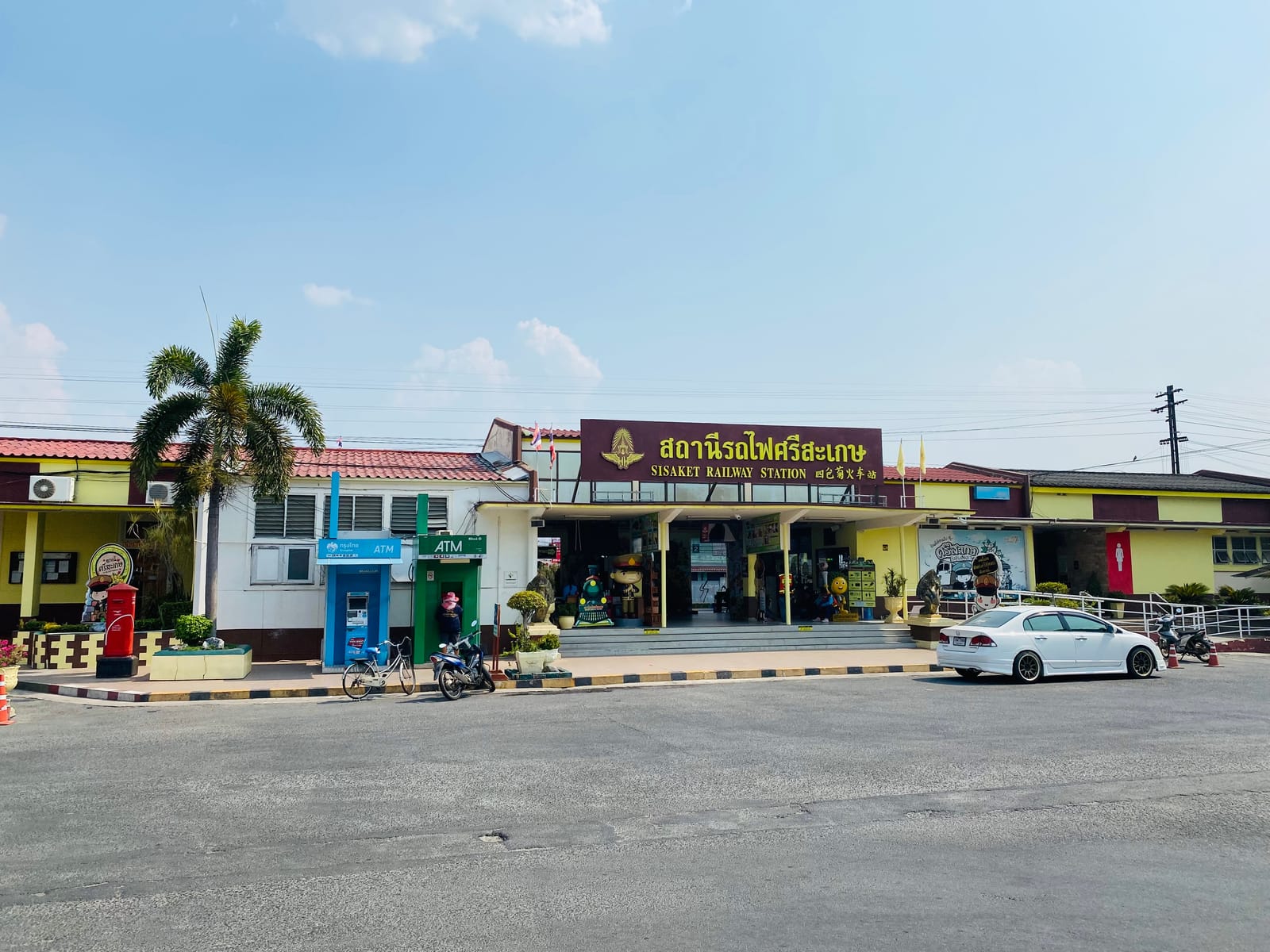
The Northeastern (lower Isan) rail line runs from Krung Thep Aphiwat Central Terminal (Bang Sue) through Nakhon Ratchasima, Buriram and Surin into Sisaket, before finishing at Ubon Ratchathani. Trains stop at Sisaket station, which sits right in the city center, so once you're off you can walk or take a tuk-tuk straight to your hotel in town. That's more convenient than the bus, which drops you further out.
- Distance and time — Bangkok to Sisaket is about 570 km, roughly 8–9 hours by train depending on the service. Special express trains are noticeably faster than rapid or ordinary ones.
- Starting price — Seated tickets start at around ฿240, while a 2nd-class air-conditioned sleeper berth costs more — ideal for the overnight train so you sleep through and arrive by morning.
- Popular service — The overnight train on the Ubon line is a favorite with Bangkokers who want to save a night's accommodation: it leaves in the evening and arrives at dawn. Book a sleeper berth well ahead over long weekends, as they fill fast.
- Booking — Book online through the State Railway's D-Ticket system (dticket.railway.co.th) or buy at the station. Always check the latest timetable on the railway website before you travel.
Straight talk
Thai trains often run behind schedule. If you have a connection or a hotel check-in to make, build in a little buffer. The charm of this line is the long stretches of Isan rice-field views and the chance to skip a hotel night by taking the sleeper — but if you're genuinely pressed for time, the bus or flying into Ubon is faster.
Intercity bus from Mo Chit 2
Air-conditioned coaches run from Mo Chit 2 bus terminal (Chatuchak) to the Sisaket provincial bus terminal. There are several operators to choose from — the state Transport Co. plus private lines such as Cherdchai Tour, Nakhonchai Air and other Isan operators. Travel time is similar to the train, but you're dropped at the bus terminal outside the city center and need an onward ride to your hotel.
- Price — VIP / first-class air-conditioned tickets run about ฿460–510 depending on seat class and operator. You can book ahead online through the operators' websites or bus-ticket aggregator sites.
- Travel time — Around 8–9 hours, with both daytime and overnight departures. The overnight runs are popular because you arrive by morning.
- Drop-off point — Sisaket bus terminal is outside the city center, so you'll take a tuk-tuk, motorbike taxi or a ride-hailing app to your hotel.
- Who it suits — Anyone who wants more departure times to choose from than the train offers, or when the sleeper berths are sold out.
Fly into Ubon, then drive across to Sisaket
Sisaket has no airport. If you want to fly, land at Ubon Ratchathani International Airport, which has several flights a day from Bangkok and is just an hour in the air. From there it's about 60–65 km on to Sisaket, roughly an hour's drive. This is the quickest option if you're short on time, but you have to factor in the onward ride from Ubon.
- Rent a car at Ubon airport — Several rental counters operate at the airport, so you can pick up a car and drive straight to Sisaket. This is the smoothest route if you're set on touring the Khmer temples and outlying districts.
- Van / bus Ubon–Sisaket — From Ubon city there are regular services into Sisaket, taking a bit over an hour, but you have to get into Ubon city to catch them — they don't leave straight from the airport.
- Train Ubon–Sisaket — If you've landed in Ubon and fancy continuing by rail, trains run back toward Sisaket. It's cheap, but you'll need to line up the timetable just right.
- Private car / taxi from the airport — The most convenient option but pricier — worth it if there are several of you splitting the cost.
Insider tip
If your plan is to see several Khmer temples and head up to Kantharalak, flying into Ubon and renting a car at the airport is usually the smoothest move — you've got wheels the moment you land and don't waste time hunting for a rental in a province where the options are fewer.
Car rental / self-drive
For exploring Sisaket, having your own car answers every plan, because the sights are spread across different districts and provincial public transport doesn't reach them. Driving from Bangkok, take Highway 1 (Phahonyothin) up to Nakhon Ratchasima, then Highway 226 through Buriram and Surin into Sisaket — about 570 km, roughly 7–8 hours including rest stops.
- Renting in Sisaket — Options are more limited than in big tourist cities, and you'll usually need to book ahead; check with the provider before you travel. Some people rent from Ubon airport instead, where there's more choice.
- Driving from Bangkok — Worth it if you're planning a longer loop through several lower-Isan provinces in one go, say linking Surin, Buriram and Sisaket on a single trip.
- Parking — Most Khmer temples and parks have lots that rarely fill up, unlike attractions in bigger cities.
- Top up the tank — On some stretches into the border districts, gas stations are far apart. Fill up before leaving town and you'll travel easier.
Getting around the province — public transport is thin, know this first
This is where a lot of people get caught out. In Sisaket town there are tuk-tuks and motorbike taxis for short hops, but the main sights — the Khmer temples and Kantharalak — are far away in other districts. Inter-district buses exist but run on an unreliable frequency and don't pull up at the sites themselves. If you don't have your own car, here are the options that actually work:
- Hire a local car by the day — Ask at the bus terminal or have your hotel connect you with a driver: hire by the day and have them run your wishlist of stops. This is the most common approach for visitors without a car — agree the price before you set off.
- Ride-hailing apps — There are some cars in town, but the numbers are low and outside the city you can barely get a ride. Don't rely on this as your main plan for reaching Kantharalak.
- Motorbike taxis — Fine for around town or nearby temples, not for long inter-district distances.
- Let your hotel arrange a tour car — Many hotels and guesthouses in town have a regular driver who can take you out for the day. Sort it out when you book your room rather than scrambling for one on the spot.
Getting to Kantharalak — gateway to the border and the temples
Kantharalak is a large district in the south of the province, up against the Phanom Dong Rak mountains and the Cambodian border. It's the gateway to Khao Phra Wihan National Park and Pha Mo I Daeng, and it's known for its volcanic-soil durian. From Sisaket town to Kantharalak district is about 60–65 km, roughly an hour's drive.
- Drive / rent a car — From town, take Highway 221 south straight to Kantharalak. The signage is clear, and this is the most convenient way.
- Bus into the district — There are services on the Sisaket–Kantharalak route, but once you reach the district you still need an onward ride up to the park, which is hard to find without your own car.
- Continuing on from Kantharalak — From Kantharalak district it's still a fair distance up to the Khao Phra Wihan checkpoint/park, and it's a mountain road — best with your own car or a hired one from within the district.
Pha Mo I Daeng / Khao Phra Wihan — always check the situation before you go
Let's be upfront here. Pha Mo I Daeng and Khao Phra Wihan National Park sit right on the Thailand–Cambodia border, a sensitive area on security grounds. There have been notices in the past temporarily closing the Pha Mo I Daeng viewpoint when the border situation grew tense, and it opens and closes depending on conditions. Before you plan to head up, make sure it's actually open at the time — don't drive all the way up only to be turned back.
- Check before you travel — Call or look for notices from Khao Phra Wihan National Park and local government pages on whether the site is open on the day you're going. The situation can change quickly.
- Getting there — You'll need your own car or a hired one, as there's no regular public transport on the climb from Kantharalak, and it's a mountain road.
- Backup plan — If Pha Mo I Daeng is closed, Sisaket still has Khmer temples like Prasat Sa Kamphaeng Yai and notable temples in town to see instead, so you needn't scrap the whole trip.
- Safety — Always respect signs and the advice of local officials in the border area, and don't wander off the marked paths.
A note on the border
Pha Mo I Daeng and Khao Phra Wihan are in a border zone where the open/closed status hinges on the security situation. Don't go by old information from old reviews — check the park's latest notice before every trip, and always keep a backup plan.
3-day itinerary — without a car and with a car
Here are two versions. The first is for those arriving by train or bus and mainly exploring in town; the second is for anyone with a car or a rental who wants to head out to Kantharalak and the outlying temples.
Arrive in town, explore the city
Out to Kantharalak, temples and the border
Souvenirs, then head home
Want a detailed full-trip itinerary for Sisaket
See the Sisaket travel guide →