🔄 Last checked 26 Jun 2026 · details and hours can change — check the venue before you go
📍 All restaurants on the map
Tap a pin for the spot + nearby stays
Ang Thong is a small province in the central plains, barely an hour and a half to two hours from Bangkok. Its charm is that everything sits close together and most attractions are free — no rush, just drive from spot to spot at your own pace. Start the morning at Wat Muang's Luang Pho Yai, the golden giant standing in the rice fields of Wiset Chai Chan. Mid-morning, swing through Pho Thong district to see the enormous reclining Buddha at Wat Khun Inthapramun and Phra Tamnak Khamyat in the open fields. In the afternoon, stop at Ban Hun Lek in town — kids love it — then finish the day at San Chao Rong Thong Market, a century-old riverside market where you can snack on ancient Thai sweets and stroll through old timber shophouses. An Ang Thong trip is the easy kind that works for temple-hoppers, photographers, and families alike.
Many spots on this list are province-defining landmarks. The real headline is Phra Phuttha Maha Nawamin Sakayamuni Sri Wiset Chaichan — Luang Pho Yai at Wat Muang — with a lap width of roughly 63 metres and a height of around 95 metres, making it the largest seated Buddha in Thailand. The shimmering gold is visible from far away. Wat Khun Inthapramun has an outdoor reclining Buddha roughly 50 metres long, one of the longest in the country. Pa Mok has a stucco reclining Buddha from the Sukhothai era beside the Chao Phraya, with the legend of a talking Buddha image. Wat Sang Kratai has an ancient ubosot whose walls are completely embraced by the roots of four large bodhi trees — one of the most photogenic spots in the province. And Ang Thong is home to Ekkarat Village, Thailand's largest and most famous drum-making community. Put them all together and you'll understand why this small city keeps drawing pilgrims and travellers back again and again.
Wat Muang (Luang Pho Yai / Phra Phuttha Maha Nawamin Sakayamuni Sri Wiset Chaichan)
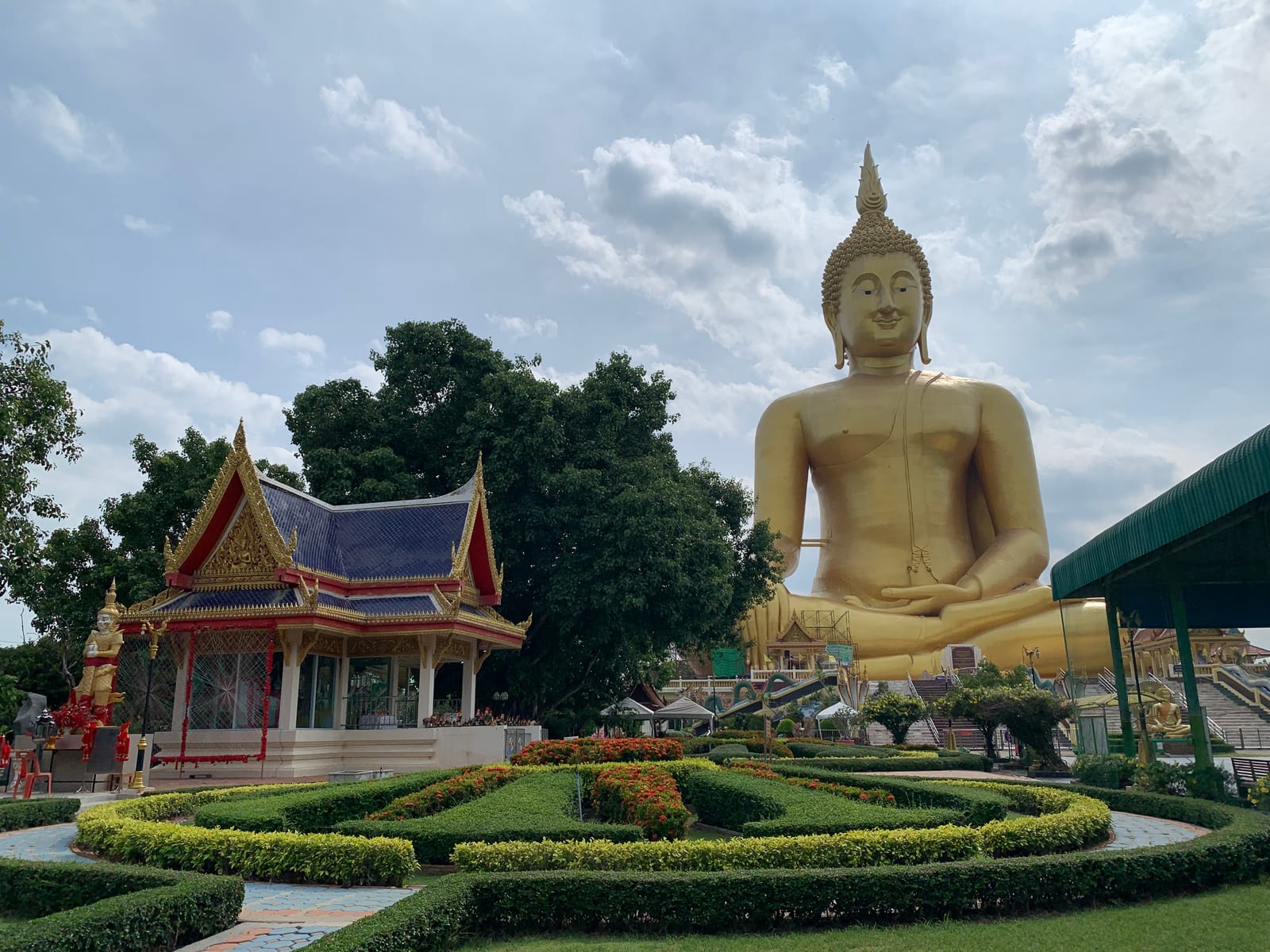
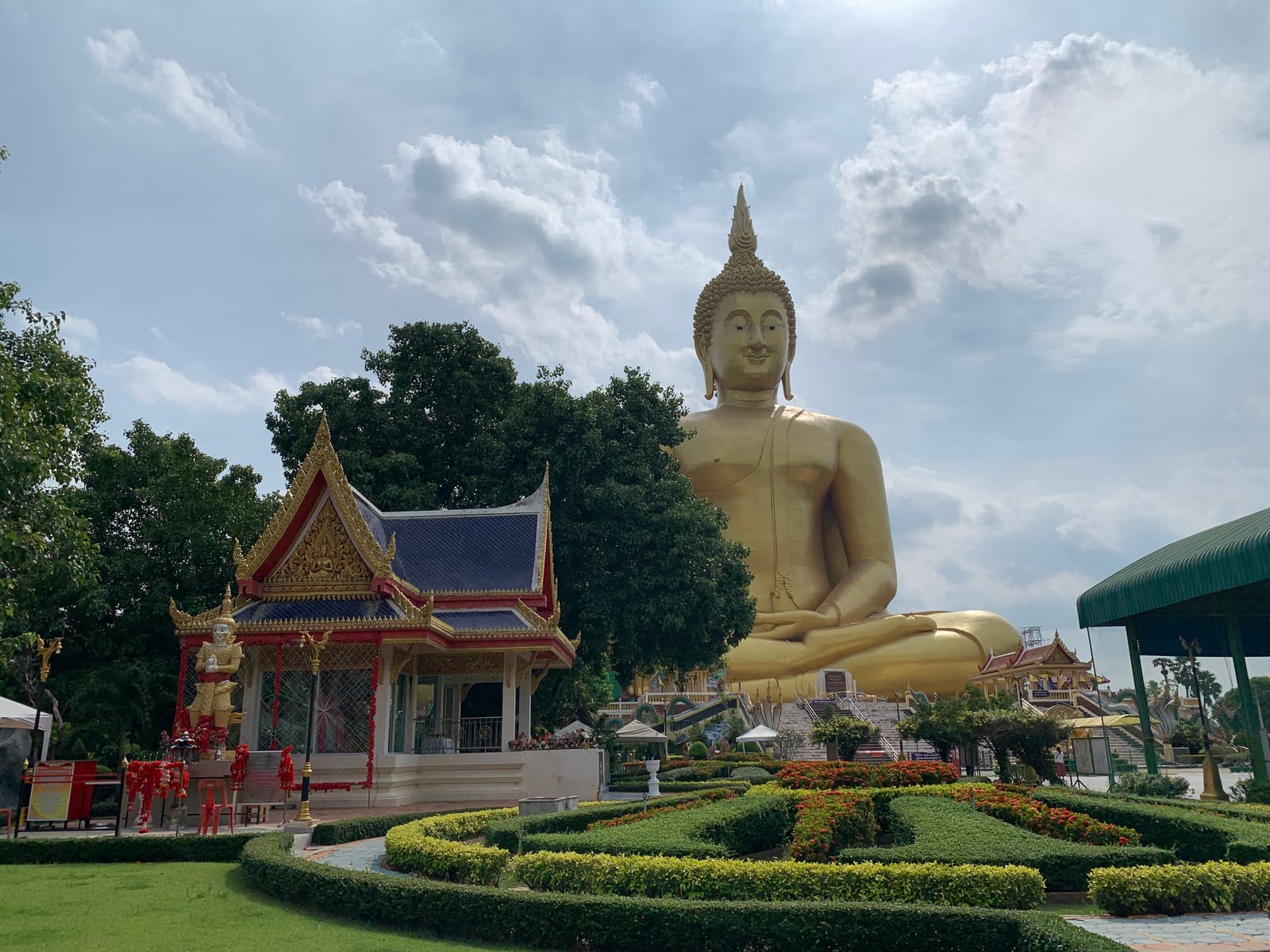
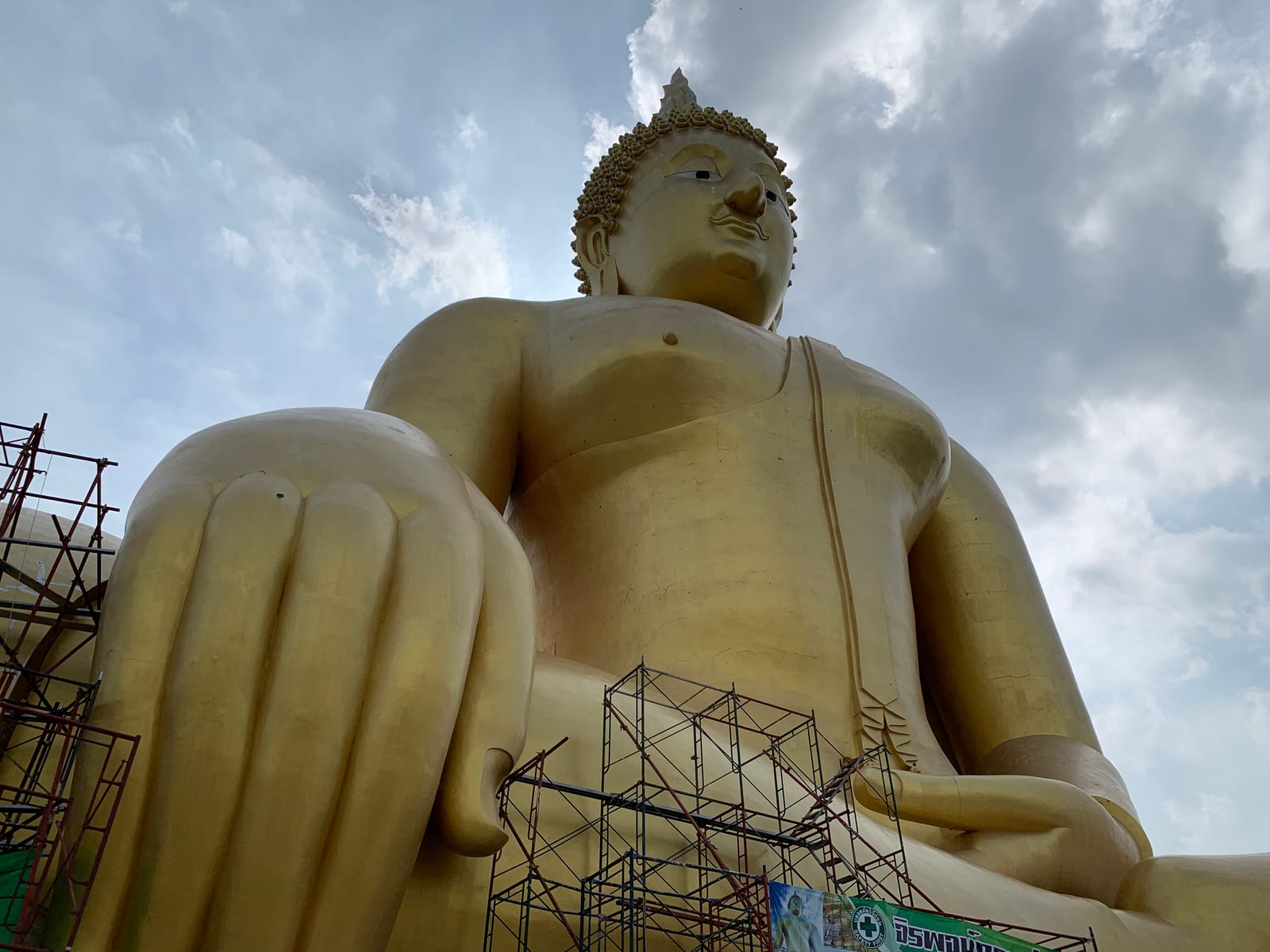
If you come to Ang Thong and skip Wat Muang, locals will tell you that you haven't really arrived. The main draw is Luang Pho Yai — Phra Phuttha Maha Nawamin Sakayamuni Sri Wiset Chaichan — a Maravijaya-posture seated Buddha, the largest in Thailand, with a lap width of roughly 63 metres and a total height from base to topknot of nearly 95 metres, equivalent to a thirty-something-storey building. Painted brilliant gold and rising above the open fields, it's visible from a distance. Many visitors say that standing beneath the actual statue makes you feel tiny in an instant. The temple suits merit-makers, families bringing elders, and anyone who likes photographing monumental landmarks.
Beyond the main Buddha, there's plenty to walk around. Don't miss the Crystal Viharn (Ratana Phrommaban-Suwannaphan), which reviewers consistently praise for its dazzling interior. The replica heaven-and-hell scenes around the temple grounds feature tall Preta sculptures and punishment tableaux drawn from the Tipitaka — vivid and, some say, genuinely unsettling; parents with small children should gauge the moment. There's also a Chinese deity zone, Thai mythological sculptures, and an ubosot ringed with large pink lotus petals to photograph.
Budget-wise, entry is free — just optional merit-making offerings and amulet rentals. The popular belief is to climb up and touch the fingertips of Luang Pho Yai and pray for career and financial blessings, which is why the temple is packed on almost every holiday. Open around 06:00–18:00 daily, located at Moo 6, Tambon Hua Taphan, Wiset Chai Chan — about 8 km west of Ang Thong town, roughly 1.5 hours by car from Bangkok.
A few things to know: the Buddha platform is an open courtyard and the sun is intense from mid-morning to afternoon — bring an umbrella, hat, water, and sunscreen. Dress modestly as this is a temple. Parking is spacious enough for tour buses. There are food stalls and souvenir shops outside the gate. For the best golden-Buddha-against-blue-sky photos, come in the early morning or late afternoon when the light is softer and the crowds thinner.
Wat Khun Inthapramun
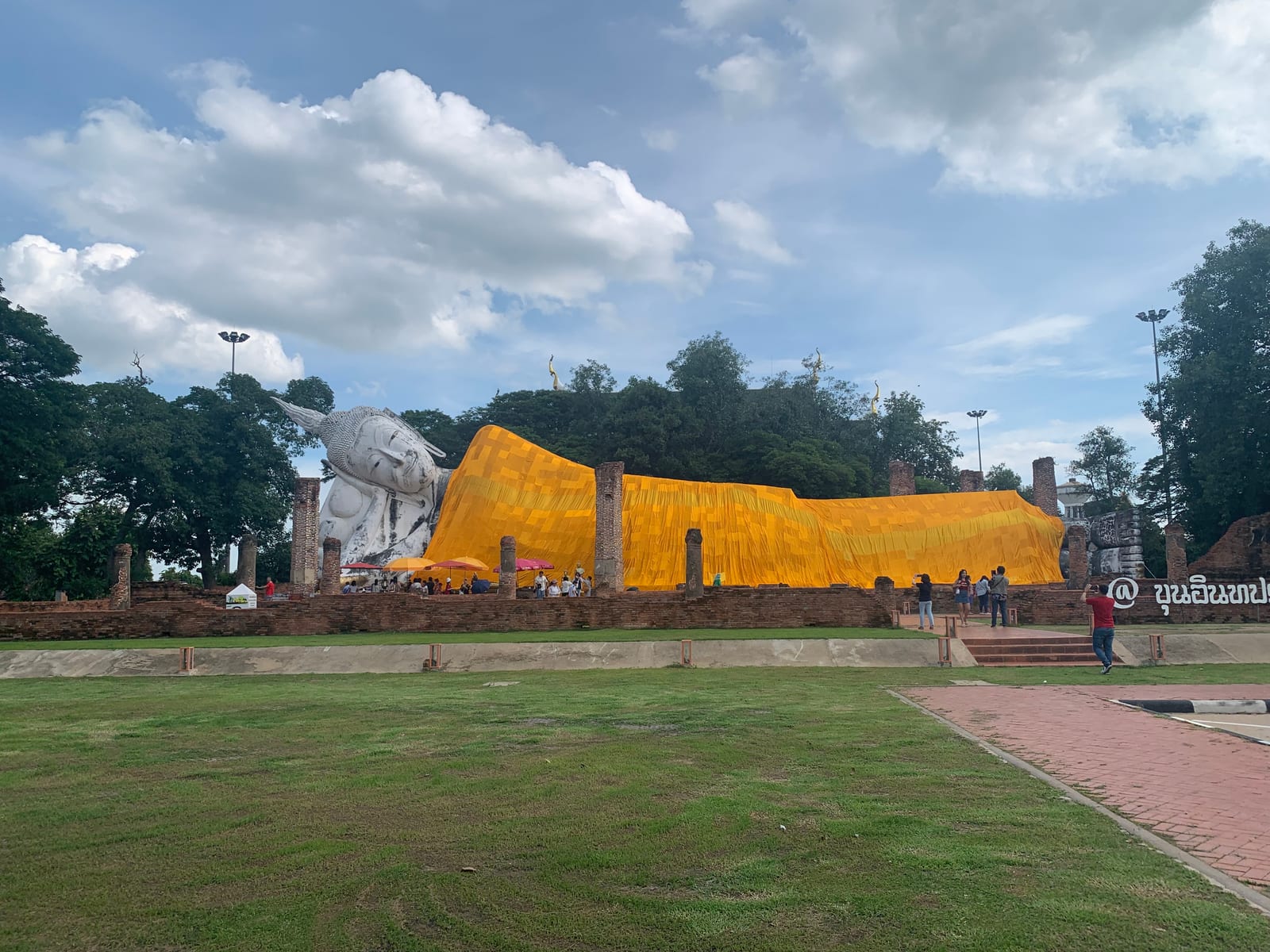
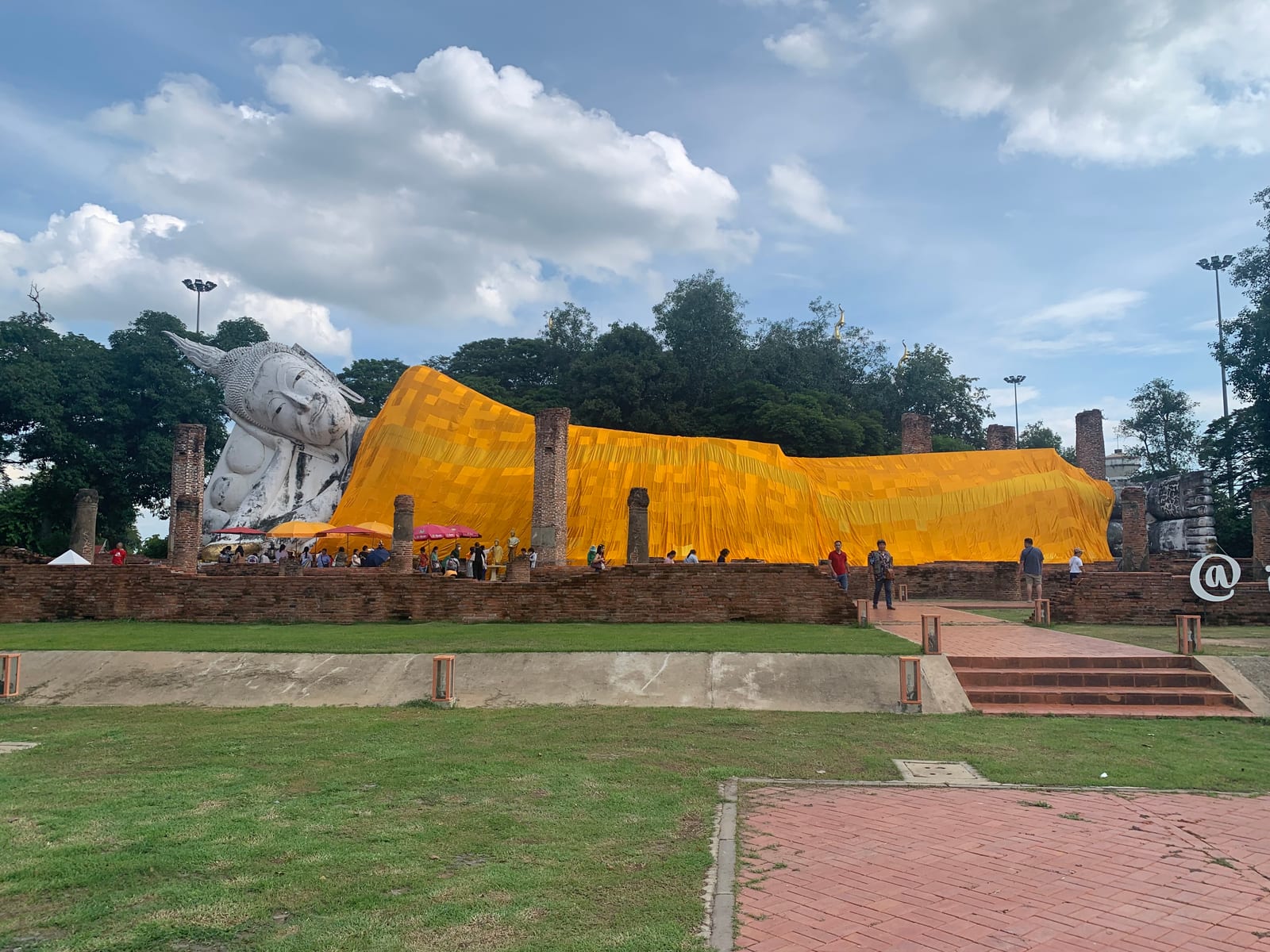
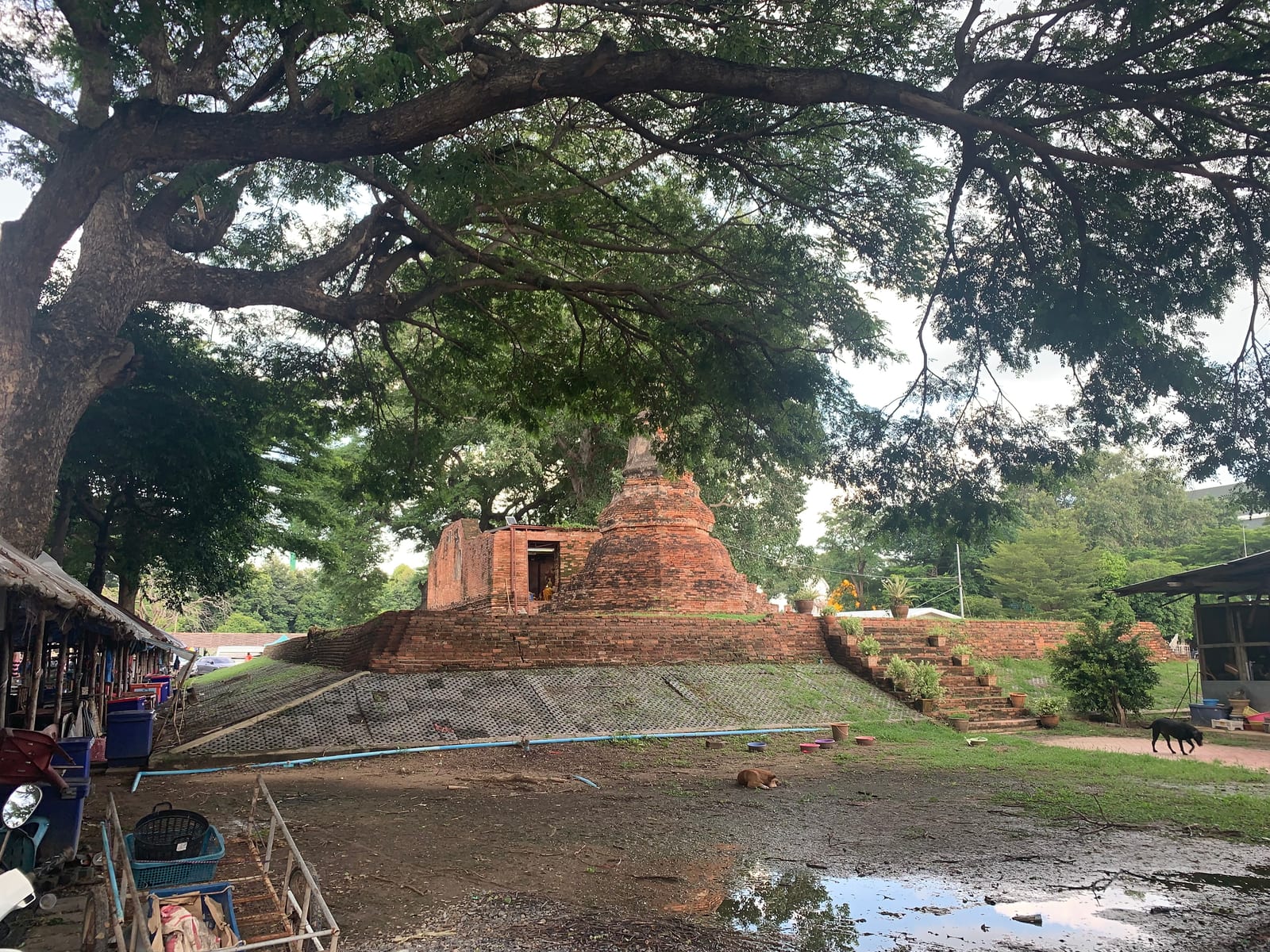
When it comes to famous temples in Ang Thong, Wat Khun Inthapramun is always one of the first names mentioned. The star here is the Phra Phuttha Sai Yasat — a large outdoor reclining Buddha roughly 50 metres long and 11 metres tall, ranked among the longest reclining Buddhas in Thailand. It is an ancient monument dating back to the Sukhothai period and restored during the Ayutthaya era. Many locals call it Phra Sri Mueang Thong or Luang Pho Phra Non. Lying in the open grounds of a more-than-58-rai temple, with a serene, gently smiling face, it genuinely inspires devotion. It's ideal for merit-makers, people seeking blessings, and anyone who loves ancient temples with history to tell.
Don't miss walking to the base of the Buddha's feet, touching them, and pressing gold leaf — people come to pray for health and good fortune. Another much-discussed highlight is the new three-storey ubosot — built at a cost of over 100 million baht — equipped with a lift and escalators so the elderly and those who struggle to walk can reach the upper floor to worship. Inside are exquisitely detailed murals. Around the grounds you'll also find old chedis, the ruined Luang Pho Khao viharn, and wax monk sculptures to pay respects to. The temple grounds often host villagers selling vegetables, duck eggs, fruits, and local snacks — pleasant to browse.
Entry is free, no admission charge. There is spacious parking. The temple is in Tambon Inthapramun, Pho Thong — not far from Ang Thong town; drive along the Ang Thong–Pho Thong highway and the temple turn-off is easy to find. Open every day from around 06:00 to evening. Since the reclining Buddha is outdoors, morning or late afternoon visits are more comfortable — midday sun on the open grounds can be fierce.
A small note: this is a revered temple visited by people from across the province and neighbouring provinces. Google reviews score it 4.7 from thousands of raters, showing genuine repeat satisfaction. Dress modestly as this is a temple precinct. If you're coming with elderly visitors, don't worry — the walkways are relatively flat and there are water points and snack stalls along the route. A very worthwhile stop on any Ang Thong trip.
Wat Pa Mok Worawihan (The Talking Buddha Reclining Image)
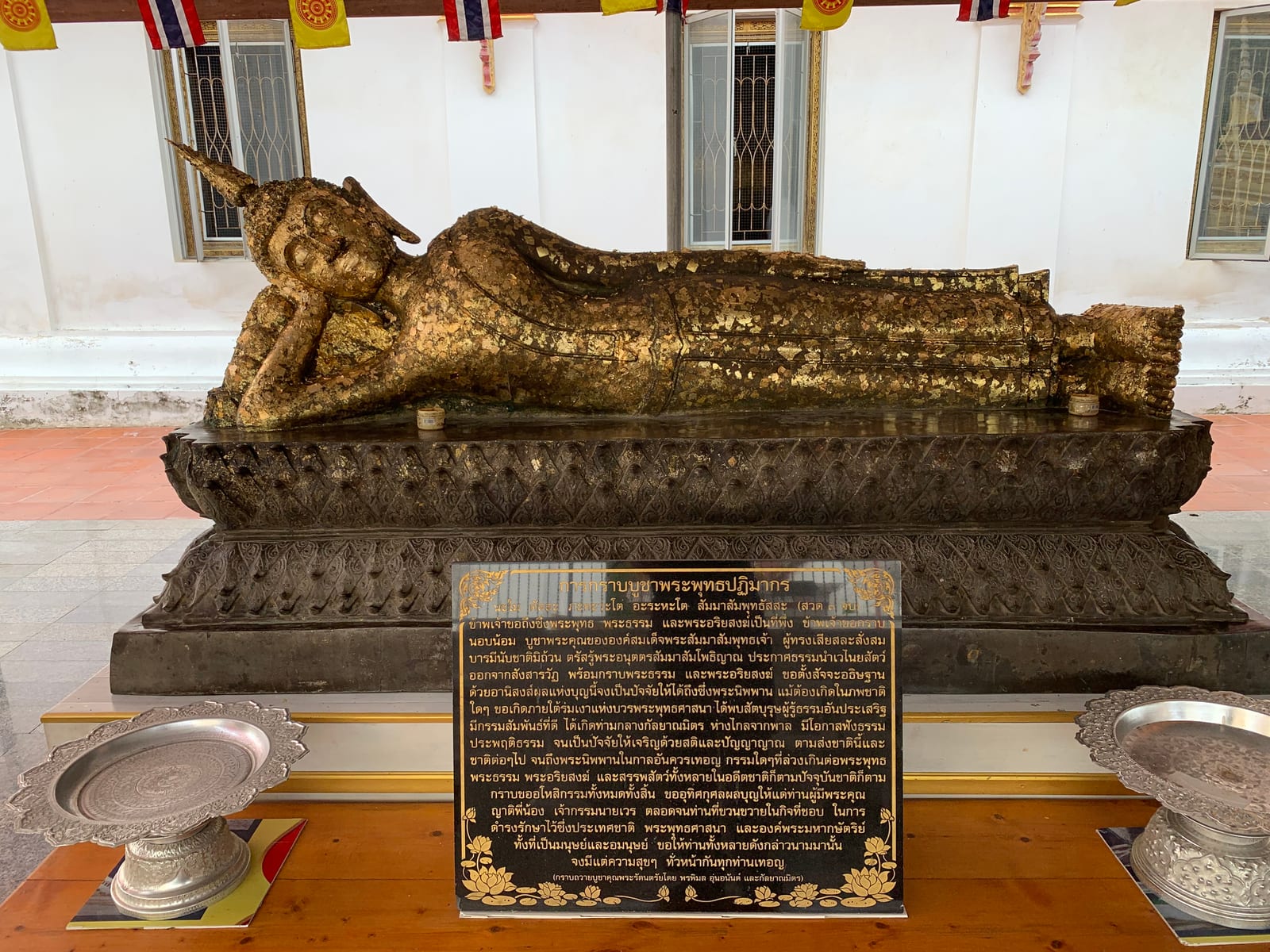
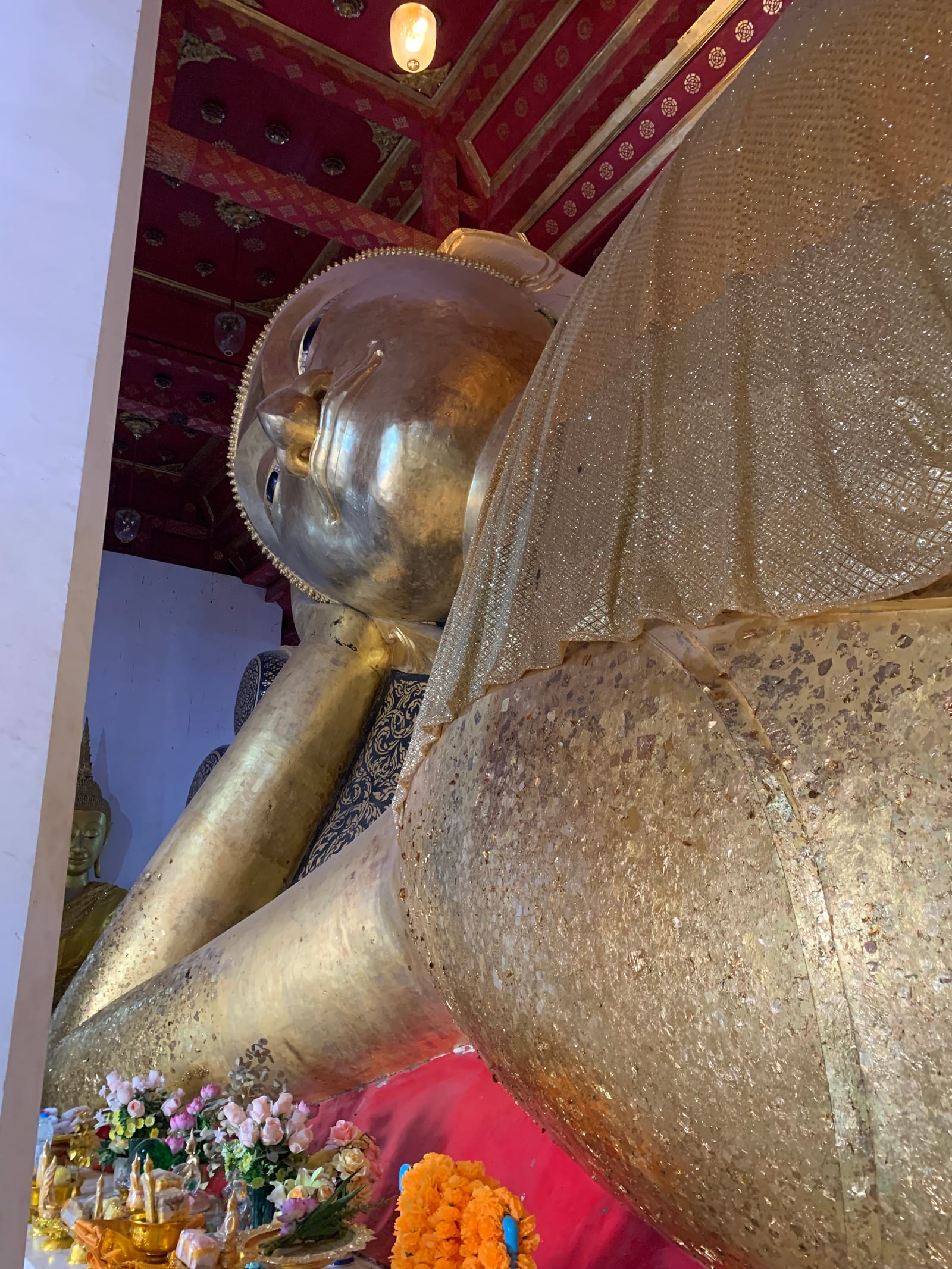
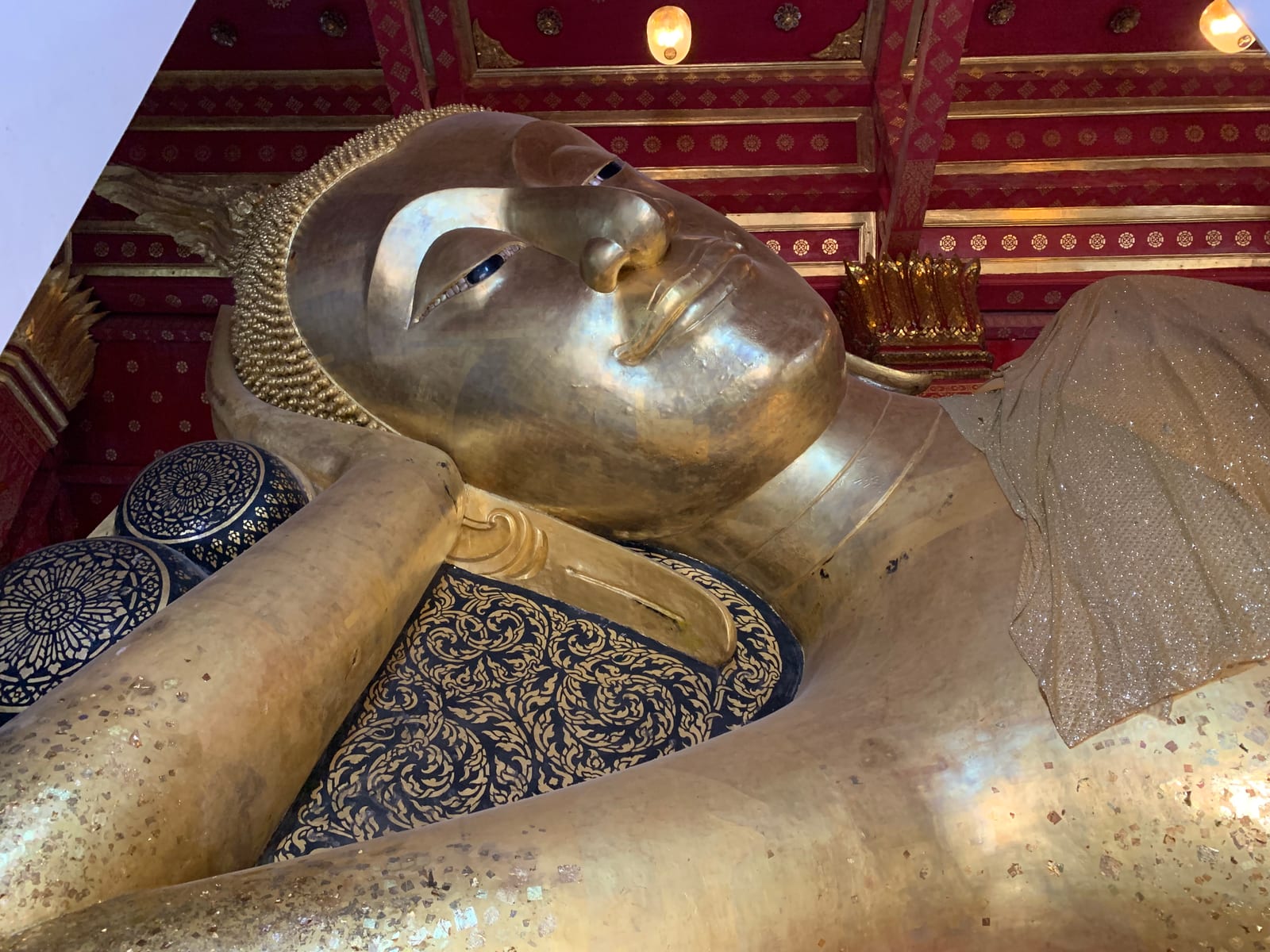
Wat Pa Mok Worawihan is an ancient riverside temple on the Chao Phraya in Pa Mok town — a royal temple that has stood alongside Ang Thong since the Ayutthaya era. The highlight everyone comes to see is the Phra Phuttha Sai Yasat, a large stucco reclining Buddha roughly 22.58 metres long, lacquered and gilded all over. The ancient craftsmanship is exquisite — lying in the Siha Saiya position with a serene, fulfilled expression. It's ideal for pilgrims seeking blessings from a reclining Buddha, especially those born on a Tuesday, and for anyone who loves ancient temples with stories to tell.
Beyond the image itself, there are two legends that make this temple special. First is the tale of 'moving the Buddha to escape the river' — during the reign of King Tai Sra, the image was relocated nearly 168 metres back from the eroding riverbank to its current viharn. Second is the legend of the 'talking reclining Buddha', said to have spoken and prescribed medicinal remedies. Stepping into the viharn creates a genuinely mysterious atmosphere. Architecture enthusiasts should also see the ubosot in the Ayutthaya-style late-period boat-shaped roof form and its old murals — including a golden mango tree painted by Her Royal Highness Princess Sirindhorn.
The temple atmosphere is peaceful and shaded. Multiple genuine reviews agree that coming in the morning means few crowds and a comfortable visit. People also appreciate that there are no pushy donation requests — give as much as your faith moves you. Spacious parking, no entry fee; budget only for merit-making. Located in the Pa Mok sub-district on the Chao Phraya, not far from Ang Thong town. It pairs naturally with a reclining-Buddha temple-hopping trip through Ang Thong and Sing Buri in a single day. Open approximately 08:00–17:00 daily.
This temple is popular because it combines a beautiful reclining image, entertaining legends, and genuine historical value. Google score sits at 4.6 from over a thousand reviews. A reminder: this is a temple — dress modestly and remove shoes before entering the viharn. Early October often sees the traditional gold-leaf ceremony on the reclining Buddha, which draws large crowds; if you prefer quiet, plan around it.
Ban Hun Lek
Ban Hun Lek is a Thai-made theme park born from the passion of craftsman Phairoj Thanomwong, who took scrap metal and old car parts and welded them into life-sized and multi-metre-tall robots and superheroes: Transformers, Iron Man, Captain America, Batman, Gundam, Aliens, Predator, plus sports cars and motorcycles formed entirely from steel. It suits families with children, superhero and sci-fi fans, and anyone who wants a fun photo stop along the Asia Highway for an hour or so.
The must-see highlight is the giant robot standing tall from outside the gate before you even enter. Inside, the venue is divided into indoor and outdoor zones with hundreds of sculptures to pose with. There's a Thai-house corner with an iron Ganesh and Buddha figures, a playground area, and a workshop zone where you can watch craftsmen assembling robots live. When you need a break, head to the air-conditioned Sapa Café, where reviews mention the 'sweet rust' (chocolate) drink and French rose tea. A noodle restaurant and souvenir shop are on site.
Entry is very wallet-friendly: adults 60 THB, children 30 THB, children under 90 cm free. Open daily 09:00–17:00. Located at 41/2 Moo 6, Tambon Talat Kruad, Mueang Ang Thong, beside the Asia Highway (Highway 32) on the Bangkok-bound side — about two hours from Bangkok. Easy parking; convenient to stop on the way back. Most visitors spend 40 minutes to 1–2 hours depending on how detailed they want to be.
Ban Hun Lek has grown in fame to the point where international media has featured it — partly because of the upcycling concept that turns waste into value, and partly because every angle makes a great photo. The owner has expanded from 3 to 6 rai, added a roof, mist fans for cooling, and wheelchair-accessible paths. One small note from actual reviews: some areas still carry faint paint-spray fumes, so if you're sensitive, bring a mask. And if you come at midday when the sun is strongest, plan to do the outdoor zones in the morning or late afternoon.
Wat Tha It (Phra That Chedi Si Phothithong)

Wat Tha It in Tambon Bang Phlap, Pho Thong District is a temple where the golden chedi stops you in your tracks the moment you pull up — it's visible from a long way off. That is Phra That Chedi Si Phothithong: an eight-sided golden chedi about 73 metres tall and 40 metres wide, blending Lanka, Ayutthaya, and Rattanakosin styles, built during the abbotship of Luang Pho Hom to enshrine Buddha relics (from the throat region). It suits pilgrims wanting to pay respects at a beautiful temple not far from Bangkok, and anyone who likes viewpoints that haven't yet been overrun by crowds. If you want a quiet temple where you won't have to compete for a frame, this is the one.
The unmissable highlight is climbing up through the chedi floor by floor — each level has Buddha images in different postures to venerate — and reaching the top for the view. Genuine reviews consistently report a 360-degree panorama of Ang Thong's rice fields, and on clear days you can make out the great Buddha at Wat Muang in the distance. Many say the chedi is spectacular and the gold startlingly vivid, though they warn the climb is quite steep — if your knees are bad, take it floor by floor with rests in between.
Budget-wise it's very easy: no entry fee, temple parking available, and there's drinking water from the temple. Located along Highway 3064 around the 7–8 km mark, about 1–2 km before Pho Thong Hospital. Easy drive from Ang Thong town. Open approximately 08:00–18:00 daily. Takes less than an hour to walk around in full — a natural stop between other temple visits in Ang Thong.
A small note: some reviewers mention the interior of the chedi is dusty in places and not always freshly polished, though the quiet and the view from the top are worth the visit. This is not a tourist-magnet temple, so you get a peaceful, private atmosphere. If you're into merit-making and love photographing beautiful golden chedis, you'll get both the blessings and the shots. It's worth climbing all the way to the top for the rice-field view that many reviewers call the temple's true highlight.
🛏️ Hotels in Ang Thong
Staying overnight makes it easier to cover Ang Thong without rushing. Pick a hotel near the old town or by the river — good value, and a short hop to the temples and market. There are options from budget guesthouses to mid-range hotels.
🔍 Check Ang Thong Hotel Prices (Agoda)San Chao Rong Thong Market (100-Year Market)

San Chao Rong Thong Market — which locals casually call the 100-Year Wiset Chai Chan Market — is a century-old market on the Noi River, settled by Teochew Chinese around 1877. Its charm is the long row of Thai-Chinese-style timber shophouses built right against each other on both sides of a covered walkway. You can stroll through the whole length without the heat, without the crowds getting too intense. It's ideal for people who love vintage market atmosphere, who seek out rare traditional Thai sweets, and for families who want to bring elders for an easy, relaxed walk. The market won a 2007 Outstanding Architecture Conservation Award for its community-led restoration after a major fire — the old timber buildings retain every bit of their character.
The must-not-miss highlight is the rare traditional Thai sweets that are hard to find elsewhere, especially Kasorn Lamchiak (Ang Thong's signature provincial sweet), along with charcoal-oven Babin, Khanom Khi Khwai, Khanom Somnud, and prawn-topped Khanom Khrok. The most-mentioned shops include Thong Nimit, which sells multiple types of ancient sweets and has won a Traditional Thai Sweets Guardian award, and the charcoal-brewed vintage coffee shop serving old-style recipes. For a savoury bite, there are boat noodles and other hot dishes to sit down with. Most items are affordably priced — you can graze the whole market without burning through your wallet.
Budget-wise, the market has no entry fee — walking the old timber shophouses and taking photos is free; you only pay for what you eat and buy. Located in Wiset Chai Chan municipality, on the Noi River near Wat Nang Nai and a Chinese shrine to Guan Yu. Open daily approximately 08:00–16:00. There's a parking area across from the market and along the road near the temple. A short drive from Ang Thong town — a natural stop for a morning snack walk on an Ang Thong trip.
A small note: the market is at its most lively on Saturday–Sunday mornings and public holidays, when more vendors are out. On weekdays some shops may be closed or have less to offer. Some traditional sweets are made fresh and sell out fast — arriving in the morning ensures you get the full selection. Allow 1–2 hours to stroll the timber buildings, sample sweets, and pay respects at the nearby Chinese shrine all in one go.
Wat Chaiyo Worawihan (Luang Pho To / Phra Maha Phuttha Phim)
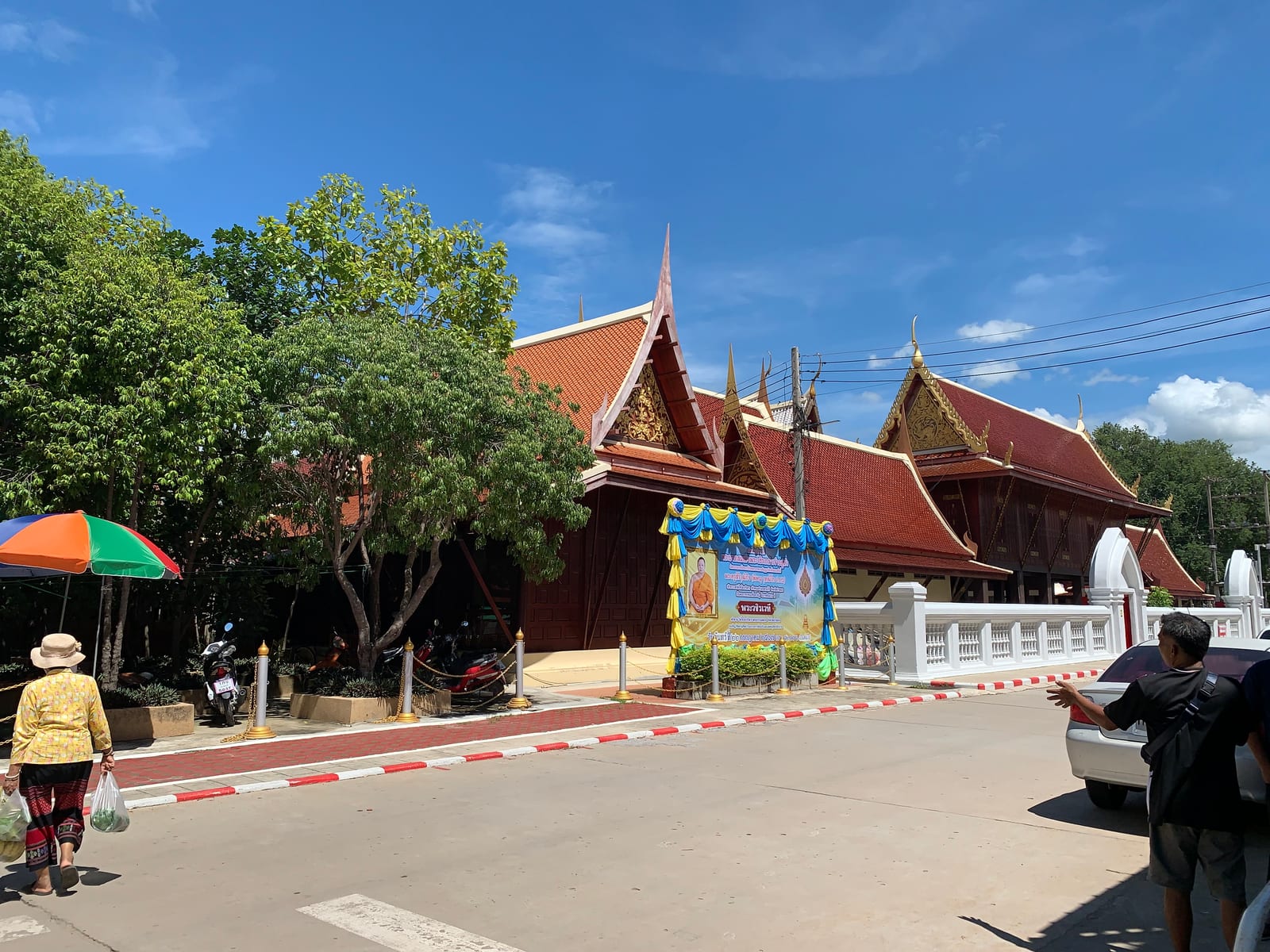
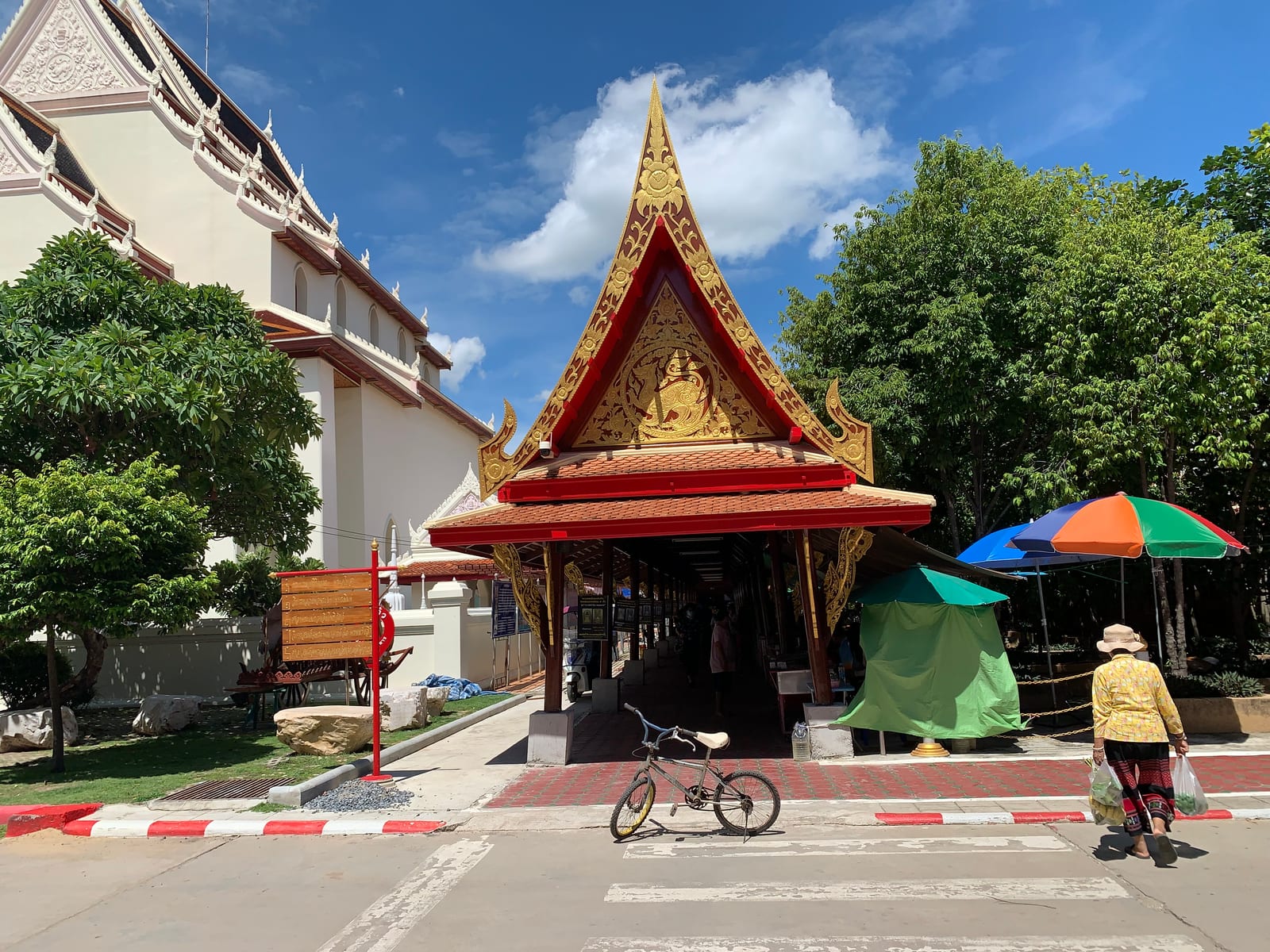
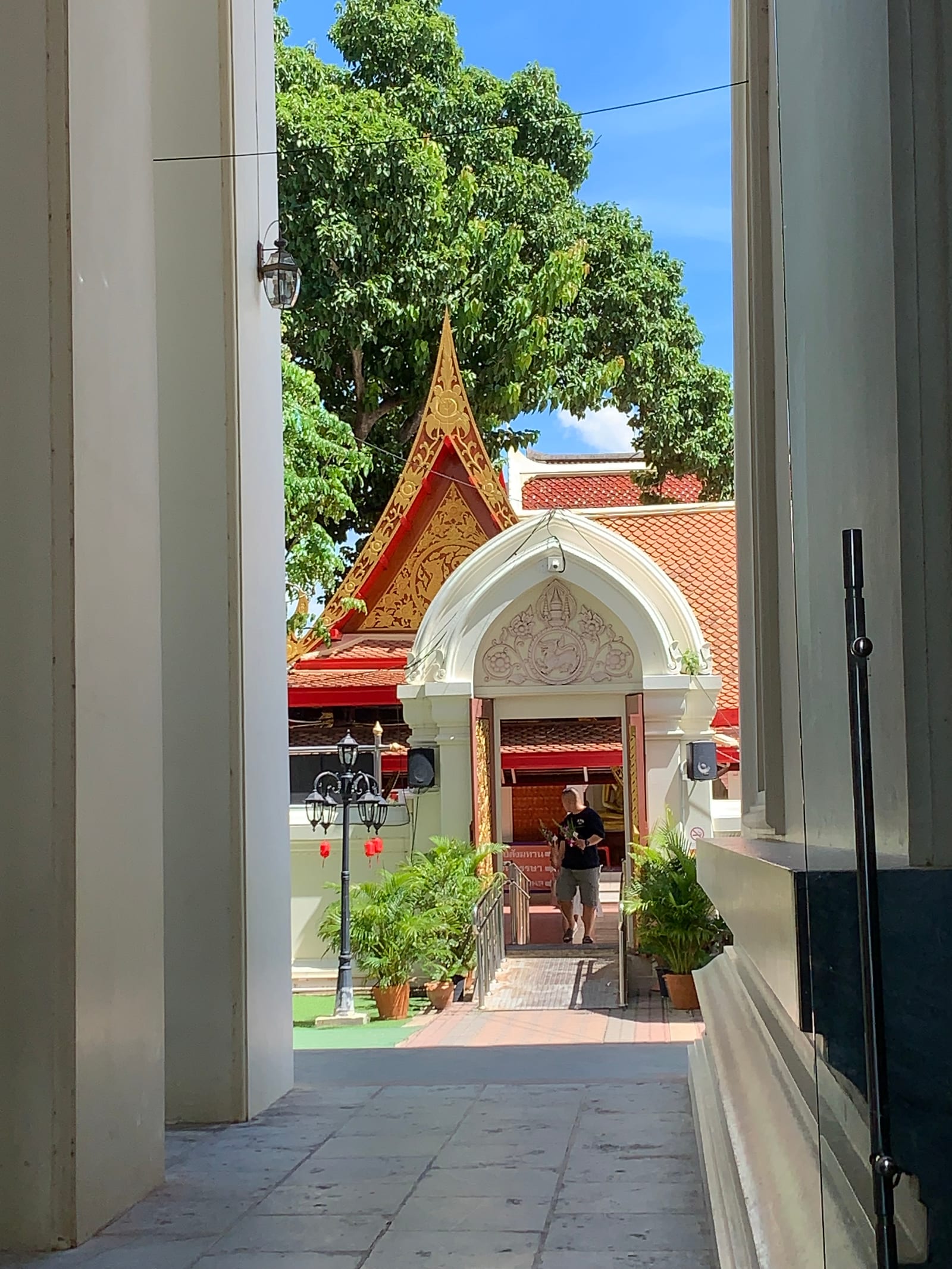
If you want to venerate a truly enormous Buddha — the kind that makes you catch your breath the moment you look up — Wat Chaiyo Worawihan (known locally as Wat Ket Chaiyo) is an unmissable pin on any Ang Thong map. The highlight is Phra Maha Phuttha Phim, or Luang Pho To: a colossal stucco meditation-posture Buddha enshrined in a soaring viharn on the Chao Phraya riverbank. This image was created by Somdet Phra Phuttachan (To Phromrangsi), later restored on a grand scale in the reign of Rama V, given a royal name, and elevated to a second-class royal temple. Anyone devoted to Somdet To, or who loves ancient temples with a long story attached, will find deep satisfaction here.
Don't miss going in to pay respects to Luang Pho To in the viharn, then continuing to the ubosot, whose Rama V-era murals depicting the life of the Buddha are so detailed that many reviewers say you should walk slowly to take them all in. For merit-making enthusiasts, the riverside pier in front of the temple is a feeding spot for the fish — in some evenings around 17:00, monks come to feed the fish and lift large ones out of the water for visitors to see up close, something children especially love. Around the temple is a local market with vendors in traditional sarongs selling local products and Thai sweets — easy to browse after paying your respects.
The overall atmosphere is shaded and peaceful, with a cool river breeze. Many reviews consistently say the temple is clean and comfortable to walk around, with free parking and no entry fee — just prepare some cash for merit-making and souvenirs. One small observation: the temple grounds are quite open, and the midday sun can be fierce — bring an umbrella or hat. Dress modestly, as this is an important royal temple that receives steady streams of worshippers. Located in Tambon Chaiyo, Chaiyo District, about 18 km from Ang Thong town on the Ang Thong–Sing Buri road, west side of the Chao Phraya. Open daily approximately 07:00–17:00. The combination of a great ancient Buddha, Somdet To association, riverside market, and fish-feeding makes this a one-stop trip for blessings, views, and food — fitting for both spiritual visitors and families wanting an easy riverside temple outing near Bangkok.
Wat Sang Kratai (Bodhi-Wrapped Ubosot)

When it comes to hidden-gem spots in Ang Thong, Wat Sang Kratai is consistently one of the first names mentioned. It is an abandoned heritage site in Tambon Sala Daeng, about 7 km west of town — a ten-minute drive. The reason people make a point of visiting is an Ayutthaya-era ubosot over 400 years old, now just three roofless wall chambers, whose four sides are completely gripped and embraced by the roots of four large bodhi trees. The image of trees cradling the temple has a haunting, mysterious quality that many visitors cite as an Ang Thong highlight. It suits moody-atmosphere photographers, heritage enthusiasts, and spiritual visitors who want to pay respects to ancient Buddhas in a tranquil setting.
The must-see is walking around the ubosot to see the bodhi roots enveloping the walls — as if nature itself is propping up the ancient structure. Inside, four Buddha images are still enshrined: Luang Pho Kaen in the first chamber, Luang Pho Wan Di, Luang Pho Si, and Luang Pho Suk in the middle, with a Ruesi hermit figure at the rear. Anyone drawn to the spiritual can come to pray. The four bodhi trees enclosing this ubosot have been registered as National Heritage Trees since 2017. Genuine reviews consistently describe the atmosphere as quiet, shaded, and unlike any ordinary temple.
Open approximately 08:00–17:00 daily, free entry, just a donation box. Adequate parking. From Ang Thong town, take the Pho Phraya–Tha Ruea road; search 'Wat Sang Kratai' on Google Maps. This spot is typically included as a stop paired with other major temples in a one-day Ang Thong trip.
Things to know before you go: the ubosot is an ancient structure and the roots are delicate — walk gently and don't climb or pull the roots. Dress modestly as this is a sacred site. Morning and late afternoon offer softer light and fewer people — better for photography. Allow a moment to sit and absorb the quiet, and you'll understand why this place keeps appearing on Ang Thong must-do lists.
Ekkarat Drum-Making Village (Ban Bang Phae)
If you're driving along the Ang Thong–Ayutthaya road through Pa Mok and spot a towering drum on display by the roadside, you've found Ekkarat Drum-Making Village — also called Ban Bang Phae by older locals — a community that has been crafting drums for sale since around 1927 and is now known as Thailand's largest and most famous drum-making source. Walk into the lanes and you'll find dozens of craftsmen's houses side by side, each open and welcoming to stroll through. It suits craft enthusiasts, parents who want to show children real traditional skills, and anyone who wants to stretch their legs on the way to Ayutthaya.
The highlight is watching every step live: latheing a chamcha wood log hollow, stretching cowhide over the drum head, hammering in the wooden pegs, and then tuning the drum right there on the spot. There are drums of every type to see — ceremonial drums, long drums, ramwong drums, temple drums, right down to miniature souvenir drums. The must-see is the giant village landmark drum with a head nearly a metre wide and a body several metres long, made from joined sections of rain tree — everyone who visits has to stand next to it for a photo. What surprises many people is that the craftsmen here also make international drums for export — Japanese taiko, Korean janggu, and samba drums.
Budget is very easy: entry is free for both adults and children. Parking available. You're welcome to ask questions, buy, or just look — no one will pressure you. Open daily approximately 08:00–17:00, but if you want to see craftsmen actually at work, mid-morning to afternoon is the best time. The village is in Tambon Ekkarat, Pa Mok District, behind Pa Mok market — not far from Ang Thong town or Ayutthaya. Best reached by car. One small note: online reviews are not plentiful because this is more of a community learning destination than a mainstream check-in spot, but visitors who walk through and watch the craftsmen at work almost always leave impressed — this kind of traditional craftsmanship is increasingly rare in Thailand.
Phra Tamnak Khamyat
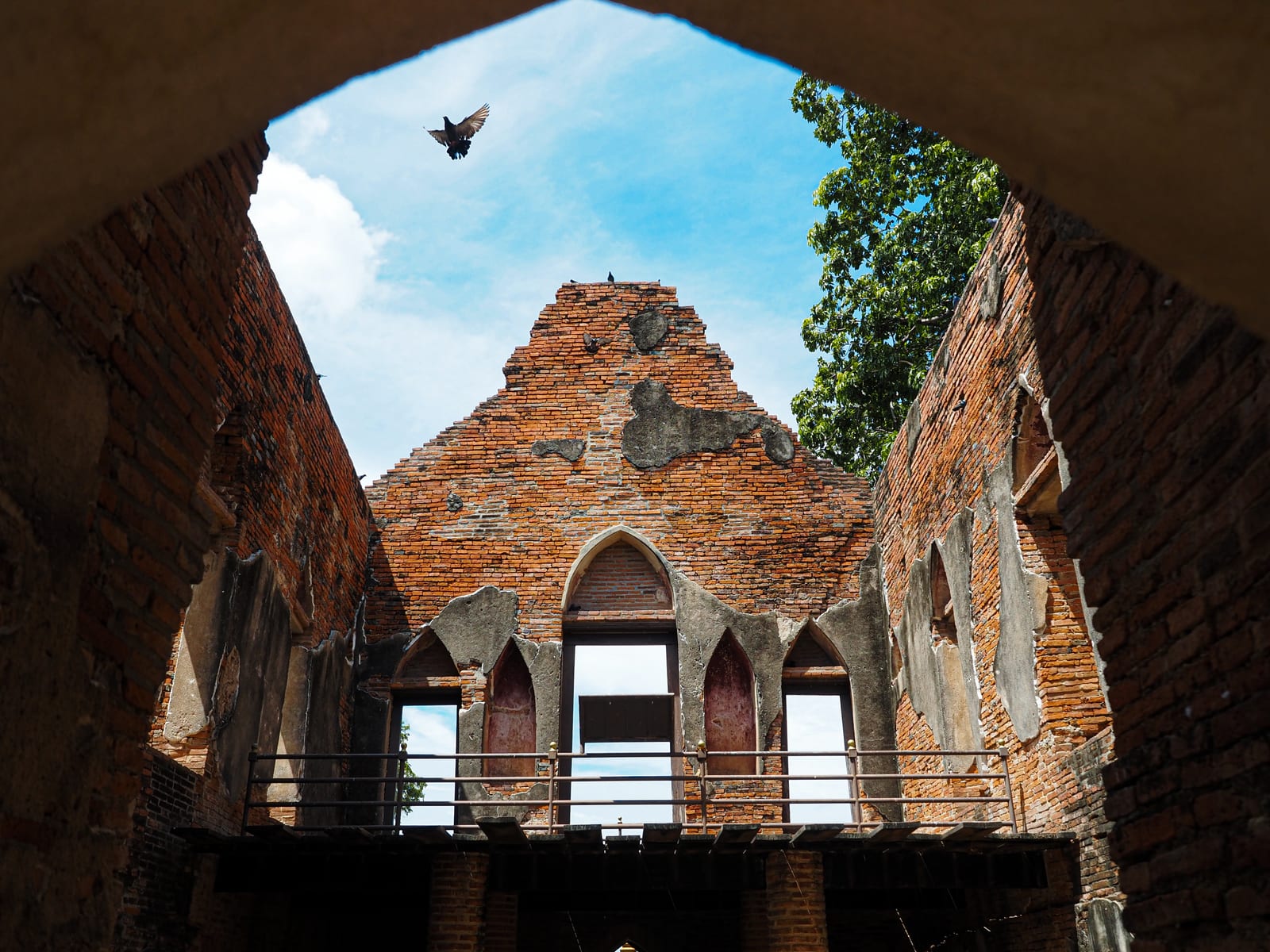
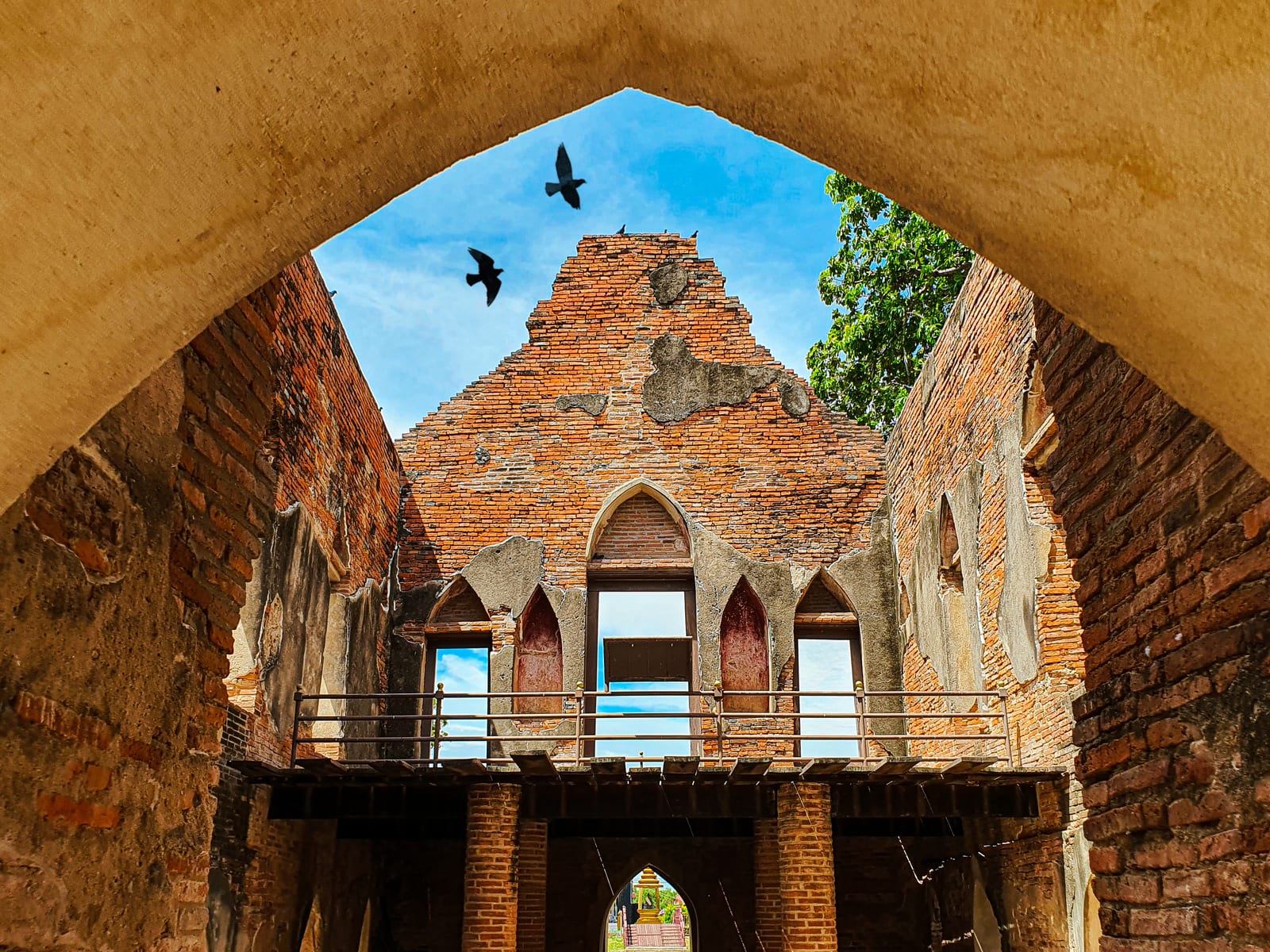
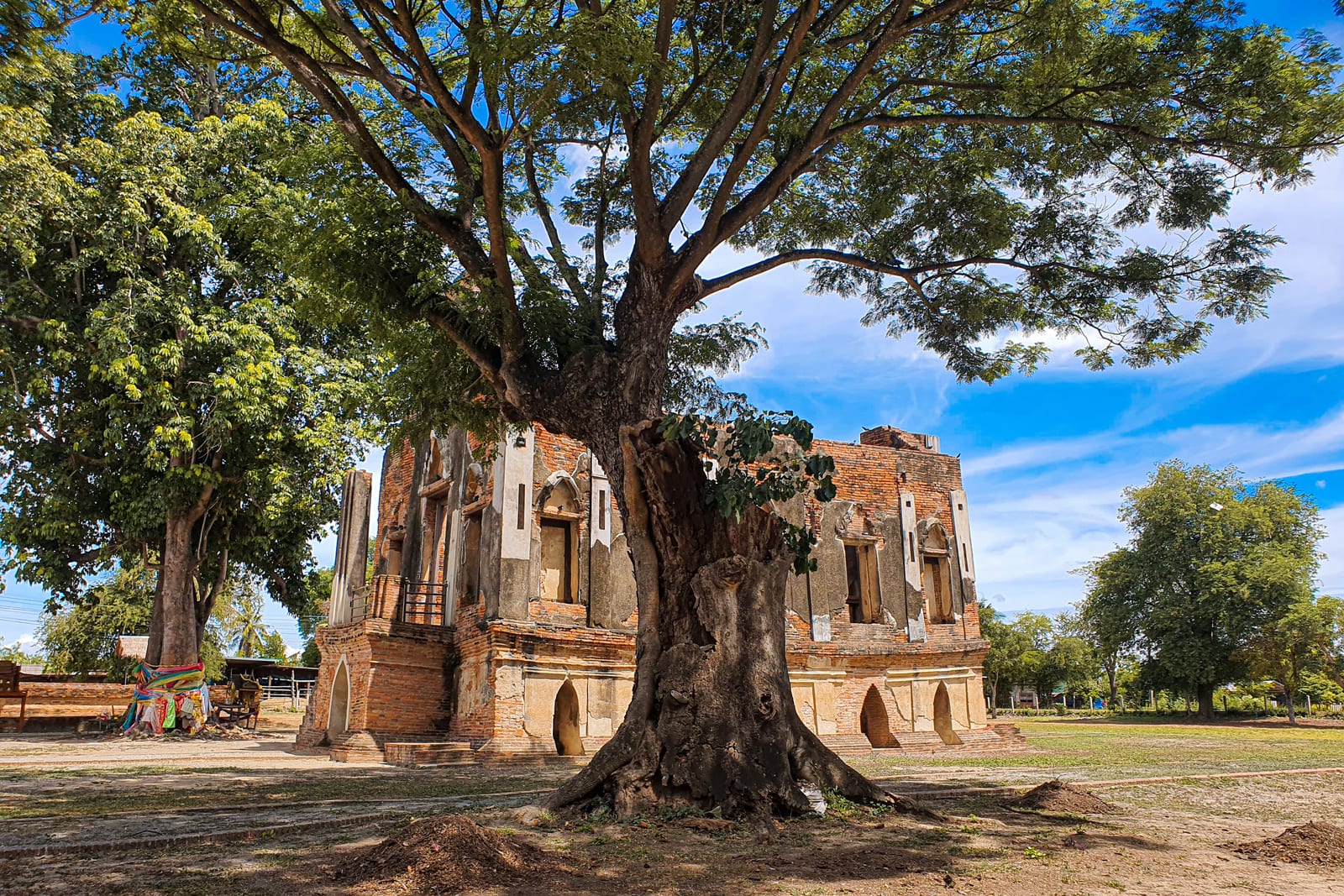
If you like quiet, story-filled spots, Phra Tamnak Khamyat will appeal to you. This is the ruin of a brick-and-stucco pavilion standing alone in the wide rice fields of Tambon Khamyat, Pho Thong District — a late-Ayutthaya heritage site linked to King Uthumphon, popularly known as Khun Luang Ha Wat, the king who abdicated the throne to enter monkhood and retreated to this area. The building is roughly 10 metres wide and 20 metres long; today only the four walls remain, the upper structure long gone, but enough of the original beauty survives to be clearly seen. It suits history enthusiasts, heritage-site photographers, and anyone who wants to escape the noise and spend quiet time in open countryside.
The must-see highlight is the stucco relief on the doorway arches and window frames — pointed-arch openings popular from the reign of King Narai onwards, showing Persian artistic influence. Walking up close, you can still see traces of the old craftsmen's work on the brick walls. Another angle many visitors love is stepping back to photograph the entire pavilion against the green rice fields and sky — a quiet, characterful frame. Morning or late afternoon offers the softest light. Genuine reviews describe the atmosphere as profoundly peaceful, so quiet you can hear the wind; some visitors joke that it's now home to a flock of pigeons.
Entry is completely free, no admission charge. It's an open outdoor site within an abandoned temple precinct — accessible throughout the day. Recommended in the late morning to evening for the best visibility and photography. Located in Pho Thong District, a short drive from Ang Thong town — easy to reach by car with roadside parking. A natural stop on a temple-hopping tour of the province.
People visit because this is one of Ang Thong's significant historical heritage sites, already registered by the Fine Arts Department. It offers both a compelling story and the understated beauty of ruins. Things to know: it's an open roofless ruin in the middle of fields with no shade — bring a hat or umbrella, apply sunscreen, and carry water. The ground around it is earth and grass, so wear comfortable walking shoes. Please help keep it clean and don't climb the old walls, so this place can remain for years to come.
Book Tours and Tickets for Ang Thong in Advance
Ang Thong's attractions are spread across several districts. If you'd rather not drive yourself, or you're visiting in a group, booking a temple-hopping and merit-making tour with a guide through Klook or GetYourGuide will make the trip run smoothly — no need to plan the route yourself. Some packages include transfers from Bangkok and cover multiple stops in a single day. Perfect for anyone who wants to sit back and let a local take the wheel.
💡 Know Before You Go: Ang Thong
Ang Thong's attractions are spread across several districts with very little public transport. Self-driving or hiring a car with driver from Bangkok is the most practical option. Grab is scarce even in town — don't rely on it.
Temple offering boxes, San Chao Rong Thong Market, and local snack stalls are mostly cash-only. Carry small bills and coins; ATMs exist in town but are rare near rural temples.
Many of the big Buddhas stand in the open. Midday sun is fierce — arrive in the morning to walk and photograph comfortably. Long weekends and festivals draw big crowds, so allow extra time for parking.
Ang Thong is a pilgrimage destination. Cover shoulders and knees when entering temple grounds or ubosots, and remove shoes before entering viharns — local visitors take this seriously.
Ang Thong is a secondary city visited mainly by Thais. English signs and menus are rare. A translation app and temple names saved in Thai script will save you a lot of trouble — locals are friendly and happy to help.
Stop by Ekkarat Drum-Making Village to watch craftsmen at work and pick up a mini drum as a keepsake. San Chao Rong Thong Market has traditional Thai sweets and local snacks to take home — most cost 20–60 THB. Bring cash for shopping.
Plan Your Ang Thong Day Trip to Cover the Most Ground
Ang Thong is ideal for a day trip from Bangkok because the attractions cluster in just a few districts — organising by zone saves the most time. Start early on the Wiset Chai Chan side at Wat Muang (Luang Pho Yai), then swing by San Chao Rong Thong Market for traditional Thai sweets by the Noi River as a mid-morning snack. Next, cross over to the Pho Thong zone to collect Wat Khun Inthapramun (the reclining Buddha), Wat Tha It (golden chedi viewpoint), and Phra Tamnak Khamyat — all close to each other. In the afternoon, loop back into town for Ban Hun Lek and Wat Sang Kratai, then finish on the Pa Mok–Chaiyo side with Wat Pa Mok, Wat Chaiyo Worawihan, and Ekkarat Drum-Making Village.
Almost every temple is free — just merit-making donations as you choose. The one with an entry fee is Ban Hun Lek: adults 60 THB, children 30 THB, children under 90 cm free. Ang Thong's temples generally allow outdoor veneration from early morning to evening. San Chao Rong Thong Market is lively from approximately 08:00–16:00 — go before noon to get the full range of sweets. The sun is strong here and many of the big Buddhas are in the open, so bring an umbrella, hat, water, and sunscreen.
After visiting several Ang Thong spots, staying overnight beats driving back to Bangkok late. Check well-located hotels in Ang Thong town and near the river — good value, and booking ahead gets you a better room.
See Hotels in Ang Thong