🔄 Last checked 25 Jun 2026 · details and hours can change — check the venue before you go
📍 All restaurants on the map
Tap a pin for the spot + nearby stays
Lampang runs at its own pace — unhurried by city-scale chaos but never dull. The old quarter along the Wang River still holds Thai-Chinese-Burmese-European wooden architecture intact. On Saturday and Sunday evenings, Talat Gao Road becomes Kad Kong Ta, a packed walking street with food stalls on both sides and so many photo angles you can't get through it quickly. Mornings and afternoons bring the century-old arched white bridge and the Nakhon Lampang Railway Station — a yellow-brown wooden building designed by a German engineer that doubles as one of the finest vintage backdrops in the North. Lampang is, in essence, a trip back in time without going far.
For temple lovers, Wat Phra That Lampang Luang is the crown — a legendary Lanna timber temple with a bell-shaped gilded chedi, an ancient wihan, and the famous upside-down chedi reflection in the Wihan Nam Tae that draws visitors from all over the country. Wat Pong Sanuk Nuea earned a UNESCO Award of Merit for cultural heritage conservation. Wat Chaloem Phrakiat (Wat Phra Phutthabat Pu Pha Daeng) in Chae Hom has more than ten white chedis lined along a ridge at 815 m, with a 360-degree mountain view. And if you're traveling with family, the Thai Elephant Conservation Center in Hang Chat is open every day for elephant bathing, feeding, and painting shows. All of this fits in one province — plan your itinerary and go.
Kad Kong Ta (Talat Jin Walking Street)
Kad Kong Ta — known to older residents as the Chinese Market Road — is the Saturday-Sunday walking street that has become Lampang's defining landmark. What sets it apart from other walking streets is its setting: it runs along Talat Gao Road on the Wang River, flanked by shophouses and wooden mansions over a century old, their architecture a mix of Thai, Chinese, Burmese, and European styles from the peak of the teak trade. You eat and walk and look up at the old buildings all night. It's the perfect first evening in Lampang for anyone who wants to soak up the old-city atmosphere without hurrying.
The food is plentiful and wallet-friendly. Reviews consistently agree: "loads of food, reasonable prices, plenty of people." Northern snacks, sai ua (Northern sausage), fresh-fried potatoes, traditional sweets, and even shawarma all show up. Don't miss walking the old buildings and street art to collect images, stopping at the art gallery in the teak house at the top of the street featuring local artists' work, and catching the traditional Thai music that student musicians play in stretches along the road. The vibe is laid-back — more locals than tourists, none of the shoulder-to-shoulder crush of big-city walking streets.
Free entry, no admission charge. What you spend depends on how much you eat — a casual graze across a few stalls is filling for well under 100 THB. Open Saturdays and Sundays only, 16:00–22:00. The crowd picks up after 18:00 when the air cools. Located in the old-quarter riverside district, Mueang Lampang — easy walking distance from most central guesthouses.
Worth knowing: seating is limited, as most of it is eat-while-you-walk. Anyone wanting a proper sit-down should look for a café or shophouse restaurant nearby. And since it only runs two days a week, plan your Lampang trip to land on a Saturday or Sunday — it's the experience most people come here specifically to see.
Wat Phra That Lampang Luang
If you can only visit one temple in Lampang, most people will point you here — Wat Phra That Lampang Luang, the ancient Lanna timber temple that has stood on a low hillock in Ko Kha District, about 18 km southwest of town, as the city's spiritual anchor for centuries. Walk up the naga-flanked staircase through an ornate plaster gateway into a layout that is pure, textbook Lanna. Ideal for merit-seekers, history lovers, and anyone wanting architecture that is genuinely hard to find elsewhere.
The highlight not to miss is the gilded bell-shaped chedi that presides over the central courtyard. Surrounding it: the massive ancient wooden wihan housing the Phra Jao Lan Thong image, and to the north the Wihan Nam Tae still bearing old faded murals. But the one thing everyone talks about is the "upside-down chedi reflection" — the image of the chedi projected inverted onto a white cloth inside the Wihan Phra Phut and the mandapa (mondop). It's a pinhole-camera effect that Lanna craftsmen calculated from the light's angle centuries ago. Everyone who witnesses it says it's genuinely astonishing.
The atmosphere is shaded and peaceful. Horse-carriage rides around the temple grounds are a signature Lampang experience (charged separately). Free entry for all ages. Open daily approximately 07:30–17:00. Google reviews give it 4.8 from over 100 reviews, and multiple sources rank it the top attraction in Lampang — Thai and international visitors alike.
Worth knowing: some sections of the mondop used to view the upside-down reflection are off-limits to women by temple tradition. Dress modestly — cover shoulders and knees, remove shoes before entering any wihan. Morning or late afternoon is the most comfortable time to visit; the light is better for photos and the heat is less fierce.
Ratsadaphisek Bridge (White Bridge)
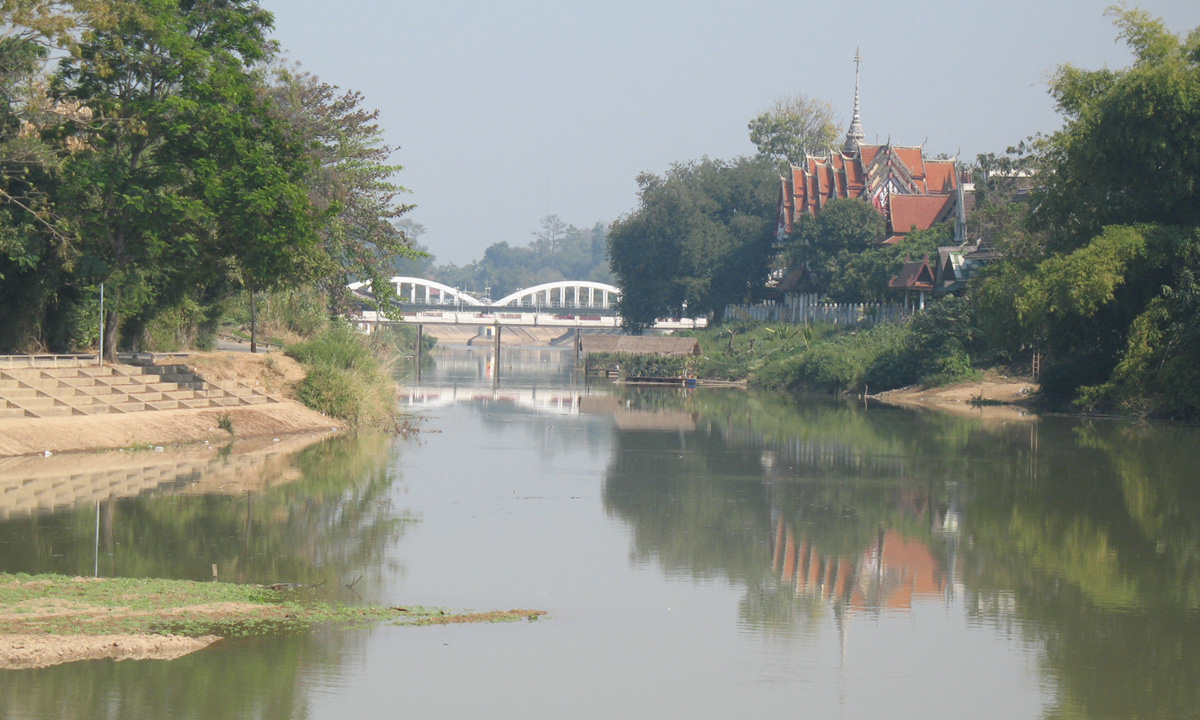
Ratsadaphisek Bridge — which Lampang locals simply call the "White Bridge" — is the white arched concrete bridge spanning the Wang River in the old quarter. It has been the city's landmark for well over 100 years. Originally a wooden bridge built to commemorate King Rama V's 25th anniversary on the throne (his silver jubilee), it collapsed after a log drove into it during flood season, and was rebuilt in reinforced concrete in 1917 — and it still stands beautifully today. Great for architecture fans, vintage-photo seekers, and anyone wanting a relaxed riverside walk.
The standout feature is four continuous bow arches — each about 120 m long in total — and four tall columns at the bridge ends bearing red royal garuda emblems (from the reign of Rama VI) and white roosters, the symbol of Nakhon Lampang. Walk down the riverside path below and you'll find cute street murals and a perfect spot for reflected-bridge photos. One of its quiet charms: at certain moments a horse carriage rolls across, giving you a classic image that's hard to capture anywhere else.
Reviews consistently say it's most beautiful at sunset, when traffic is light and the walk is easy. For water-reflection shots, early morning around 7–8 AM is ideal — the Wang River is glassy and the bridge shadow is sharp. The bridge is also the starting point of the Kad Kong Ta walking street; on Saturday-Sunday evenings the whole area comes alive.
Free entry, always open — it's a working public bridge with active traffic. Located in the center of town in Hua Wiang Subdistrict, Mueang Lampang, close to Kad Kong Ta and several riverside cafés. On walking-street weekends, parking is tight — come early or walk in from Kad Kong Ta.
Nakhon Lampang Railway Station
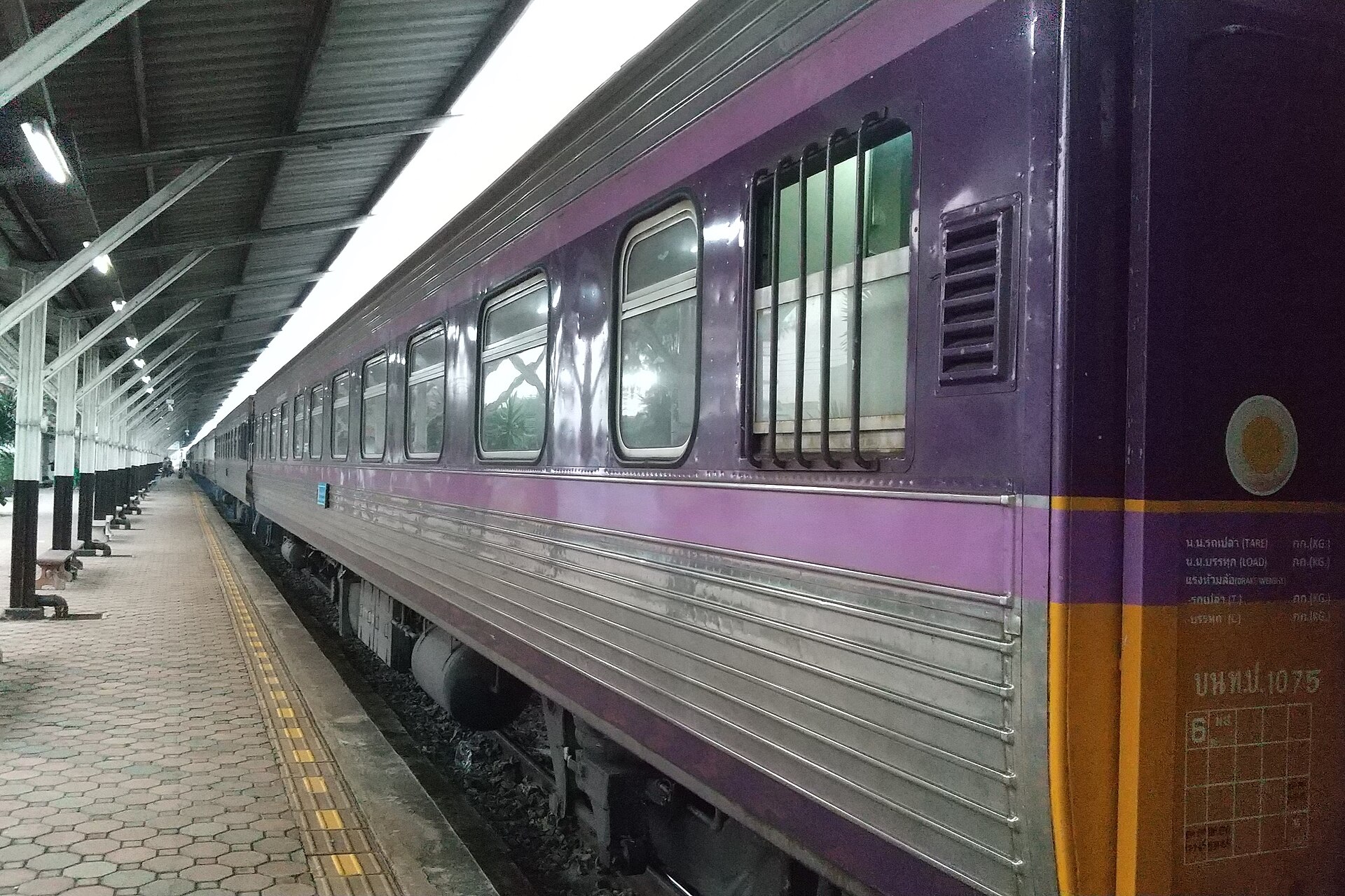
If you're in Lampang for vintage photos, this is a must-mark pin. Nakhon Lampang Railway Station is a two-storey wooden building painted yellow-brown, blending Lanna and European styles (Bavarian cottage), designed by a German engineer and opened in 1916. It's over a century old and listed as an outstanding heritage building. Great for architecture fans, photographers, and families who want to show kids a real working steam-era station.
The highlight everyone photographs is the station building itself — its wooden joinery, arched canopy, and "Nakhon Lampang" signboard still carry the original atmosphere intact. Out front is a model horse carriage you can climb for a photo, perfectly in keeping with the horse-carriage city identity. Further along is a preserved vintage C56 steam locomotive, number 728, from World War II, plus an elephant-trunk fountain at the station entrance — more photo angles than you'd expect. Morning or late afternoon gives the best light and keeps it cooler.
Free admission — walk around and photograph at no charge. Parking is available. Open 24 hours as it's a working station. Located on Prasan Maitri Road, Sop Tui, a short drive from the city center. Right next to the station is Kad Kao Jao (Rattana Market), a century-old market worth a follow-up stop.
Real reviews praise the classic architecture, cleanliness, friendly ticketing staff, and free parking. Most people spend under an hour to cover all angles. Worth knowing: it's an active station with actual train services — delays can happen. If you're planning to catch a train, check schedules and book ahead through the D-Ticket app.
Wat Chaloem Phrakiat Phrachomklao Rachanusorn (Wat Phra Phutthabat Pu Pha Daeng)
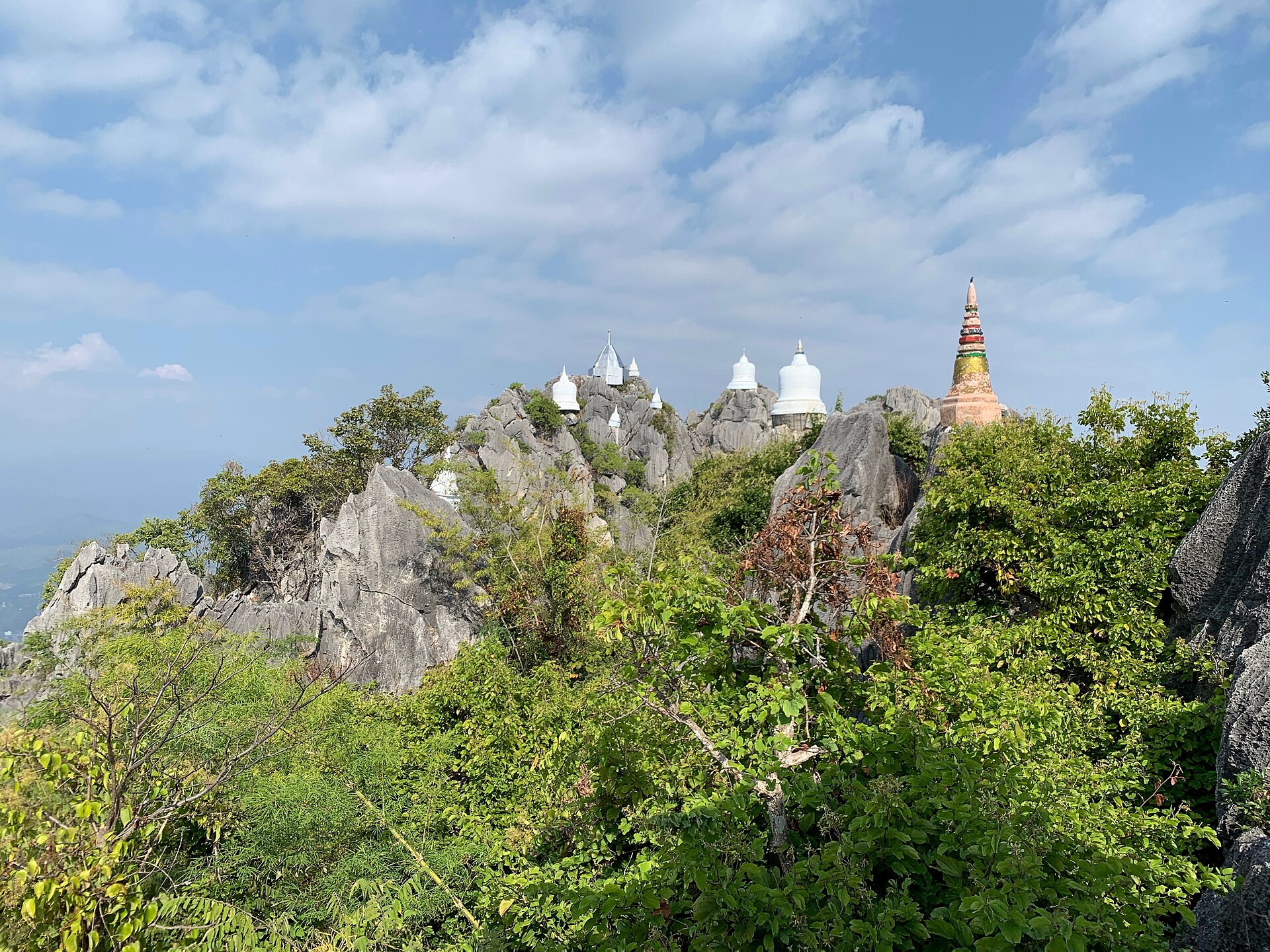
When it comes to Lampang's Unseen-category temples, Wat Chaloem Phrakiat Phrachomklao Rachanusorn — or as locals simply call it, "Wat Phra Phutthabat Pu Pha Daeng" in Chae Hom District — is the first name that comes up. The image people associate with this place is row upon row of white chedis and gilded stupas — more than ten of them — stepped down a dramatic rocky ridge against the sky. From below, they look as if they're floating in the air. Perfect for merit-seekers who want both worship and scenery in one place — though fair warning: this one requires working legs, because you can't drive to the door.
The way up: park your own vehicle at the lower lot and take the local community shuttle truck up the hill (approximately 70 THB per person return — foreigners pay more). Then climb roughly 300-plus stairs and a steep path for about 1 km. Reviews consistently describe it as "tiring and hot, but absolutely worth it." Bring your own water — there's very little for sale at the top. The summit divides into two zones: the sacred chedi side for worship, and a pavilion with a full 360-degree view of the mountain range and Chae Hom District below. This is where everyone reaches for their camera.
The temple sits at approximately 815 m above sea level, built in 2004 to honor King Rama IV and to enshrine an ancient Buddha footprint that the local community has long revered. Its rarity as a visual has earned it a place on Unseen Thailand lists and kept it going viral on social media. TripAdvisor rates it 4.7 from over 100 reviews — ranked #1 attraction in Chae Hom.
Key info before you go: weekday hours 08:00–16:00; Saturday–Sunday from 06:30. Go in the morning to avoid the heat and catch the breeze. Wear shoes you can hike in, dress modestly as it's an active temple, and allow enough time for the round trip. Anyone afraid of heights or unable to climb many stairs should consider carefully — but if you can manage it, the view at the top genuinely makes you forget the effort.
🛏️ Book a place to stay in Lampang
To enjoy the old quarter and Kad Kong Ta without rushing, stay in the town center or near the Wang River — most sights are walkable and you can return easily. Lampang has boutique hotels in old wooden houses, cozy guesthouses, and larger hotels along the main road. During long weekends and festivals rooms go fast — compare prices across sites and book ahead for the best location at the best rate.
🔍 Check Lampang hotel prices (Agoda)Wat Phra Kaeo Don Tao Suchadaram
Wat Phra Kaeo Don Tao Suchadaram is one of Lampang's most ancient city-foundation temples, sitting on the Wang River in the old quarter. It's a royal-grade temple thousands of years old, and one that visitors to Lampang rarely skip — because it's directly tied to the Emerald Buddha. According to historical records, the temple once housed the Emerald Buddha for approximately 32 years before it was moved on toward Chiang Mai. For anyone who loves temples combining beautiful architecture with legendary history, this covers it all in one visit.
The highlight not to miss is the large gilded chedi in Lanna-Mon style, standing about 50 meters tall, believed to enshrine a hair relic. When morning light falls on the chedi it shimmers beautifully — reviews consistently agree that early morning is the best time for photos. Beside the chedi is a Burmese-style mandapa with layered castle-form roofing (pyathat style), built in 1909. Its intricate wood carving and interior detailing are exceptional — foreign reviewers frequently note it as a mandapa you rarely find elsewhere. The temple complex also includes a reclining-Buddha wihan, the main wihan, and a Lanna Heritage Museum displaying Buddhist artifacts.
Entry to the general temple grounds is free. Photography and worship are unrestricted. A shuttle to the upper section costs approximately 40 THB return, collected by staff at the gate. Located in Wiang Nuea Subdistrict, Mueang Lampang — near the old quarter and the Wang River bridges. A horse-carriage ride through the neighborhood adds to the atmosphere. Open daily approximately 08:00–17:00 (museum approximately 09:00–17:00).
Worth knowing: this is a sacred royal temple. Dress modestly, remove shoes before entering any wihan, and keep your voice down in the monastic area. Some reviews note that compared to Lampang's more dramatic temples it looks understated at first glance — but the real draw is the historical significance and the Burmese mandapa, which is genuinely one of a kind. Google reviews: approximately 4.6 from nearly 2,000 reviewers — a landmark worth including in any Lampang trip.
Thai Elephant Conservation Center (National Elephant Institute)
The Thai Elephant Conservation Center — officially the National Elephant Institute under Royal Patronage — is one of Thailand's largest state-run elephant care and conservation centers, set in Thung Kwian Forest, Hang Chat District, between Lampang and Chiang Mai. Ideal for families with children who want a hands-on learning experience, anyone wanting a close-up encounter with elephants cared for by dedicated mahouts, and nature-oriented travelers stopping en route north.
The highlights most talked about are the elephant shows: bathing demonstrations where elephants spray water and play together, the elephant painting show that leaves audiences genuinely astonished, and a log-dragging demonstration recreating the traditional method. Regular show slots are morning and afternoon; elephant bathing comes just before the main show. Don't forget to buy sugarcane and bananas to feed the elephants — kids love it. Another spot not to miss is Thailand's first elephant hospital, open for visitors to see the care of injured and disabled elephants — a window into conservation work that changes how you understand it.
On budget: Thais pay low-hundreds entry, children less, extra activities such as elephant riding are charged separately, plus a small parking fee. It's genuinely accessible. Open daily 08:30–15:30. Go in the morning when the weather is cooler and you can catch both bathing and the full show. Located on the main highway — easy to drive to, about half an hour from central Lampang.
It stays popular because it's a state facility focused on genuine care and education, not just a passing show. Google rates it 4.4 from thousands of reviewers. Most comments praise how well the elephants are looked after and how varied the activities are. Worth knowing: show times may shift seasonally — check with staff at the entrance. If you're bringing small children, prepare hats and water since the grounds are wide.
Wat Pong Sanuk Nuea
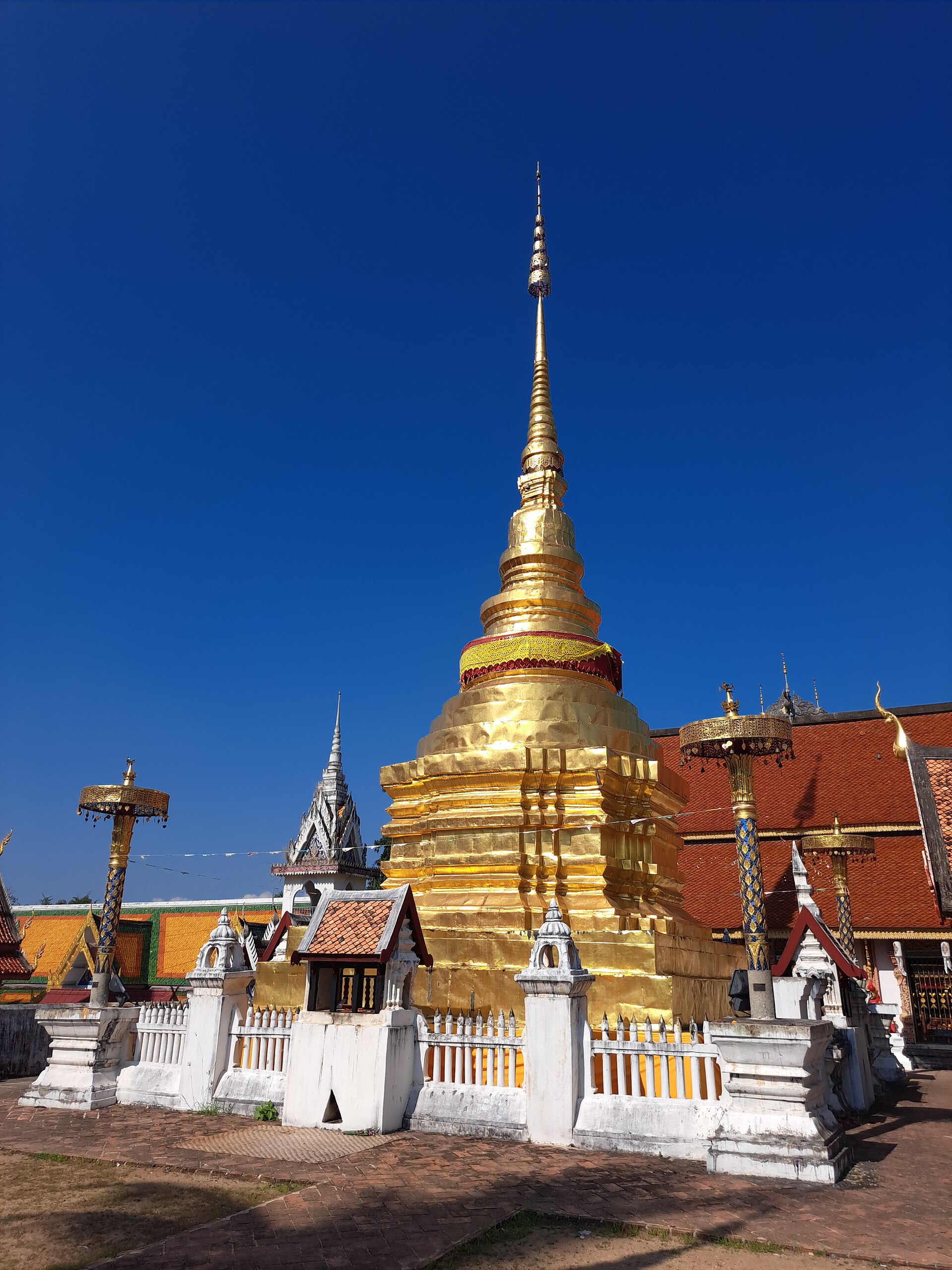
Wat Pong Sanuk Nuea is an ancient temple in the heart of Lampang's old quarter, built on a low earthen mound (mon doi) that you climb up a short naga staircase to reach. The highlight everyone comes to see is the Wihan Phra Jao Phan Ong — a cruciform-plan wooden mandapa with a triple-tiered roof, blending Lanna, Burmese, and Chinese craftsmanship. Said to be the last surviving wihan of this form remaining in Thailand. Ideal for temple lovers, history enthusiasts, architecture fans, and anyone who wants peaceful, beautiful photo angles without the crowds.
The must-see is inside the wihan: four Buddha images seated back-to-back facing the four directions, surrounded by 1,080 small metal-embossed votive tablets lining the walls — the source of the name "Phra Jao Phan Ong" (Thousand-Image Buddha). The restoration of this wihan was executed with such precision that it won the UNESCO Award of Merit for Cultural Heritage Conservation in 2008 — the first Thai temple to receive it. Beyond the wihan there's a brass-sheathed Lanna-style chedi, a reclining-Buddha wihan, an old naga gateway, and a small museum housing wooden Buddha images and ancient scriptures found during restoration.
The grounds are shaded by large trees, quiet and calm. Real reviews consistently recommend coming in the morning — fewer people, softer light, easier to take in the carved-wood details at your own pace. Some reviewers mention it was used as a TV drama location. The temple sits slightly off the main road but is well worth the walk once you arrive. Google rates it 4.4 from several hundred reviews.
Free entry. Open daily approximately 06:00–18:00. Located on Pong Sanuk Road, Wiang Nuea, Mueang Lampang — in the old quarter, easy to drive to with parking. Worth knowing: dress modestly, remove shoes before entering the wihan, and approach it with quiet respect. Lampang residents consider this one of the city's most important temples.
Central Lampang
Central Lampang is the largest shopping mall in Lampang, on the Lampang-Ngao superhighway, Suan Dok Subdistrict. It opened in 2012 as a three-storey building with basement level. The most talked-about feature is the building's exterior, which incorporates Lanna fretwork detailing into modern graphic design, with a translucent roof that lets natural light flood in — airy and open rather than cave-like. Great for visitors wanting a cool escape from the heat, a leisurely walk, a proper meal, or a movie.
Worth doing: study the Lanna fretwork on the facade and snap the local-art landmark angles. Inside: Robinson department store, Tops supermarket, SF Cinema multiplex, Thai and Western restaurants, cafés, dessert shops, and a children's play zone upstairs. Reviews consistently praise the wide layout, easy navigation, large shop variety, and ample parking — roughly 1,000 spaces, both covered underground and in the rear surface lot.
Free entry. Budget depends on how much you eat and shop. A single-dish meal in the main food court runs low hundreds THB; sit-down restaurant prices scale up by venue. Open Mon–Fri 11:00–21:00, Sat–Sun 10:00–21:00. Located just outside the old quarter — easily reached by songthaew or taxi.
It stays popular as a genuine community hub for Lampang residents — shopping, eating, movies, and regularly rotating events, concerts, and food markets. Worth knowing: evening on holidays and during events can be busy with queue waits at popular restaurants. Weekday afternoons are the quietest time.
Khelang Nakhon Public Park
Khelang Nakhon Public Park is Lampang's real urban green lung, on Wang Khwa/Tha Khrao Noi Road in the center of Mueang District. At roughly 34 rai of land developed by the Nakhon Lampang municipality for walking, running, exercise, and sitting under large trees, it's perfect for health-conscious visitors, families with kids, working locals who need an escape, and travelers staying in town who want to stretch their legs at dawn or dusk. A key practical advantage: multiple entry points, easy vehicle access, and plenty of parking — no frustrating circuits looking for a spot.
The highlight most mentioned is the approximately 700-meter rubberized running track around the park — flat, smooth, comfortable underfoot whether you run or walk. Exercise stations and outdoor fitness equipment are spaced along the route. Heavily shaded by large trees throughout. Real reviews from Lampang residents consistently call it "clean, shaded, comfortable" and the most popular place in the city for running and exercise. Mornings and evenings are busiest — line-dance groups, regular walkers, the full community vibe. This isn't a flashy landmark for Instagram, but it delivers calm and breathing room in the middle of town.
Free entry, always open from roughly 06:00–21:00 daily. Well-located in the town center near Phatthana Phak Nuea Bridge — a short drive or songthaew ride from any central hotel. Multiple entry points off Wang Khwa Road and Tha Khrao Noi Road.
Worth knowing: this place is about exercise and rest, not photogenic check-ins. Midday sun is strong — morning or evening is far more comfortable. The municipality does periodic maintenance work and may close sections temporarily. Bring your own water, put on your running shoes, and lap the 700-meter track the way the locals do.
Book tickets and tours in Lampang
Lampang's sights are spread across town into Ko Kha, Hang Chat, and Chae Hom. If you'd rather not drive yourself or want a guide to explain the Lanna temple stories, try booking a guided Lampang tour or Thai Elephant Conservation Center activity tickets through Klook or GetYourGuide in advance — no queueing on arrival and your itinerary fits together smoothly.
💡 What to know before you visit Lampang
In town you can call Grab or a local taxi, and horse-carriage rides are a signature way to see the old quarter. But out-of-town sights like Ko Kha, Hang Chat, and Chae Hom are spread apart — renting a car or hiring a full-day private vehicle is the most practical option.
Kad Kong Ta and most street-food stalls work primarily on cash. Bring smaller notes and coins. Some vendors accept PromptPay QR, but don't count on it at every stall — withdraw cash before heading to the market.
Kad Kong Ta opens only on Saturday and Sunday evenings, approximately 17:00 to late. Temples are best visited in the morning when the sun is soft and crowds are smaller. Avoid midday heat.
Lampang's Lanna temples are sacred sites. Dress modestly — cover shoulders and knees. Remove shoes before entering any wihan. Lower your voice in the chedi compound.
English signs and menus exist at major attractions and the mall, but market stalls may have very little. Google Translate or pointing at photos works well. Tipping is not required, but rounding up or leaving a small amount for good service is appreciated.
At the Thai Elephant Conservation Center there are multiple activity options — choose programs focused on watching elephant bathing, feeding, and mahout traditions for a more meaningful, comfortable experience. Check show times and activity prices at the entrance when you arrive.
Plan your Lampang trip over 2 days to get the most out of it
Dedicate the first day to the old quarter, where everything is close enough to walk — start at Ratsadaphisek Bridge (White Bridge) in the morning while the light is still soft, then walk to Wat Phra Kaeo Don Tao Suchadaram and Wat Pong Sanuk Nuea in Wiang Nuea. Continue to Nakhon Lampang Railway Station for the vintage wooden building. Close the evening — on Saturday or Sunday — at Kad Kong Ta, grazing your way from 17:00 to late.
Save the second day for the further spots: head to Wat Phra That Lampang Luang in Ko Kha in the morning — the upside-down chedi reflection in Wihan Nam Tae is the highlight — then drive to the Thai Elephant Conservation Center in Hang Chat in time for the morning or afternoon elephant bathing show. If you still have energy and want a 360-degree mountain view, head up to Wat Phra Phutthabat Pu Pha Daeng in Chae Hom. Khelang Nakhon Public Park and Central Lampang can be saved for a leisurely evening or whenever you need to rest your legs.
Want to wake up early and walk the temples and old quarter without rushing? Book a stay in central Lampang or near Kad Kong Ta — rooms fill fast on long weekends. Compare prices across sites and pick what works for you.
Check Lampang hotel prices