🔄 Last checked 28 Jun 2026 · details and hours can change — check the venue before you go
📍 All restaurants on the map
Tap a pin for the spot + nearby stays
The charm of Maha Sarakham is that it's a laid-back university town whose highlights are spread right across the province. In the centre stands the old City Pillar Shrine, dating to 1865 and still a spiritual anchor for locals. Behind the Rajabhat University campus lies Kaeng Loeng Chan, a broad reservoir where people walk, run, and cycle the roughly 10-kilometre loop around the water to catch the sunset. Come evening, Tonson Market in town lights up for a stroll through Isan street food. If you're into spirituality or nature, drive out of town to Kae Dam to walk the wooden bridge over the fields and stop at Wat Nong Hu Ling to see Thailand's first boat-shaped ubosot; head to Kosum Phisai to greet the monkey troop at Kosamphi Forest Park on the Chi River; or drive south to Na Dun to collect a temple, a museum, and a stone sanctuary in one trip. You can string together the spiritual, the urban, the natural, and the historical all in one go.
This list includes the pins you shouldn't miss in Maha Sarakham. There's the Kae Dam Wooden Bridge, an old wooden bridge stretching more than a kilometre across a reservoir amid rice fields and lotus ponds, now the province's signature photo spot. There's Wat Pa Wang Nam Yen in Tambon Koeng, home to an entire ubosot built of golden takian wood — said to be the largest in the world — with 32 takian posts, paired with the large golden Sri Maha Sarakham Chedi. And there's Phra Borommathat Na Dun, a large white chedi at the centre of a Buddhamonthon, the spot where evidence of the ancient city of Nakhon Champa Si and old terracotta votive tablets were unearthed. Not far away is Ku Santarat, a laterite Khmer sanctuary from the reign of King Jayavarman VII, in relatively complete condition and free to enter. Scroll through the details spot by spot and map out your own route.
Kae Dam Wooden Bridge
If you want to see a side of Maha Sarakham that isn't in town, drive out toward Kae Dam district, about 20 kilometres away, and stop at the 'Kae Dam Wooden Bridge' at Wat Dawadueng, Ban Hua Khua. This old wooden bridge stretches across the Kae Dam reservoir, linking Ban Hua Khua with the village side of Kae Dam. Villagers originally built it to cross the reservoir and used it for decades, and it gradually became a popular check-in spot from around 2015 onwards. It suits people who love the atmosphere of the fields, a quiet Isan way of life, and photographers hunting for a frame no one else has.
The highlight is walking the narrow wooden planks that reach far out across the reservoir and lotus ponds, green water and lotus leaves on both sides. At the bridge entrance they've built a photo corner with charming wooden window frames, and there's a large frog statue standing by — the area is known for its abundance of frogs, which are a local food. Many genuine reviews agree that coming early in the morning or in the evening near sunset gives the best atmosphere and photos, while midday sun is quite harsh since there's no shade on the bridge.
Entry is free, with no charge; you can park by the roadside. Couples, families, and community-cycling travellers can all drop by easily. At times the Ban Hua Khua community also sells woven crafts, reed mats, and local food to try, so a visit here combines photography with a real taste of village life.
One thing to know: the bridge is made of old, well-worn wood, and some stretches have deteriorated and been repaired at intervals over the years. Watch for planks that may be slippery or damaged, walk slowly, don't crowd together too densely, and check the latest condition before you go for peace of mind. But if you catch it right — good light, the pond full — this is one of the most classic frames in Maha Sarakham, worth seeing at least once.
Wat Pa Wang Nam Yen
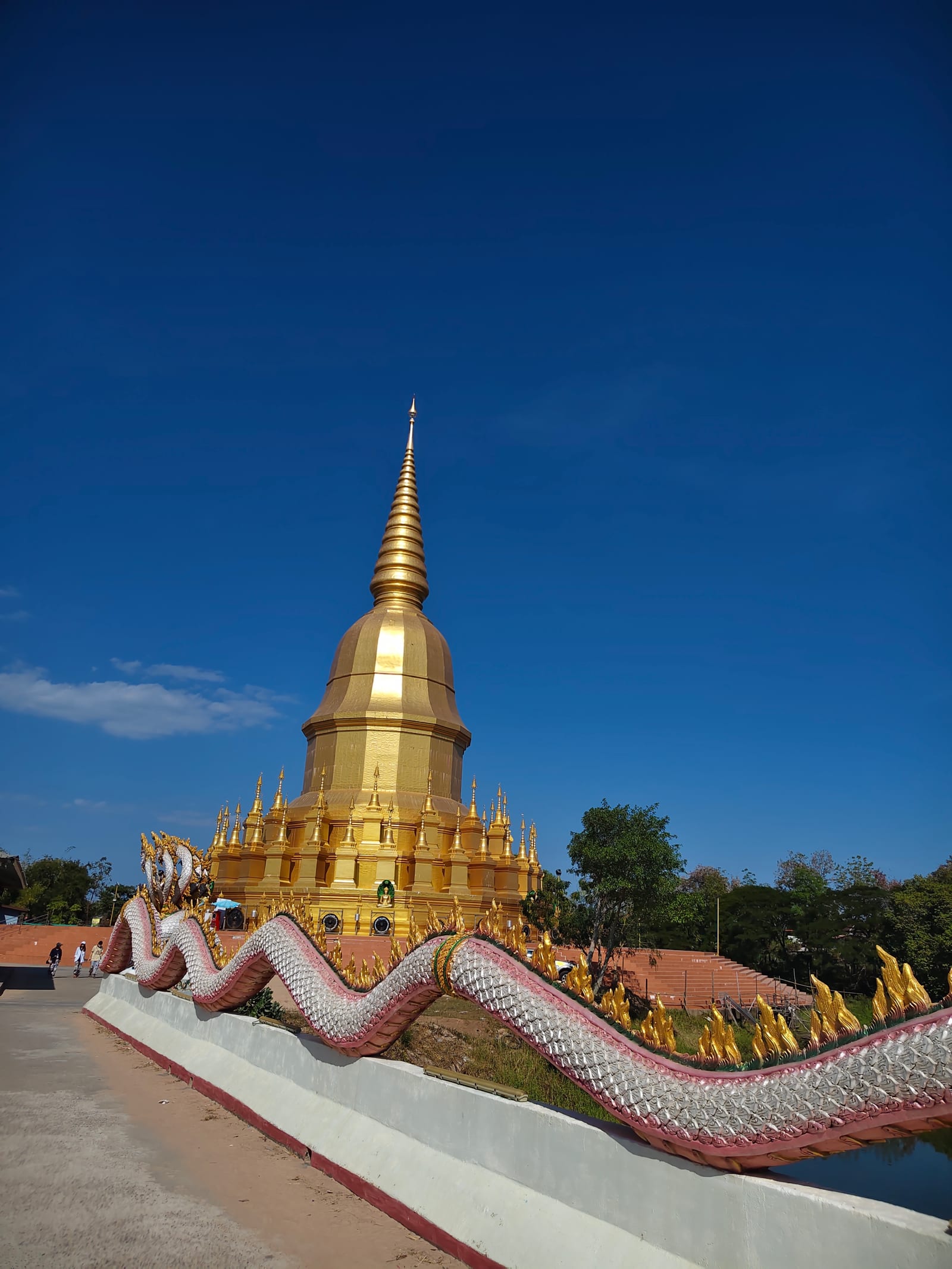
If you have to pick one temple to visit in Maha Sarakham, Wat Pa Wang Nam Yen (officially Wat Phutthawanaram) is the answer most people mention. It's a large forest temple of more than 30 rai at Ban Wang Nam Yen, Tambon Koeng, Mueang district, built and developed by Luang Pho Suriyan Khosapanyo until it became a merit-making landmark that people from all across Isan come to see. It suits those who come to make merit, people who love timber architecture, and families who want to bring elders for an easy walk around a beautiful temple.
The unmissable highlight is the ubosot built entirely of golden takian wood, said to be the largest in the world, using 32 enormous golden takian posts. Step inside and you can feel how detailed and grand the woodwork is. Many reviews agree that 'the wooden ubosot is enormous' and looks unlike any ordinary temple. It's paired with the large golden Sri Maha Sarakham Chedi, visible from far off, and a huge wooden sermon hall that uses 112 wooden posts. Inside is also enshrined a golden crowned Buddha image for worship and blessings.
The atmosphere is shaded and calm in the forest-temple way, pleasant for a photo stroll, and about 1–2 hours is just right. Best of all, entry is free, with no charge. Open daily around 06:00–18:30. Another popular spot is the Café Amazon in front of the chedi, where you can sip coffee and take in the temple.
Things to know: the Isan midday sun is very strong, and visitors who've been recommend coming in the morning or evening for an easier walk and better photos. Dress modestly, as ceremonies and merit-making continue here regularly. This temple was chosen as one of 25 Unseen New Chapters in 2023, so it's no surprise it gets busy on holidays — come early for the best atmosphere.
Phra Borommathat Na Dun
Phra Borommathat Na Dun is a large white chedi standing gracefully in the middle of a broad plaza — the origin of the name 'Buddhamonthon of Isan' — and it counts as the sacred landmark of Maha Sarakham. This spot was once flat land in the fields of Ban Na Dun, until in 1979 villagers unearthed terracotta votive tablets and a model stupa containing Buddha relics in a three-tiered reliquary of gold, silver, and bronze — evidence of the ancient Dvaravati-era city of Nakhon Champa Si. The authorities then built the chedi to enshrine them for people to venerate. It suits merit-makers, history lovers, and families who want a stop along the way through southern Isan.
The unmissable thing is walking around the white chedi, which photographs well from every angle, especially under clear skies and in the soft evening light. Then stop at the nearby Nakhon Champa Si Museum to see the real terracotta votive tablets. Most reviews agree the place is clean, with a wide plaza, shade, and a calm quiet — a good spot to sit and settle your mind. Many give it full marks for the good atmosphere and upkeep.
Entry is free, with no charge, and there's convenient parking. Open daily around 07:00–18:00. It's in Tambon Phra That, Na Dun district, about 65 km from Maha Sarakham town — easiest to reach by car. If you come in late February to early March, you'll catch the annual Phra Borommathat Na Dun veneration festival, a grand multi-day, multi-night event with mor lam, markets, and especially large crowds.
It's popular because it combines the sacred, the historical, and photogenic angles all in one place. Things to know: this is a sacred site, so dress modestly, and the midday sun on the open plaza is quite strong — bring an umbrella or hat and come in the morning or evening for comfort.
Kaeng Loeng Chan
Kaeng Loeng Chan is a large reservoir to the west of Maha Sarakham town, behind Maha Sarakham Rajabhat University, only a few kilometres from the centre — effectively the green lung and exercise ground for the whole province. The highlight is the road running around the reservoir, roughly 10 kilometres long, where people walk, run, and cycle almost every evening. It's great for nature lovers, families who want to bring children to run around, and cyclists after a long waterside route. Along the embankment there's also a public park with a flower garden, rest pavilions, and a pavilion over the water to sit and catch the breeze.
The unmissable thing is the sunset over the reservoir; many reviews agree that in the evening the sky changes colour and reflects off the water beautifully — it's a popular photo spot. If you haven't brought a bicycle, you can hire one cheaply for around 20 baht from local community groups, and there are food shops by the water to refuel after a ride. The overall atmosphere is shaded, with plenty of large trees, and it's not crowded like commercial tourist sites. Most people here are locals coming to exercise or bring their families for a picnic.
You needn't worry about entry fees — it's free, and the area is open to use at any time, though the most popular times are around 6 a.m. and in the evening before sunset. It's in Tambon Kaeng Loeng Chan, Mueang Maha Sarakham, next to the bypass road — easy to reach by car or motorcycle, with spacious parking. At times there are running or cycling events held here as annual activities, especially in the cool season when the weather is at its best.
Things to know before you go: the facilities are still simple, with limited toilets and not many shops, so bring some water and snacks. If you plan to cycle the loop, allow enough time and avoid the midday sun. In the rainy season, some stretches of ground can be slippery and the water may rise, so checking the weather first is best. Come in the morning or evening for the best atmosphere.
Wat Nong Hu Ling (Anantanakharat Merit-Boat Ubosot)
If you think a temple's ubosot has to be a rectangular building with tiered roofs like the ones you've always seen, Wat Nong Hu Ling in Kae Dam district will make you stop and look. Here the ubosot is shaped like a large, gleaming golden 'boat', with the naga Anantanakharat coiled around it. Locals casually call it 'the Boat Temple', and often say this is the first boat-shaped ubosot in Thailand. This merit-boat took nearly ten years to build, funded by devotees' donations gradually pooled together — so it isn't just a piece of architecture, but faith taking shape little by little.
The charm here is in the details, deliberately laden with meaning. The abbot designed it himself, and every point has significance, from the entrance you duck under to release the bad from your mind, to the boat form that signifies the path beyond suffering. Inside the ubosot is enshrined a Buddha image in the first-sermon posture, as if inviting anyone who steps in to sit and listen to the Dhamma quietly. The naga and the stucco patterns around the boat are finely done — you can wander around and take photos to your heart's content, especially in the soft light of morning or evening when the gold catches the light.
The overall atmosphere is that of a quiet rural temple, without the crowds of famous city temples. It suits people who want to pay respects, photograph unusual architecture, or drive through Isan at an unhurried pace. Those who love traditional merit-making often mention the candle procession around the boat-shaped ubosot on important religious days, a sight you don't often get to see.
Getting there: the temple is in Tambon Mittraphap, Kae Dam district, close enough to Maha Sarakham town to reach comfortably on a day trip. Dress modestly, as this is a religious site, and allow a little time to walk around the boat. If you go inside to worship, remove your shoes and observe temple etiquette. It's a well-rounded stop for adding something more unexpected to a Maha Sarakham trip.
🛏️ Hotels in Maha Sarakham — Stay in town near Kaeng Loeng Chan and Tonson Market
To make the most of Maha Sarakham, try staying a night. That way you can cycle by Kaeng Loeng Chan in the evening, walk Tonson Market for Isan street food, and in the morning drive out to worship at the takian-wood ubosot at Wat Pa Wang Nam Yen or head to Na Dun while it's still quiet. Popular hotels cluster in Maha Sarakham town near Mahasarakham University and Tonson Market, with easy access to the spots around town. There are both central hotels and lodgings near the university — pick a location close to whatever you want to visit first thing, and it'll pay off most. Compare prices and reviews before you book.
🔍 Check Maha Sarakham Hotel Prices (Agoda)Tonson Market
Tonson Market is a night market in the centre of Maha Sarakham, in the Tambon Talat area within the municipality, and it's become the evening meeting spot for locals. Its strengths are attractive lighting and wide walkways that are comfortable to stroll, not cramped, and every stall has a roof against sun and rain, so you can keep eating and shopping even when it rains. It suits coming with friends, a partner, or the whole family, or dropping by alone for a bite after work. There's plenty of parking, and it's easy to reach.
The most-talked-about highlight is the central seating zone with a big screen showing live football. If you like the chill of sitting with a beer, live music, and watching the match while you eat, this is the place. A famous stall in the market like Nai Tong Moo Krata sets its tables so you can see the football screen. The much-praised snacks include cheese tea — sweet in just the right way, not cloying, with a rich cheese and a friendly price — and there are tasty Isan dishes like frog laap to try as well. One loop around and you can find savoury food, sweets, and clothing, bags, and shoes to shop.
You needn't worry about cost — the market is free to enter, and you only pay for what you eat, so a budget in the low hundreds fills you up easily. It gets lively in the early evening, and once it's dark the crowds grow and more stalls are open. Open daily, with the night-market zone running from about 16:00 to midnight, and the community-market zone open from the afternoon into the evening.
Things to know: during festivals or the rainy season the market sometimes changes its hours, so it's worth checking the market's Facebook page before you head out so you don't miss it. And if you're set on watching a big match, come in the early evening to book a table in front of the screen, since it gets busy. This place keeps growing in fame and has become the city's landmark night market in just a few years.
Kosamphi Forest Park
Kosamphi Forest Park is a patch of rainforest on the Chi River of around 125 rai, just about 28 kilometres from Maha Sarakham town — under half an hour to drive. The selling point everyone talks about is the troop of hundreds of long-tailed macaques that come out to greet you right from the entrance, and what's more special than elsewhere, there are golden-furred macaques said by many sources to be found only here in the whole Asia-Pacific. It's great for families bringing children to see the monkeys, nature lovers who want a shaded forest walk, and anyone after a free spot near town that doesn't need much planning.
The unmissable thing is buying bananas or peanuts to feed the monkeys (keep your valuables and plastic bags secure — the monkeys are quick), walking the nature trail, a concrete path you can walk or cycle to see the forest, crossing the suspension bridge over a pond in the middle of the park for photos, and walking down to Kaeng Tat by the Chi River, which in the dry season becomes a popular swimming spot for people around here. Before going in to see the monkeys, locals like to stop and pay respects to Luang Pho Ming Mueang, the town's revered Buddha image at the entrance.
Inside, the atmosphere is shaded by large trees like yang na, tako, and khoi, so walking feels cool, like escaping the heat into the forest. Entry is free, no ticket charged. Open daily around 08:00–18:00. The time reviewers recommend is late afternoon into the evening, when the monkeys come out in greater numbers and are livelier than at midday, when the heat is intense and they hide in the shade, so you see fewer of them.
Things to know: the monkeys here are used to people and quite mischievous — watch what's in your hands, your glasses, your phone, and food in bags. Don't tease or approach monkeys with young. In the late rainy season the Chi River may flood parts of the park, forcing the monkeys up into the trees, so checking the weather before you go is reassuring. Overall it's a free spot near town where you get to see monkeys, walk in the forest, and relax by the river all in one place — long a popular pin in Kosum Phisai district.
Maha Sarakham City Pillar Shrine
If you arrive in Maha Sarakham and want to start your trip auspiciously, the City Pillar Shrine is the first stop locals like to recommend. It sits right in the heart of town on Nakhon Sawan Road, near Lak Mueang Maha Sarakham School, and serves as a spiritual anchor and blessing spot for the whole province. What makes it special is that the shrine has a story going back to 1865, in the time of Phra Charoen Ratchadet (Thao Kuat), the first city ruler who gathered his people from Roi Et to found a new city, then built the City Pillar Shrine as a sacred protector of the town. It suits the spiritually inclined, people wanting blessings for work and luck, and anyone who likes to collect each province's historical landmarks.
The unmissable highlight is the pillar itself, made of chaiyaphruek wood, beautifully carved and lacquer-gilded, enshrined in a four-porched building with entrances on all four sides so you can circle it in worship. At the entrance you'll find sets of flowers, incense, and candles on sale for those who want to pay respects and make a wish, for just a few dozen baht. Many come here to fulfil vows or pray about important matters. During the annual Boek Fa merit festival and the Red Cross fair there are grand offering rituals to the guardian spirit of the city pillar, especially lively times.
The atmosphere around the shrine is shadier than you'd expect, with lilawadee trees planted around the courtyard, chairs to rest on, and everything clean and tidy. Genuine reviews agree the building itself isn't large and looks simple, and it takes less than an hour to walk around and pay respects — so it's better as a short stop along the way than a place to linger. Some come as early as 6 a.m. when they're sweeping the courtyard and opening the shrine, when the air is pleasant.
Entry is free, with no charge, open for worship roughly from 6 a.m. to 6 p.m. daily. Parking by the roadside isn't hard, as it's in the middle of town, near the market and food area for an easy stroll onward. One small thing to know: it's a sacred place, so dress modestly and be respectful when you go in to worship. It's popular because it's central enough for anyone passing by to drop in, and it's tied directly to the history of founding Maha Sarakham — so when you're in the province, it's worth stopping to pay respects at least once.
Isan House Museum, Mahasarakham University
If you want to understand how Isan people lived 40 to 50 years ago, the Isan House Museum at the Walai Rukhavej Research Station of Mahasarakham University answers that vividly. This isn't a cold glass-case museum, but a cluster of real wooden houses moved and arranged in a shaded forest — Isan houses, Phu Thai houses, and Yo houses. Each is set up as a 'living museum' you can actually walk up into to see the household utensils. It's great for culture lovers, people who like learning about rural life, and families who want to bring children to see the real thing beyond the textbook.
The unmissable thing is walking through the houses one by one, because each tells a different story, from kitchenware, jars, and pots to farming tools, all the way to the old-style loom that once took many hands to weave. Around the grounds there are also a cart shed, a field hut, a haystack, and a model rice paddy, giving a full picture of an Isan village of the past. Those who've reviewed it consistently mention the atmosphere shaded by large trees, and photos that come out warm with a retro mood.
Budget is very easy, since entry is free. Open daily around 08:00–16:00. The museum is within the Walai Rukhavej Station grounds in Na Dun district, near Phra That Na Dun, so people often make a continuous trip — worship at Phra That, then walk the Isan houses in one go. That's one reason this is a cultural pin people mention when they come to Sarakham.
One small thing to know: the area is quite large and the houses are open-air, so come in the morning or late afternoon to avoid the midday sun, and wear comfortable shoes since you'll be walking and climbing the wooden house steps. At times it can be quiet with no guide on hand, so it's worth calling the Walai Rukhavej Research Institute ahead if you're coming as a group, to make the most of your visit.
Ku Santarat
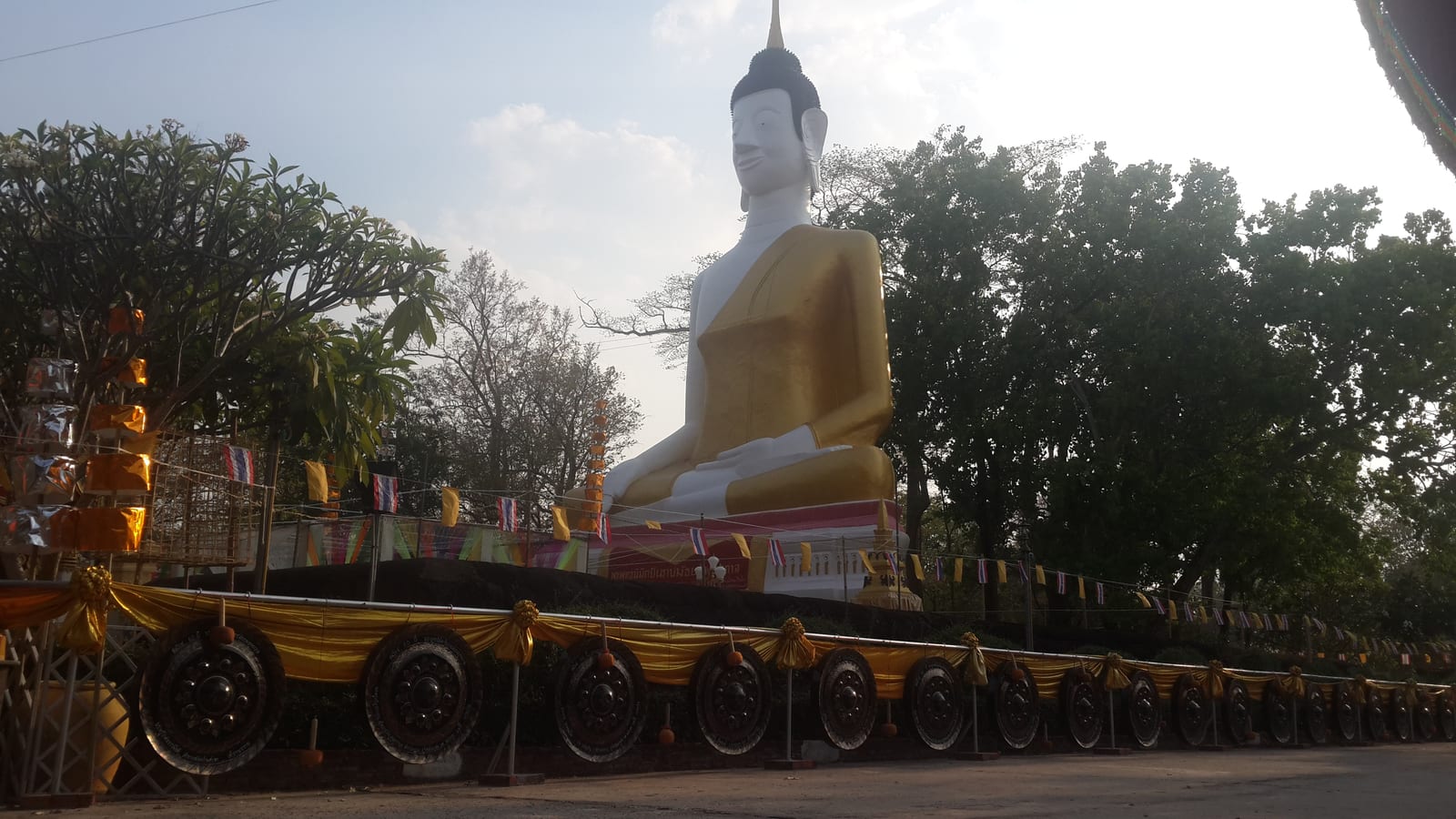
Ku Santarat (sometimes called Ku Non Mueang) is a laterite Khmer stone sanctuary tucked away in the fields of Ban Ku Non Mueang, Tambon Ku Santarat, Na Dun district, about 4 kilometres from the district centre. It is one of the 'arokayasala' — the royal hospitals built in the reign of King Jayavarman VII around the 18th Buddhist century (1157–1207 CE). Anyone who loves the feel of ancient Khmer history, or likes quietly tracing the remnants of the Nakhon Champa Si civilisation, will find this ideal, because it isn't as crowded as the famous sanctuaries in southern Isan — you can walk around at ease without competing for a photo angle.
The highlight is the square central prang facing east, built up in layers of laterite, with a real doorway on the east and false doors on the other three sides, ringed by a laterite wall, and a pond or 'baray' of about 10×12 metres at the north-eastern corner in the Khmer water-management pattern. What many people note from reviews is that the sanctuary looks fairly complete compared with other ku in this area, though the lintel carvings and decorative pillars were never finished — believed to have been left incomplete since ancient times, which gives it a raw quality where you can clearly see the stone, a charm of another kind.
The Fine Arts Department registered it as a heritage site back in 1935, and today it's open to visit for free, with no ticket charged. Open during the day, roughly 08:00–18:00. The site is an open plaza in the sun, so morning or evening is best for good photos without too much heat. The great thing is that it's just a few kilometres from Phra Borommathat Na Dun, so it's easy to do a continuous trip in a single day — many people worship at Phra That, then stop at Ku Santarat and Ku Noi as one set.
Things to know: this is an open-air heritage site with no shops or cafés on hand, so bring your own drinking water and a hat. The access road is fairly small but reachable by sedan; there are some signs, but keep GPS on. Please help keep it clean and don't climb the sanctuary, so future generations can see the real thing.
🎫 Tickets & Tours in Maha Sarakham — Book Ahead, Skip the Queue
Maha Sarakham's attractions are spread across several districts, from the Kae Dam wooden bridge and Kosamphi Forest Park in Kosum Phisai to the temples and heritage sites in Na Dun. If you're not driving yourself, or you want to cover several spots in one trip, booking a guided tour or tickets in advance through Klook and GetYourGuide means you don't have to plan the route — someone takes you to everything in one day, and you can book tickets ahead so there's no queue on-site. Compare tour and activity options around Maha Sarakham first.
💡 Know Before You Go: Maha Sarakham
The attractions in central Maha Sarakham are close together, but the Kae Dam wooden bridge, Kosamphi Forest Park, and Phra Borommathat Na Dun are out of town in different directions. Public transport is limited and Grab is very scarce in Maha Sarakham. The most convenient way is to rent a car or a motorcycle — sort out your transport before heading out of town.
Food at Tonson Market, bicycle hire at Kaeng Loeng Chan, flowers and incense at the City Pillar Shrine, and most temple donation boxes take cash. Carry small bills for roadside food and parking. ATMs are easy to find in town, but rare at the out-of-town spots.
The midday sun is strong in Maha Sarakham. Go to the Kae Dam wooden bridge and Kaeng Loeng Chan in the morning or evening near sunset for better photos and an easier walk. Tonson Market only runs from the evening into the night, so if you're set on a food walk, plan your timing.
Wat Pa Wang Nam Yen, Phra Borommathat Na Dun, and Ku Santarat are sacred places where people come to worship. Cover shoulders and knees, remove your shoes where the signs indicate, and keep your voice down in the ubosot and around the chedi. At the City Pillar Shrine, flower, incense, and candle sets sell for around 20–50 baht each.
Kosamphi Forest Park has hundreds of long-tailed macaques to greet you — fun, but the monkeys are quite mischievous. Keep your glasses, hat, plastic bags, and food secure, hold food out carefully, and don't provoke or get too close to the young ones.
Outside the Mahasarakham University area, English signs and menus are scarce. Bring a translation app to help, or point at the picture at Tonson Market and Isan eateries — you'll get by. It's a university town with younger people who can help communicate a little and are kind to visitors.
Plan Your Maha Sarakham Trip to Get the Most Out of It
Maha Sarakham is easy to visit because the town's highlights cluster close together. In the morning, worship at the City Pillar Shrine in the old town for a blessing, then stop at Wat Pa Wang Nam Yen in Tambon Koeng to see the entire golden takian-wood ubosot and the large Sri Maha Sarakham Chedi. In the afternoon, head to Kaeng Loeng Chan behind the Rajabhat University, hire a bicycle, and ride the roughly 10-kilometre loop around the reservoir to wait for the sunset. In the evening, continue to Tonson Market to walk and eat Isan street food. You can cover the in-town spots in a single day.
If you have more than a day, drive out of town. Photographers can head to Kae Dam to walk the more-than-a-kilometre wooden bridge across the fields and lotus ponds in the soft light of morning or evening, then stop at Wat Nong Hu Ling to see the boat-shaped ubosot in the same district. Nature lovers can bring children to Kosamphi Forest Park in Kosum Phisai to feed the macaques and stroll along the Chi River. And the spiritually and historically inclined can drive south to Na Dun to collect Phra Borommathat Na Dun, MSU's Isan House Museum, and Ku Santarat, the Khmer stone sanctuary in the same zone, all at once. Planning to cover Na Dun in one loop saves the most time.
Maha Sarakham is fun even as a day trip, but staying a night in town lets you cycle by Kaeng Loeng Chan in the evening, walk Tonson Market for Isan food, and in the morning drive out to worship at the takian-wood ubosot or head to Na Dun for the chedi and stone sanctuary. Compare prices and reviews for hotels in Maha Sarakham before you book.
🔍 Check Maha Sarakham Hotel Prices (Agoda)