🔄 Last checked 26 Jun 2026 · details and hours can change — check the venue before you go
📍 All restaurants on the map
Tap a pin for the spot + nearby stays
When you think of Samut Sakhon, the first image that comes to mind is fishing boats lined up along the Tha Chin River, a sea breeze carrying that unmistakable salt-and-brine smell, and mounds of shrimp, clams, crab, and fish laid out for sale before sunrise. Mahachai is close enough to Bangkok for a comfortable day trip, yet the moment you turn off into Phan Thai Norasing or cross the river to Tha Chalom, the pace of life drops immediately. The Phan Thai Norasing area has its legendary loyalty shrine and a long red bridge tracing the Gulf of Thailand — perfect for watching sunsets and, in the cooler months, dolphin pods. On the Mahachai side, Talaad Thalae Thai and Mahachai Market offer wholesale seafood at source prices, while Tha Chalom is a historic riverside community where you can spend an entire afternoon riding a trishaw through street-art-lined lanes. One trip here covers shrines, markets, the sea, and canal-side life all at once.
Standouts you can count on: Phan Thai Norasing Shrine — the legendary site of the loyal helmsman — where people come to pray for career luck and then browse the adjacent canal-side market. The Red Bridge stretches into the Gulf and has become the province's signature photo spot for sea-and-sunset shots. On the Mahachai town side, the Samut Sakhon City Pillar Shrine hosts the country's only water-borne spirit procession, and Wat Krok Krak draws fortune-seekers from across Thailand to pray before the only black-sunglasses-wearing Buddha in the country. Wat Yai Chom Prasat, meanwhile, is a nationally registered Ayutthaya-era heritage site famous for its four-layer deep-relief carved wooden doors. Every style of travel, one province.
Phan Thai Norasing Shrine (Phan Thai Norasing Historical Park)
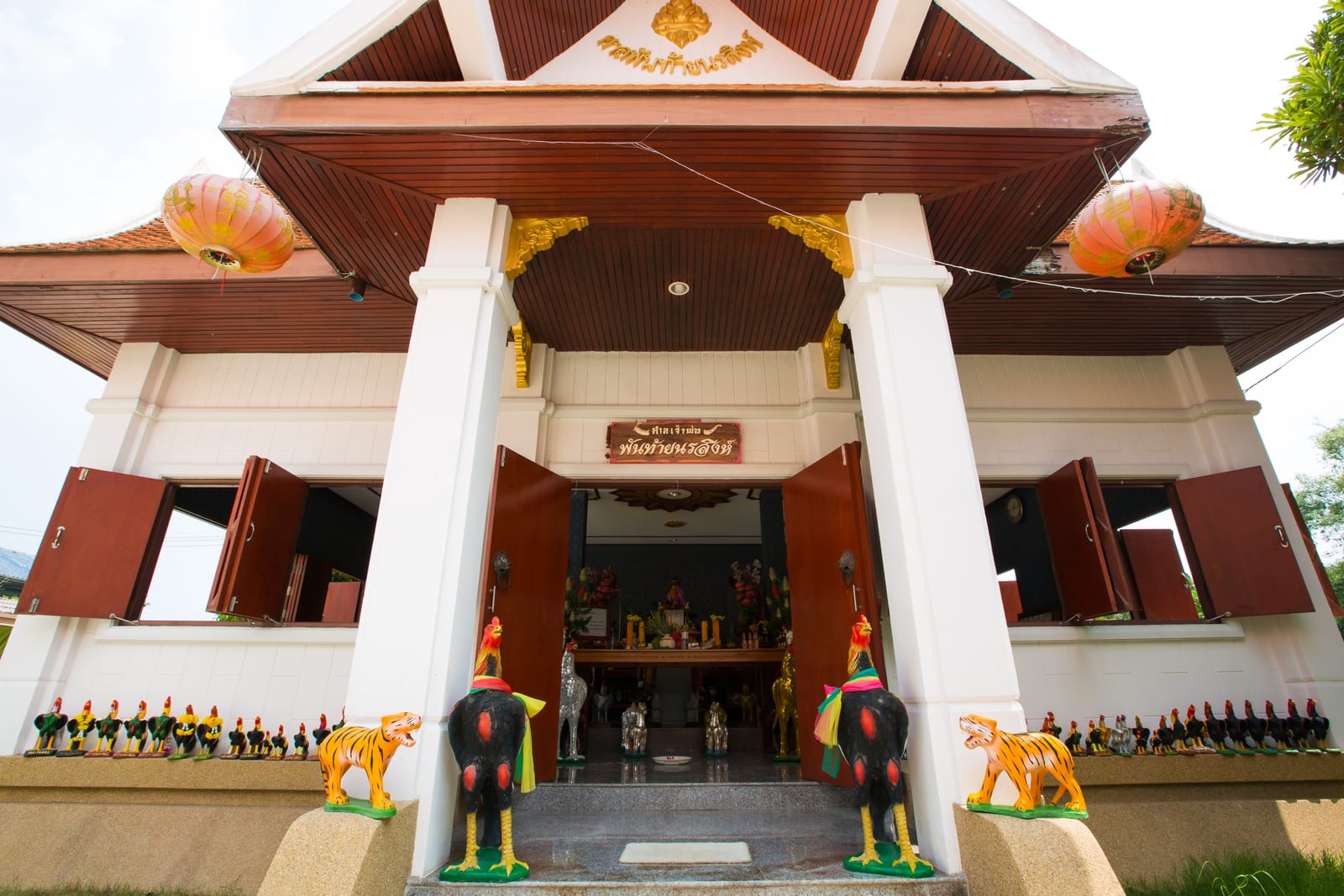
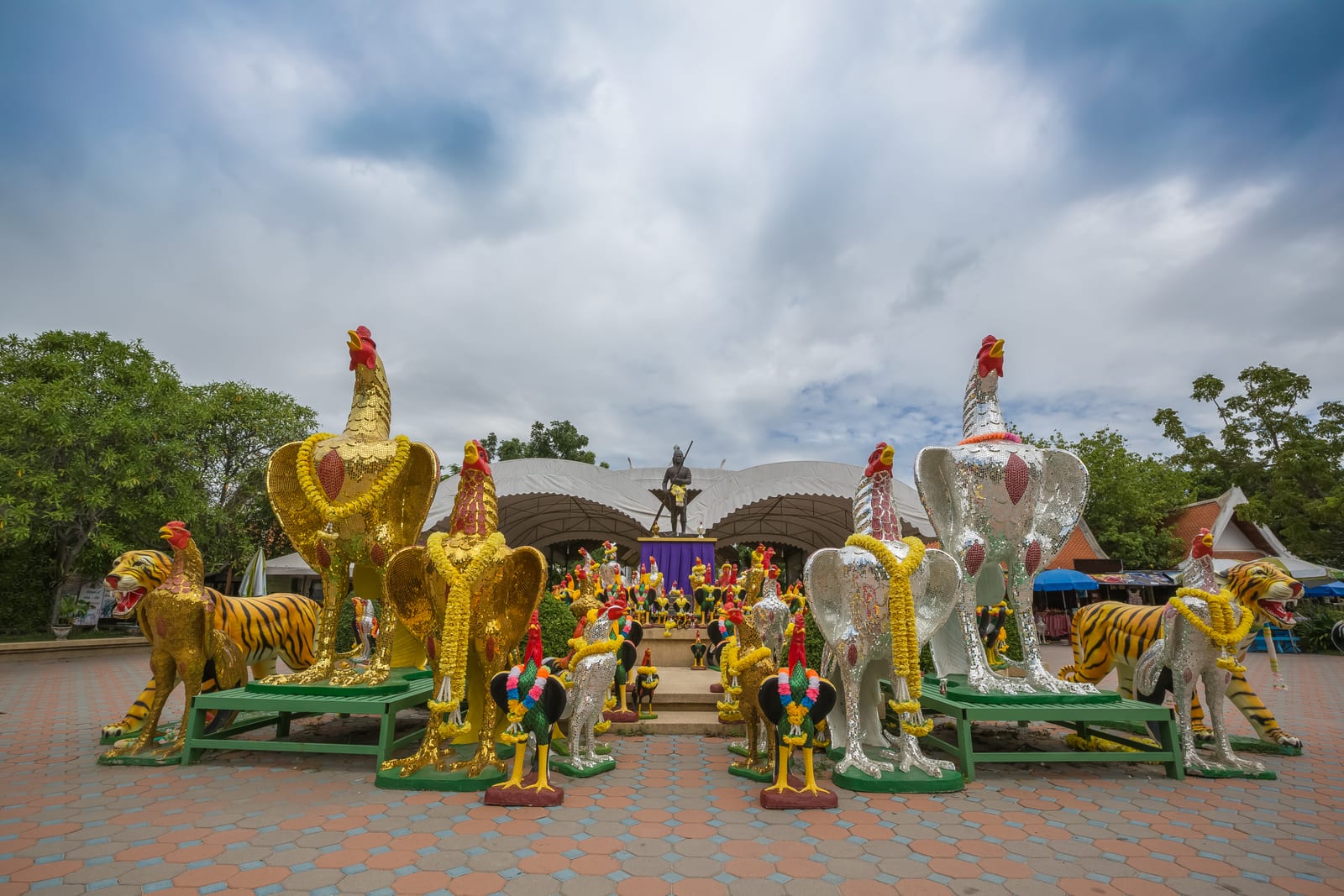
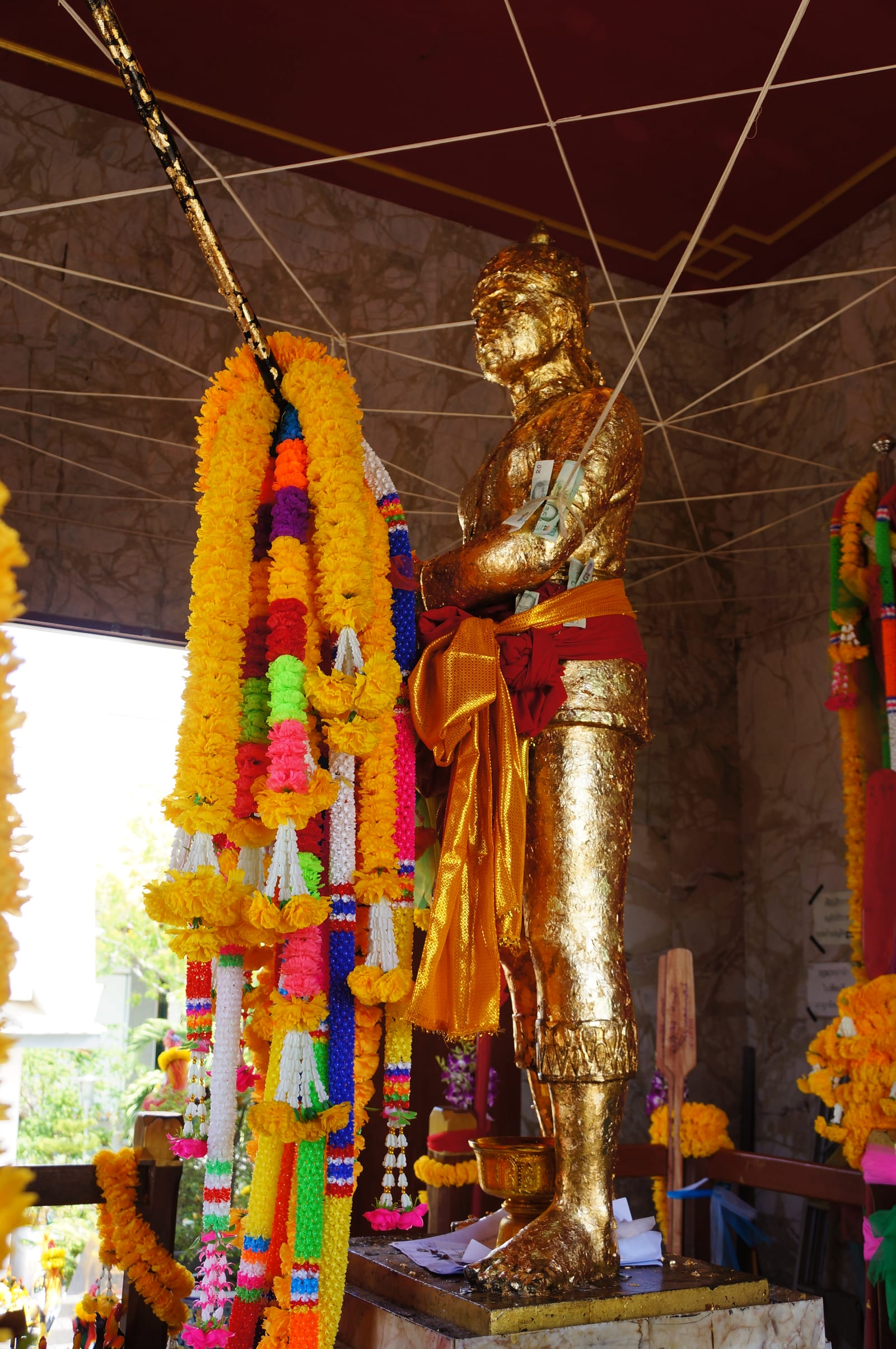
Phan Thai Norasing Shrine — also known as Phan Thai Norasing Historical Park — is a riverside shrine on Khok Kham Canal built to honour "Phan Thai Norasing," the royal helmsman who accepted execution rather than break the law. That legend of integrity has made this one of Samut Sakhon's most popular merit-making destinations, drawing people who come to pray for career advancement, stability, and protection, as well as families who want to show children the real site behind the history-textbook story.
The centrepiece is a life-size bronze statue of Phan Thai Norasing at the ship's helm. Visitors press gold leaf onto his shoulders and upper arms, believing it helps with the burden of heavy workloads. Around the shrine stand rows of golden and silver fighting-cock figurines, because legend holds that Phan Thai Norasing loved cockfighting — those who make a wish and see it fulfilled bring fighting cocks as offerings. Another crowd favourite is the massive ancient teak dugout canoe, nearly 20 metres long, displayed in the centre of the courtyard as one of the shrine's oldest artefacts.
The grounds are shady and well-kept, with spacious parking. Worshippers come throughout the day. Entry and veneration are free; you only pay for flowers, incense, gold leaf, or votive offerings as you see fit. On weekends and public holidays, the Phan Thai Norasing Canal Market opens right next to the shrine — a good spot to graze on Thai sweets, local food, and souvenirs after paying respects.
The shrine is located in Phan Thai Norasing sub-district, Mueang Samut Sakhon, on the Khok Kham Canal side, accessible via Rama II Road — roughly one hour from Bangkok. It's open daily around 08:00–18:00 (Sat–Sun often later). Note: if you want to browse the market, come on a weekend — most stalls are closed on weekdays. During the annual spirit-procession festival the grounds get very busy. Smart, modest dress is most appropriate for entering the shrine.
Red Bridge Dolphin Viewpoint
The Red Bridge Dolphin Viewpoint is a bright red-railed wooden walkway stretching roughly 700 metres out into the sea at Phan Thai Norasing sub-district, Mueang Samut Sakhon — one of the closest stretches of the Gulf of Thailand to Bangkok. It's perfect for anyone who wants to escape the city and breathe sea air on a same-day round trip without a long drive. Both sides of the bridge are lined with green mangroves and bamboo breakwaters. Walk to the far end and you're met with an unobstructed panorama of the Gulf. Reviewers consistently say the atmosphere is open, fresh, breezy, and easy to photograph from every angle — the red railings against the sky look good no matter where you point a camera.
The real draw right now is the flock of thousands of seagulls that arrives from around November to March. Vendors sell bird food to throw, and the birds swarm around you close enough for striking shots — multiple reviews note that "the real thing is even better than the photos." The name 'Dolphin Viewpoint' dates from earlier years when Gulf dolphin pods would come close to the bay during the cool-season winds of November–January. Honestly though, dolphin sightings are now rare — come for the birds, the view, and the sunset, and you won't be disappointed.
Best time to visit is from around 4 p.m. onward: the light softens, the breeze picks up, and you can stay for the Gulf sunset. Open daily 06:00–21:00; free entry. Car parking is around 20 THB; motorcycles park free near the Matjanu spirit shrine. Note: the bridge is wooden and fairly narrow — on weekends you'll be passing people in both directions, and some sections can be slippery. Wear comfortable walking shoes, bring a hat, and pack water — there's no shade on the bridge itself.
This spot is popular because it's close to Bangkok, free to enter, and delivers sea, birds, and a sunset in one place. It's the go-to photo stop for Samut Sakhon locals and Bangkok visitors wanting ocean scenery close to home. Rating aggregators score it around 4 out of 5, praising the views and atmosphere with minor notes about weekend crowds and the reduced chance of dolphin sightings today.
Talaad Thalae Thai
If you love seafood and want the freshest catch at the lowest price, Talaad Thalae Thai on Rama II Road around km 30, near Tha Chin Bridge, is the destination to mark on your map. This is the country's largest wholesale seafood trading hub — shrimp, clams, crab, fish, and squid arriving by the crate from boats and farms, many still wriggling in water tanks. It suits people who want to buy for home cooking, restaurant owners sourcing stock, and travellers who simply want to experience a real working seafood market. The drive from Bangkok is around 45 minutes.
What reviewers consistently mention is "fresh produce, cheaper than in the city." Shrimp and fish are praised for quality, bulk discounts are available, and vendors are friendly. A standout trick: buy fresh seafood from the market stalls, then carry it to the restaurant row out front and pay by the kilo to have it cooked to order — grilled, stir-fried, tom yum, or steamed with lime and garlic. Beyond fresh produce, there's a dried and processed seafood zone with dried shrimp, dried squid, chilli pastes, souvenirs, and wholesale-priced fresh fruit like watermelon, coconut, banana, and dragon fruit — a complete haul in one stop.
The atmosphere is a real wholesale market: wet floors, crowds, delivery trucks weaving through. The liveliest action runs midnight through dawn — shrimp trading around 00:00–06:00, fish around 04:00, squid around 07:00. For the best selection and freshest product, come early. No entry fee; your spend depends entirely on what you buy. Buying fresh seafood to cook at home is exceptional value compared with supermarkets. Google ratings sit around 4.3 stars, reflecting that most visitors leave happy.
A few tips: wear shoes that can get wet — floors are slippery. Bring cash and a cooler bag or ice pack if you're transporting fresh seafood any distance. Bargain politely and compare a few stalls before committing. The smell of a real seafood market takes a moment to adjust to, but most people who do say the freshness and value make them come back.
Mahachai Market
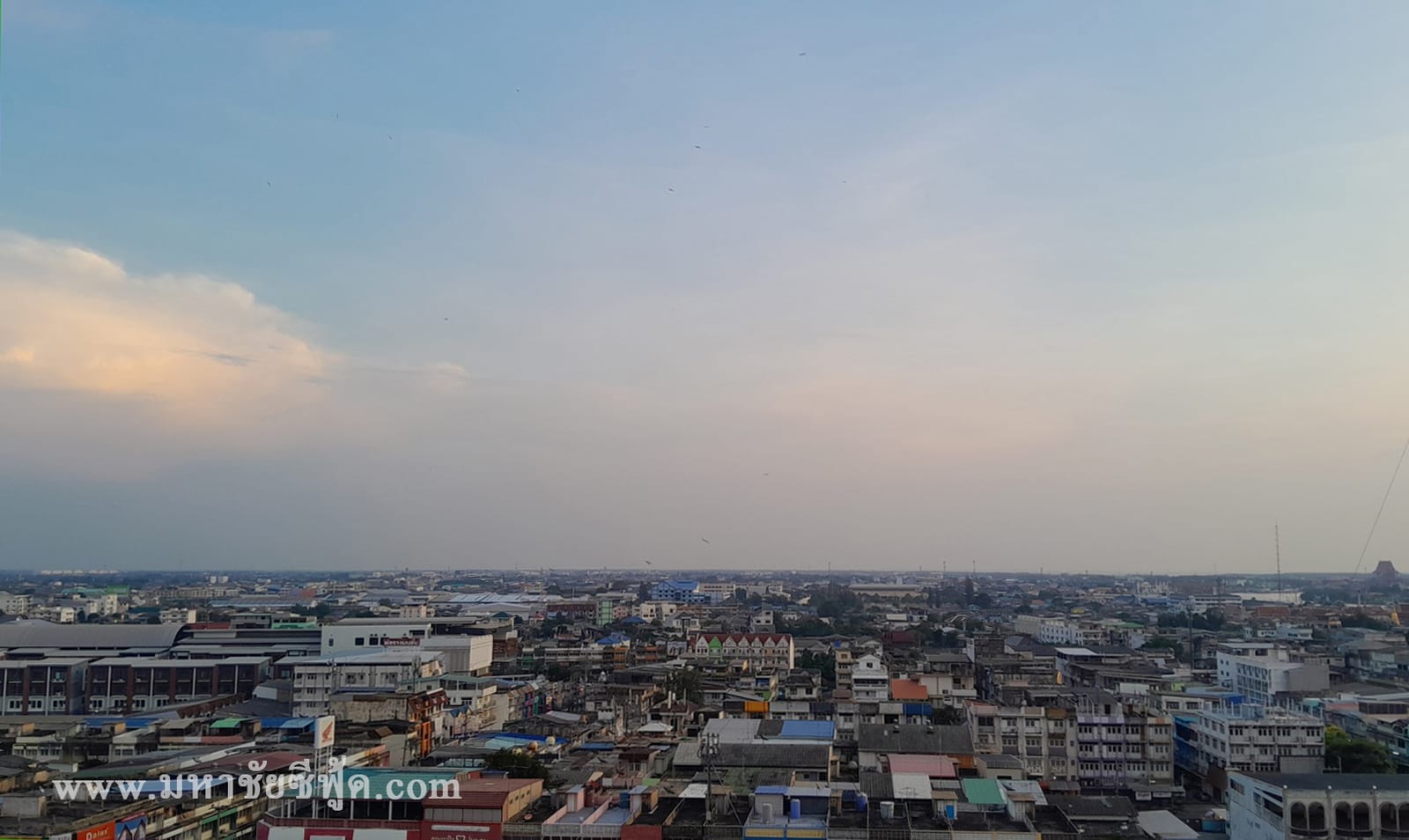
Mahachai Market is an old estuary market on the Tha Chin River that many rate as the closest top-tier fresh seafood market to Bangkok. Walk just a few steps from Mahachai railway station and you're there. The setting is pure fishing town — old shophouses, train whistles, the sharp smell of the sea. Anyone who wants to buy fresh shrimp, clams, crab, or fish at good prices, or simply wants to observe an unpolished way of life by the water, will find this place exactly right — whether you're a home cook after straight-from-the-boat ingredients or a traveller after old-market photographs.
The highlight is fresh seafood that begins arriving off the boats from around 3–4 a.m. Dawn until mid-morning is when selection is at its widest and freshest: shrimp, clams, crab, fish, and squid. For dried goods — dried shrimp, dried squid, salted fish, and processed seafood — there's plenty to pick as souvenirs. A tip that multiple reviewers agree on: shops along the street frontage tend to price higher; walk through to the rear shophouse lanes and you'll find dried goods that are cheaper and fresher — sometimes by hundreds of baht. Compare a few stalls before deciding.
Entry is free; you pay only for what you buy. The market is in Mahachai sub-district, Mueang Samut Sakhon, adjacent to Mahachai railway station and the ferry pier across to Tha Chalom, close to the City Pillar Shrine. Open daily around 05:00–18:00, but if fresh seafood is the goal, come early — the best goes fast. The easiest way here is the Wongwian Yai–Mahachai train line from Bangkok; step off and you're at the market entrance instantly, with the bonus of a proper train-ride feel built into the trip.
The market endures because it's a real, living fishing market at reasonable prices, within easy reach of the capital. Most reviews praise the freshness, the friendly vendors, and the pleasure of browsing even in the heat. Practical notes: midday sun is strong and some sections have wet, slippery floors — wear practical shoes, bring cash, and pack a cooler bag if you're transporting fresh produce home.
Samut Sakhon City Pillar Shrine and Fort Wichian Chodet
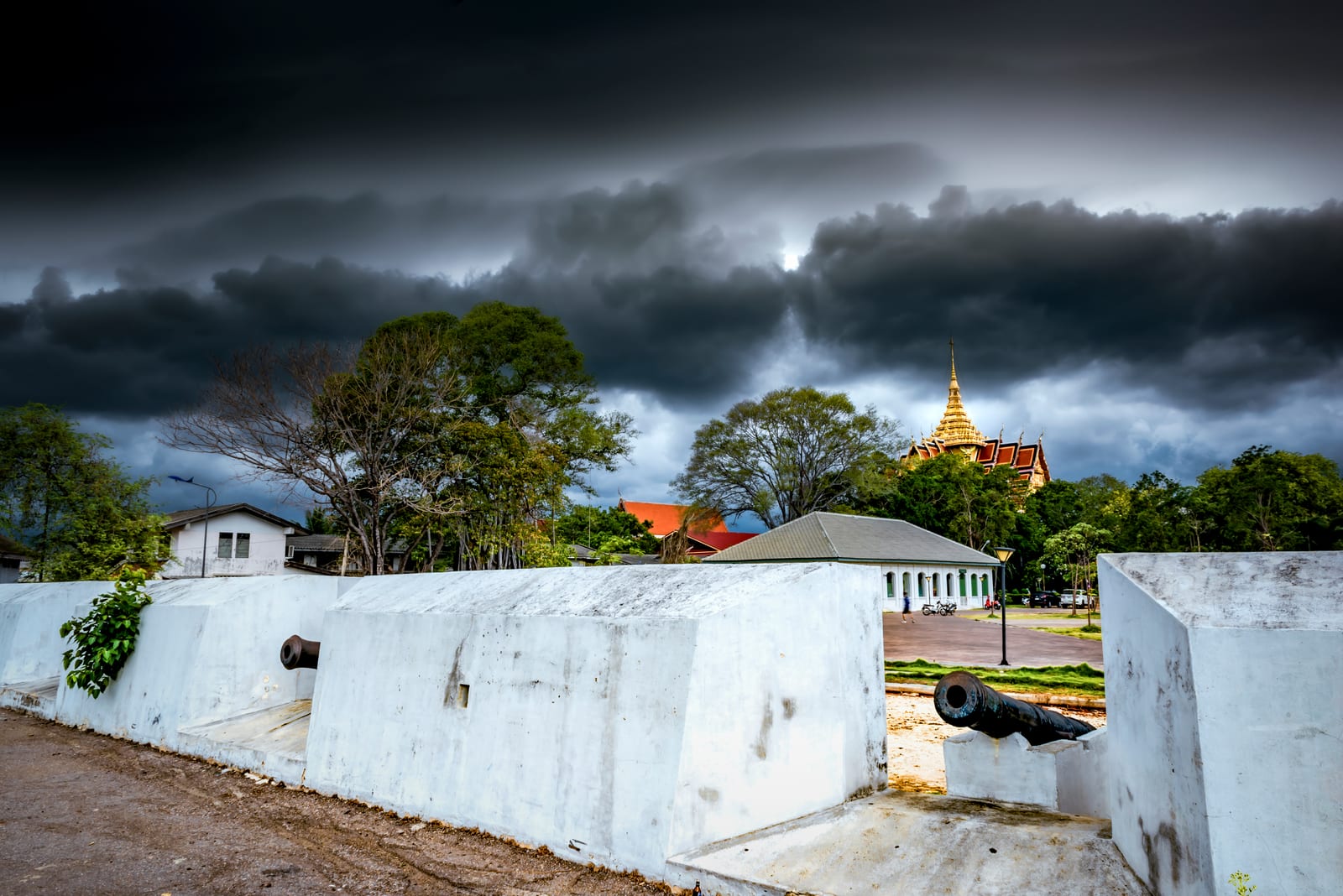
If you've reached Mahachai and want one place that combines the sacred and the historical, this delivers both. The Samut Sakhon City Pillar Shrine sits within the grounds of Fort Wichian Chodet on the Tha Chin River in the centre of town. It suits people who want to pay respects before starting a trip, devotees who enjoy visiting sacred sites, and history walkers who like old structures. The centrepiece is the Wichian Chot spirit figure — a deity carved entirely from a Bodhi tree, right hand raised in blessing, left holding a sword, standing on a palanquin flanked by two attendant figures, about one metre tall. Samut Sakhon residents have revered this figure for generations.
Don't miss the four-sided city pillar and Fort Wichian Chodet itself — a cannon fort built during the reign of Rama III around 1828 to guard the mouth of the Tha Chin River. Walk the old brick walls and see antique cannon still positioned at their embrasures, some bearing British crown insignia and inscriptions to examine up close. The surrounding area is a riverside public park with a cool breeze, pleasant for a stroll and photographs. Reviews generally praise it as clean, shady, and easy to park along the road.
Both shrine and fort are free to enter with no admission fee, accessible from morning to evening. The location is central Mahachai — easy to reach, close to the markets and the ferry to Tha Chalom. The detail that generates the most conversation is the city-spirit water procession, which sees the deity carried across the Tha Chin River by boat — the only procession of this type in Thailand. Running continuously since 1965, it usually falls in early June and brings Chinese opera, lion and dragon dances, fireworks, and food stalls that fill the park and bring the whole town alive.
Practical note: during the festival the site fills quickly and roadside parking goes fast — if you want to explore the fort at your own pace, a weekday morning is quieter. Dress modestly as a sacred site. And when you have the Tha Chin River and passing fishing boats in view, pause for a moment — it captures Samut Sakhon's riverside character perfectly.
🛏️ Recommended Stays in Samut Sakhon
Samut Sakhon is close enough to Bangkok for a day trip, but if you'd rather go at a relaxed pace or use it as a base for exploring the Rama II corridor and neighbouring provinces, one night is well worth it. We've rounded up well-located stays in the Mahachai area and along Rama II — easy to reach, easy to book in one place.
🔍 Check Samut Sakhon hotel prices (Agoda)Wat Krok Krak (Luang Pho Pu in Black Sunglasses)

Wat Krok Krak is a nearly 200-year-old temple on the Tha Chin River in Krok Krak sub-district, Mueang Samut Sakhon. What made it famous nationwide is "Luang Pho Pu" — the principal Buddha in the ordination hall, a Chiang Saen-era laterite image in the Subduing Mara posture that "wears black sunglasses," believed to be the only such image in Thailand. It's a destination for those who enjoy offbeat sacred places and unusual sights, as well as families looking for a merit-making stop near Bangkok — roughly 50 kilometres from the capital, under an hour's drive.
The sunglasses have a story. Long ago an eye infection swept through the village and nothing cured it, so locals vowed to the Buddha that if everyone recovered they would gild his eyes. When the epidemic cleared the whole village showed up to keep the vow, but gilding the eyes made the image look strange. The abbot at the time resolved the problem by placing black sunglasses on the statue instead. Since then, devotees who pray for eye health or fulfil a vow bring sunglasses as offerings rather than gold leaf. Fortune-seekers also come to pray for business success and good luck.
A second highlight worth pausing at is the teak ordination hall built in the shape of a Chinese junk, with a gracefully curved Thai-Chinese roofline along the river. The whole compound is shaded and cooled by breezes off the Tha Chin River. Reviews note the temple is modest in scale — a full loop takes only a short time — but the payoff is a photograph with an unusual Buddha and the chance to pick up inexpensive local snacks from roadside vendors on the way out. Free entry, open daily around 06:00–17:00.
Practical notes: the temple is on a riverside lane — GPS navigation makes it much easier to find. The annual fair in early January brings large crowds and a market; come on a weekday if you prefer quiet. Dress modestly for the temple. If you're bringing sunglasses as a votive offering, feel free to bring them along.
Tha Chalom Old Quarter
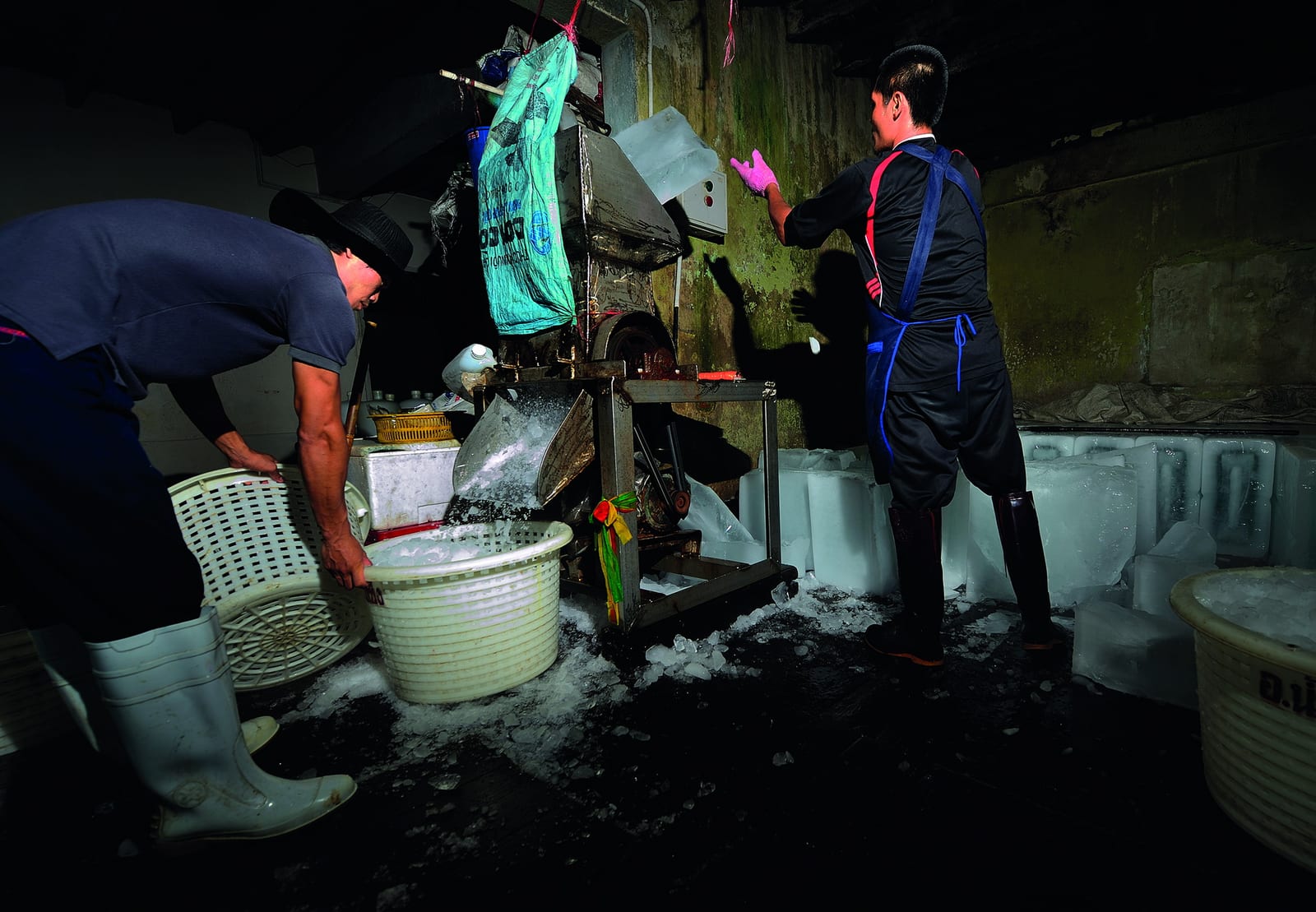
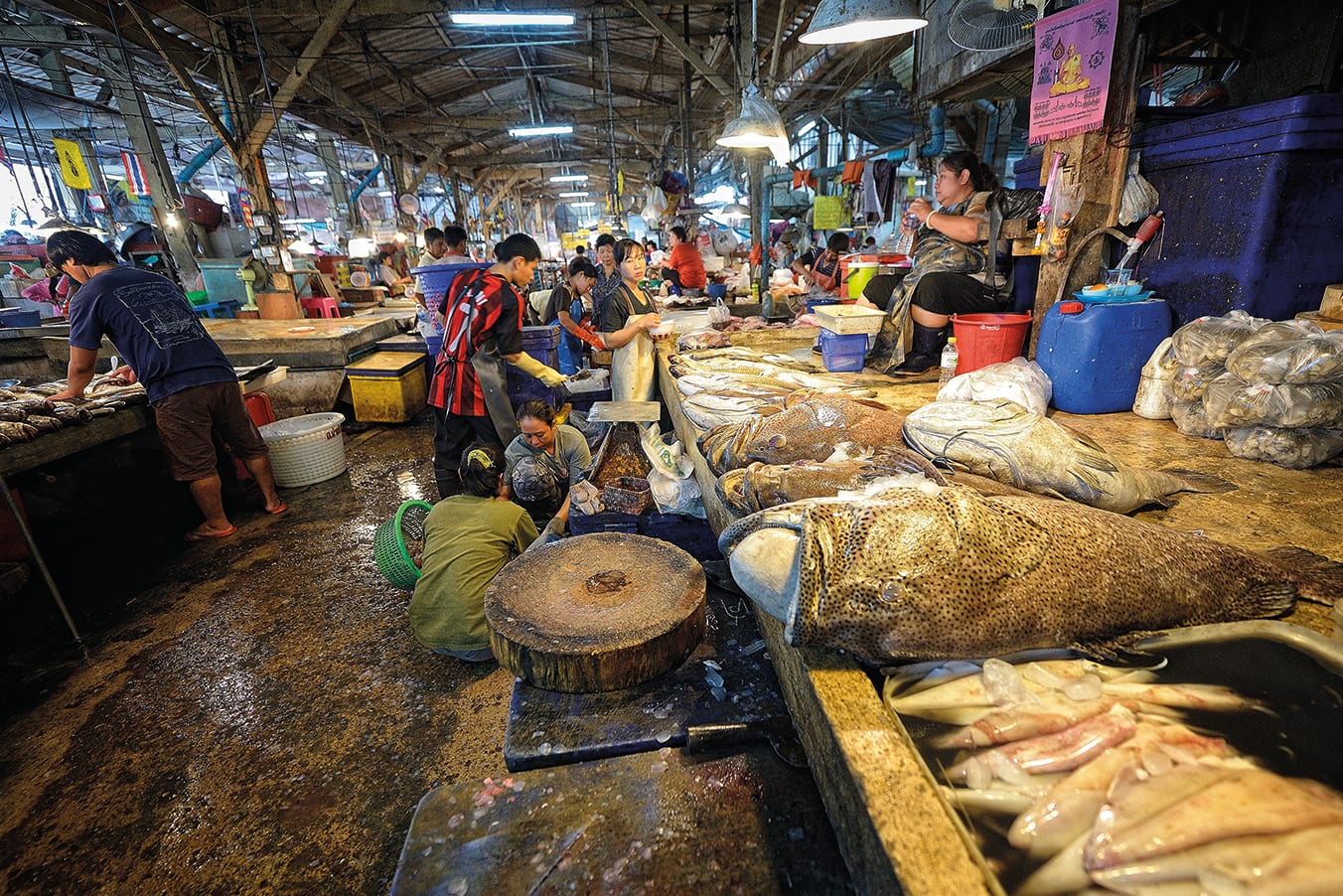
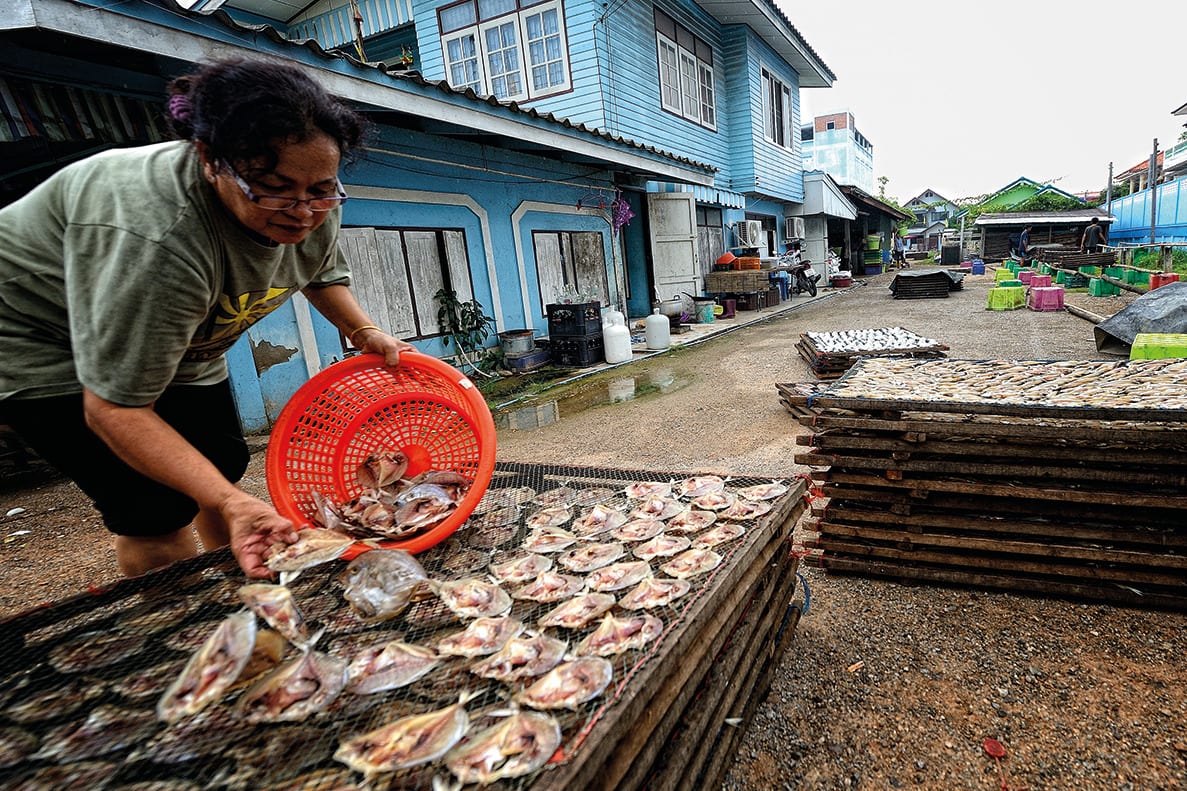
Tha Chalom is a historic community on the Tha Chin River, directly across from downtown Mahachai — a short ferry ride of just a few minutes. It was Thailand's first municipal sanitation district, established during the reign of Rama V, and retains the feel of old wooden shophouses, a century-old market, and a Thai-Chinese fishing community that hasn't been overly tidied up for tourists. It's a good destination for anyone who wants a slow, walking day — photographing, temple visits, and absorbing the atmosphere of a waterfront neighbourhood that moves at its own pace. Reviews consistently say the community is clean, comfortable to walk, and that the local residents are welcoming.
The unmissable highlights are the street murals on building walls and manhole-cover art along Thawai Road, painted by artists and community members to depict fishing boats, the railway station, dragons, and everyday life in old Tha Chalom. Another thing many visitors enjoy is a trishaw (samlor) ride around town — the driver takes you past the street art, the temple, and shrines, and the going rate is around 100 THB per round (some quote 200; always agree first). End the loop at Wat Suthiwat Wararam, also known as Wat Chong Lom — a nearly 200-year-old royal temple at the river mouth, with a Rama V statue at the entrance, a steady river breeze, and lovely water views for sitting and resting.
Budget-wise this is very easy: walking the community and photographing is free, and you only pay for the trishaw or bicycle rental if you want to try it. The Ban Tha Chalom Tourism and Community Activities Centre is open Sat–Sun around 09:00–17:30, offering bicycle rentals, souvenirs, and a map of photo spots before you set off. The community itself is walkable any day, but if you want the full range of services and more open shops, weekends are the better call.
Tha Chalom has grown steadily in popularity because it combines old-town character, art, temple, and river views in one compact area, and it's a short train or drive from Bangkok. Practical notes: shops and trishaw service are liveliest on weekends and some close on weekdays. Wear comfortable walking shoes, bring cash for the trishaw and small shops, and aim for morning to early afternoon for the best light and cooler temperatures.
Wat Yai Chom Prasat

Wat Yai Chom Prasat is an old temple on the Tha Chin River in Tha Chin sub-district, Mueang Samut Sakhon, about 4 kilometres from the town centre. It is believed to date from the Ayutthaya period — the reign of King Maha Chakrapat — making it over 400 years old. Rama V later conferred the name "Wat Yai Sakon Buri" and donated 39 volumes of the Tripitaka, elevating it to royal-temple status. Anyone who appreciates ancient temples, traditional craftsmanship, and riverside history should put this on their list for Samut Sakhon.
The detail that gets talked about most is the carved wooden doors of the ordination hall. The carving cuts four layers deep into the wood, creating a three-dimensional effect of botanical vines, trees, mountains, animals, and figures — with clear Chinese artistic influence, fitting for the "Tha Chin" (Chinese Landing) district name, which recalls the Chinese trading communities of the past. The Fine Arts Department registered these doors as national artistic treasures in 1962. Beyond the doors, the complex includes an old ordination hall, a late-Ayutthaya-style viharn, wall murals, and a row of smaller stupas.
The temple grounds are quiet and shaded by the river. Reviewers agree there's no entry fee, parking is adequate, and a full circuit — photographs, prayers, and quiet appreciation — takes well under an hour. Open daily roughly 08:00–17:00; morning or late afternoon is nicest when the sun isn't directly overhead.
One thing worth knowing: this is a genuine historic temple, not a visitor-infrastructure-heavy attraction. Some sections of the ancient structures show their age. Come with an appreciation for old craftsmanship and you'll get more from it. Dress modestly to enter the ordination hall, and when you're at the carved doors, look carefully at the depth of each layer — the quality of work is rare in any temple.
Khok Kham Salt Farm Village

Samut Sakhon produces more sea salt than any other province in Thailand, and Khok Kham is one of the communities where salt farming has been practiced seriously for generations. The Tourism Authority of Thailand promotes it as a tourism village because, beyond the vast open salt flats, there's a community learning centre (locals call it the salt-farm school) where you can watch traditional sea-salt production from start to finish — drawing seawater into the pans, leaving it to evaporate under sun and wind, until it crystallises into salt. People who have been say the appeal lies in the quiet and the slow pace of mudflat life — this is not a loud, busy attraction.
Every review mentions the white salt mounds stacked into pyramids against the sky. The best light for photographs is late afternoon when the sun goes golden and the water trapped in the pans reflects the sky like a mirror. Come at dawn and you might catch salt farmers harvesting "fleur de sel" — the thinnest crystals floating on the water's surface, a premium grade of salt. Birdwatchers find this place especially rewarding: migratory shorebirds stop over in the salt pans during the cooler months of late year to early year, including the critically endangered Spoon-billed Sandpiper making a detour from Siberia.
The salt-farming season runs during the dry months, roughly November to May — this is when you'll find the mounds and see real work in progress. In the rainy season the pans rest and the scenery is less dramatic. Ideal visiting times are late afternoon for golden-hour light, or dawn for birdwatching and fleur de sel collection. From downtown Mahachai it's close: take Rama II Road then turn off toward Khok Kham, about 15–20 minutes by car (roughly 36 kilometres from Bangkok). The salt fields are community land — walking and photographing is free. Workshops for salt-spa products or group activities require prior contact with the community.
Tips from people who have been: wear shoes you don't mind getting dirty and be prepared for full sun exposure — the salt fields have no shade. Bring a hat and water. Do not walk into the active salt pans as they are the community's livelihood. If you're coming as a group, there's a salt-field café in the Khok Kham area with a swing seat facing the pans — a good spot for another type of photo. Then continue to Phan Thai Norasing Shrine and Khok Kham Canal nearby and you have an easy half-day loop close to Bangkok.
Samut Sakhon Mangrove Research Center (Mahachai Bay / Bang Ya Phraek)
If you're in Samut Sakhon and want somewhere that lets you breathe — not a mall, not a market — try the Marine and Coastal Resources Research Centre No. 2 (Mahachai Bay) in Bang Ya Phraek sub-district. This is a substantial mangrove forest at the mouth of the Tha Chin River on its western bank. The highlight is an elevated nature-study boardwalk running about 1.5 kilometres through the mangrove canopy. It's a comfortable walk for families with children, couples after a quiet stroll, or photographers and birdwatchers in search of shots — all within easy reach of Bangkok without a long drive.
Don't miss the elevated walkway through the forest and the raised red suspension bridge that has become the most-photographed spot on site. Looking down from the walkway into the mud you'll see mudskippers skipping and fiddler crabs scurrying. Visitors from abroad have reported kingfishers, herons, sunbirds, and bulbuls around the centre building. In winter the forest receives migratory birds in greater numbers — birdwatchers should bring binoculars.
Free entry. Open Mon–Fri approximately 09:00–16:00, closed on public holidays. This is a government facility under the Department of Marine and Coastal Resources. Groups or anyone wanting a guided walk should contact the centre's Facebook page in advance. The atmosphere is shaded and breezy from the bay, though midday can be warm in open sections along the water.
Before you go: the location is somewhat off the beaten track and public transport connections are limited — driving or hiring a car is the most practical approach. Check the opening schedule carefully as the centre is closed on weekends and public holidays. Bring a hat, sunscreen, and your own water as on-site amenities are limited. If you like quiet and enjoy watching a real estuary ecosystem up close, this spot rewards the effort.
🎫 Tickets & Tours in Samut Sakhon
Samut Sakhon's highlights are spread across Mahachai, Phan Thai Norasing, and Tha Chalom. If you want to cover several spots in one day without doing the planning yourself, booking a guided tour or reserving tickets in advance through Klook or GetYourGuide means no queuing and a guide who knows every highlight.
💡 Before You Go to Samut Sakhon
From Bangkok, drive or take a minibus / the Wongwian Yai–Mahachai train — about one hour. Grab is available but coverage is thinner than in major cities. Within Mahachai town, motorbike taxis and the ferry across to Tha Chalom do the job. Renting a car is the best option if you plan to cover multiple spots in one day, since the attractions are spread across several sub-districts.
Vendors at Talaad Thalae Thai, Mahachai Market, Tha Chalom shops, the Khok Kham salt fields, and trishaw rides mostly take cash. Some accept PromptPay QR but not every stall. Keep small bills on hand for easier payments.
Talaad Thalae Thai and Mahachai Market are freshest from before dawn until mid-morning. The Red Bridge is at its best in the evening at sunset. If you want a chance at spotting dolphins, come between November and January. Weekdays are quieter and easier to photograph than weekends.
Phan Thai Norasing Shrine, the City Pillar Shrine, Wat Krok Krak, and Wat Yai Chom Prasat are places of worship. Cover shoulders and knees, remove shoes when entering buildings, and keep noise low when others are praying or making offerings.
Most vendors speak Thai; basic English works at the main tourist spots. English signage appears at larger shops. A translation app or picture-pointing covers the rest. Mahachai locals are friendly and generally happy to help visitors.
Talaad Thalae Thai and Mahachai Market sell fresh seafood at source prices. Walk around and compare stalls before buying. If you're bringing fresh produce home, pack a cooler bag or foam box with ice — many vendors offer ice-packing as a service for longer journeys.
Plan a Full-Value Day Trip in Samut Sakhon
The classic itinerary starts early at Talaad Thalae Thai or Mahachai Market to catch the fresh seafood and pick up dried goods and souvenirs while selection is widest. Then move into Mahachai town to pay respects at the City Pillar Shrine and walk the walls of Fort Wichian Chodet by the river, before heading to Wat Krok Krak to pray before the sunglasses-wearing Luang Pho Pu.
In the afternoon cross the river to Tha Chalom, ride a trishaw through the street-art lanes and old market, then visit Wat Yai Chom Prasat for the four-layer carved wooden doors. Close the day in the Phan Thai Norasing area — pay respects at the shrine and browse the adjacent canal market before walking out to the Red Bridge for the Gulf sunset. If you're there between November and January, there's always a chance of spotting a dolphin pod.
Whether you're staying overnight in Samut Sakhon or using it as a base for the Rama II corridor and surrounding areas, we've pulled together well-located stays in the Mahachai area and along Rama II — easy to get to and simple to book in one place.
See recommended stays in Samut Sakhon