🔄 Updated 21 Jun 2026
If you've come to Kamphaeng Phet to see the old city, Wat Phra Kaew is the starting point almost everyone picks, because it sits right inside the walled city area, next to Wat Phra That and the grounds that were once the palace. Its layout is similar to Wat Phra Si Sanphet in Ayutthaya and Wat Mahathat in the centre of Sukhothai — a royal temple inside the palace precinct with no resident monks, used for royal ceremonies. A few steps from the car park and you can already take in the whole temple at a glance.
Why Wat Phra Kaew is the big temple at the city's centre
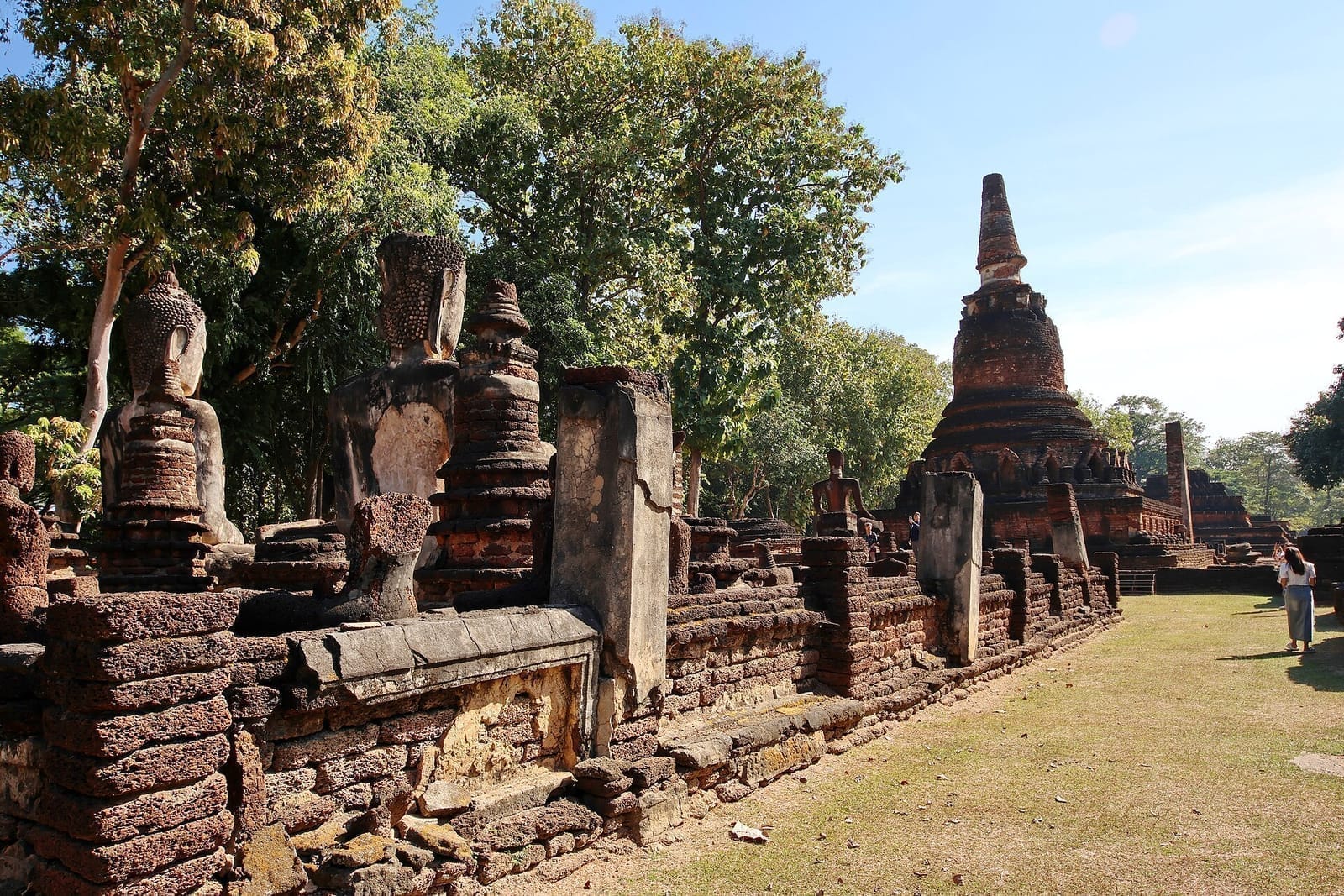
After the Fine Arts Department excavated the site, they found a single temple holding 35 stupa bases of various styles, 8 viharns large and small, and 3 ordination hall bases. A site this big, with this many structures, tells you straight away that this was a royal temple of real importance to the city. The temple plan is a rectangle laid out parallel to the city wall, and the temple's own wall is built from whole rounded laterite blocks about a metre high — laterite being the main material Kamphaeng Phet's builders used for nearly everything.
Laterite is what gives this city its particular character, unlike Sukhothai which leans on brick. When the afternoon sun hits the porous, orange-brown stone, the colour warms up a lot. Plenty of people say Wat Phra Kaew photographs best in the early morning and late afternoon, because the low-angle light gives the laterite surface some depth.
Want more out of Kamphaeng Phet? Book tours & activities
Booking online ahead on Klook or GetYourGuide is usually cheaper than the gate and skips the queue. Pick only the experiences you actually want — prices and availability are shown live on each site.
Three things you have to see at the temple
The main Lanka-style stupa
A large round Lanka-style stupa stands as the centrepiece of the temple. Lions and elephants once decorated the base, and it's the first thing that catches your eye as you walk in.
The row of laterite Buddha images
The laterite cores of the principal Buddha and other images sit in a long row. Some still show a hint of the face, others are down to just the base — seeing them lined up makes the scale of the temple click.
The cluster of stupa bases around it
Thirty-five stupa bases in different shapes are scattered across the courtyard. You can walk around comparing how the base of each style differs — good for anyone who likes the details.
Entry fees, opening hours, and what to know
- Opening hours — The old city area inside the walls is open daily, roughly 08:00–17:00. The historical park's service desks run on government office hours. Come from morning to late afternoon for good light without too much heat.
- Entry fee — Wat Phra Kaew charges separately from the other zones: around 10 THB for Thais and 30 THB for foreigners. A combined park ticket runs about 20 THB for Thais and 100 THB for foreigners (prices may change — double-check at the ticket booth).
- Free entry — Seniors aged 60 and over, and students in uniform, get in free.
- Dress — This is a historic site with no resident monks, but dress reasonably modestly. Wear comfortable shoes, since the ground is stone courtyard and sand.
- No climbing — You can't climb onto the stupa bases or the Buddha images. Shots from ground level already come out great.
A note on light and heat
The temple courtyard is wide open with little shade, and the midday sun is fierce. In the hot season, come before 10am or from about 3pm onward. Bring water and a hat or umbrella. Late afternoon near closing time gives the best light for photographing the laterite.
Start at Wat Phra Kaew, then how to walk the rest of the city
The nice thing about Kamphaeng Phet is that the temples inside the city walls are very close together. Start at Wat Phra Kaew and you can keep walking without getting back in the car. Here's a single-morning route to try.
Walking the old city, starting from Wat Phra Kaew
Rent a bike or walk
Inside the city walls you can comfortably walk. But if you want to continue to the Aranyik temple group outside the city, a bike is far more convenient. There are rental spots near the park, and if you drove in you can just park and explore zone by zone on foot.
Who it's good for
- History lovers — You get to see a royal-temple plan from the Sukhothai to early Ayutthaya period, and laterite craftsmanship you don't often come across.
- Photographers — The rows of laterite Buddhas and stupas in morning and evening light give you that quiet old-city mood, far less crowded than Sukhothai.
- Families and seniors — The ground is fairly flat and easy to walk, seniors enter free, and it's a good spot for a morning stroll.
- Travellers passing through — Kamphaeng Phet sits midway between Sukhothai and Nakhon Sawan, so an hour or two walking around Wat Phra Kaew is well worth the stop.
Want to see all of Kamphaeng Phet — temples, old city, and food
See the Kamphaeng Phet travel guide →