🔄 Updated 21 Jun 2026
Before we get to the schedule, here's the big picture on why a cross-province Sisaket–Surin plan makes sense. The key is that these two provinces border each other along Highway 226 and share the same northeastern rail line. Driving from downtown Sisaket to downtown Surin takes about 1–1.5 hours, and scattered along the way and around both towns are thousand-year-old Khmer temples. Plan the route well and you can hit the standout temples of both provinces in one trip without doubling back.
Let me be upfront: the plan in this article only includes temples that sit well inland and are open to visitors as usual. Surin's Ta Muen temple group, which sits right on the Thai–Cambodian border, is currently closed because of the border situation, so we've left it off the route and explain the details at the end of the article — including Pha Mo I Daeng and Khao Phra Wihan over on the Sisaket side.
Route overview: which temple is in which province
The idea behind this plan is to finish off the Sisaket-side temples first, since they cluster around Uthumphon Phisai and Huai Thap Than — right on the way toward Surin — and then keep driving across into Surin for the next set of standouts. Here are the main temples worth catching on this plan.
- Sa Kamphaeng Yai (Sisaket · Uthumphon Phisai district) — the largest and most complete Khmer temple in Sisaket, about 26 km from the city, with three prangs, several lintels, and a temple museum. It's the highlight on the Sisaket side. Free entry.
- Ban Prasat (Sisaket · Huai Thap Than district) — three brick prangs in the middle of a village inside Wat Prasat Phanaram, quiet and peaceful, sitting along the way before you cross into Surin. Free entry.
- Sikhoraphum (Surin · Sikhoraphum district) — five brick towers on a single platform, known for the apsara and dvarapala carvings around the doorframe. It's the highlight on the Surin side. Open 7am–6pm, entry 10 THB for Thais.
- Ban Phluang (Surin · Prasat district) — a single small white-sandstone sanctuary, but the carvings on its pediment and lintel are finely detailed and beautiful. Open 7am–6pm.
Sequence it so the drive flows without backtracking
If you're driving your own car, work from east to west: start with the Sisaket-side temples (Sa Kamphaeng Yai, then Ban Prasat), which lie along the way, then keep driving into Surin's Sikhoraphum district, which comes next on Highway 226. From there, head south to Ban Phluang in Prasat district. This route runs one direction the whole way — no doubling back.
Book the activities in your Sisaket trip ahead
Booking online ahead on Klook or GetYourGuide is usually cheaper than the gate and skips the queue. Pick only the experiences you actually want — prices and availability are shown live on each site.
If you only have 1 day: catch the highlight of each province
If you've only got a single day but want both provinces, this plan focuses on one highlight temple per side — Sa Kamphaeng Yai in Sisaket and Sikhoraphum in Surin — then slots in a smaller temple along the way if there's time. Leaving a little earlier in the morning makes it most comfortable.
Sa Kamphaeng Yai, then over to Sikhoraphum
One day is a bit packed
The one-day plan does cover everything, but you'll drive a lot and have little time to spare. If you can swing it, stretch it to 2 days, 1 night for a much more relaxed trip — you get to stay a night in Surin and don't have to rush the drive back in the evening.
2 days, 1 night: stay one night in Surin
This is our favorite version. Day one, take your time with the Sisaket-side temples, then drive over to sleep in Surin. Day two, catch the Surin temples and the local food of the elephant town before heading back. You get it all — temples, food, and a stay in each city.
Sisaket-side temples, then over to Surin
Ban Phluang + food of the elephant town
3 days, 2 nights: go deep on both provinces
If you're set on a full temple-hunting trip, three days is just right. Day one, do the Sisaket temples plus a temple in town. Day two, cross to Surin for Sikhoraphum, Ban Phluang, and the elephant town. Day three, catch the secondary temples and the souvenirs of both provinces before heading home.
Sisaket temples + temple in town
Cross to Surin: Sikhoraphum, Ban Phluang
Secondary temples + souvenirs before heading home
Which temple is most worth it if you have to cut some
If you don't have time to hit them all, here's how we'd rank them for value, looking at the temples of both provinces together. Use it to decide what to cut.
Sikhoraphum (Surin)
Five brick towers on a single platform, known for the apsara and dvarapala carvings around the entrance doorframe. It's the prettiest and most photogenic temple on the route. If you can only pick one on the Surin side, pick this.
Sa Kamphaeng Yai (Sisaket)
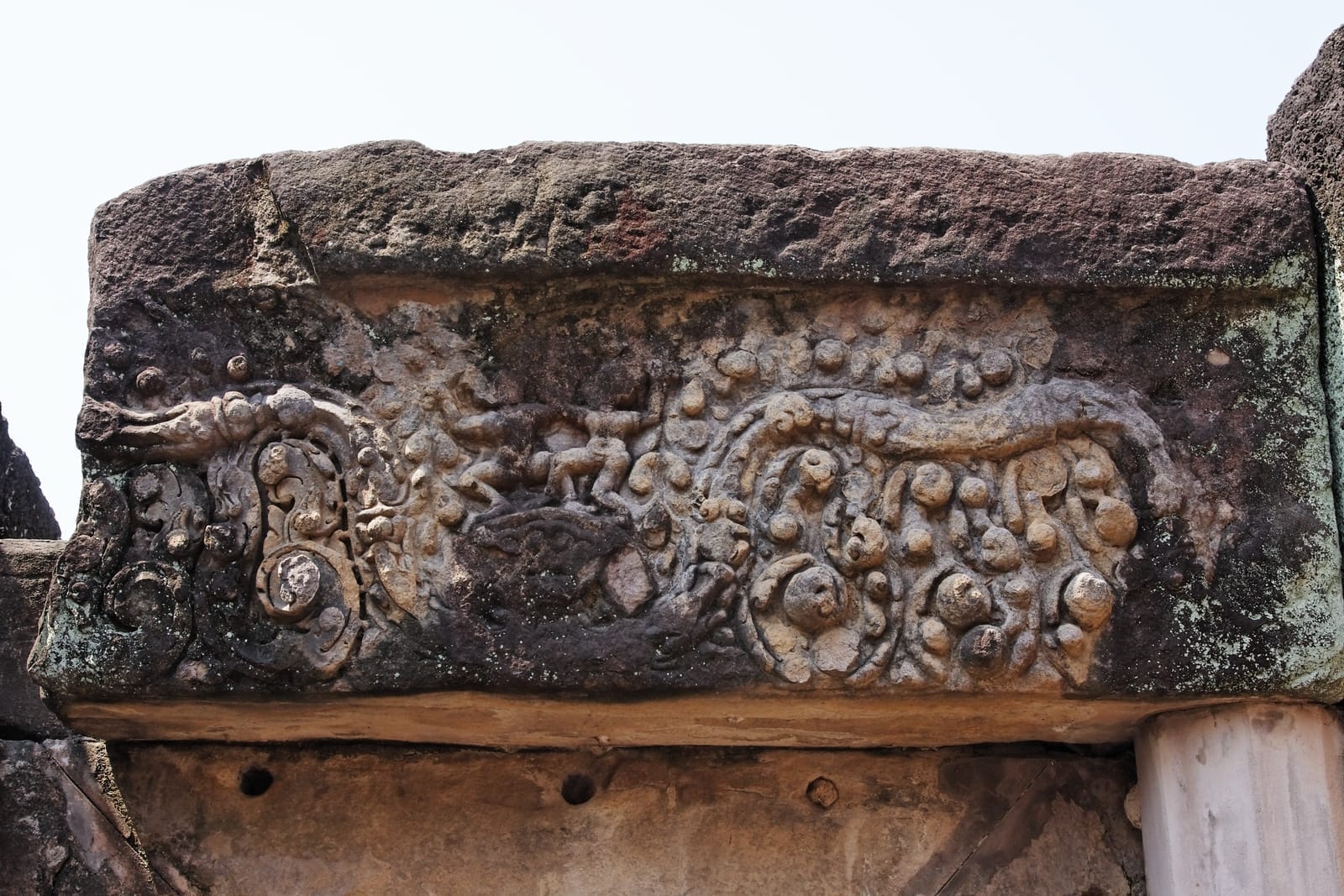
The largest and most complete in Sisaket, with three prangs and several lintels — including Indra on his elephant and Vishnu reclining on the cosmic serpent — plus a temple museum showing excavated finds. If you can only pick one on the Sisaket side, pick this.
Ban Phluang (Surin)
A single small white-sandstone sanctuary, but the pediment and lintel carvings are finely detailed and very beautiful — great for anyone who likes studying the craftsmanship up close. It's south of Surin city.
Ban Prasat (Sisaket)
Three brick prangs in the middle of a village inside a temple, quiet, with few crowds — you get the feel of a temple still living alongside its community. It's along the way before you cross into Surin, so it's an easy stop.
Sa Kamphaeng Noi (Sisaket)
A Khmer arogayasala (hospital) by the roadside with a pond in front of the sanctuary. Less remains than at the others, but it sits right on the main road, so it's a quick stop along the way.
Food and souvenirs from both provinces
Temple-hopping is tiring, so you'll want some food to cap it off. Both Sisaket and Surin are Isan towns with good food, and each has its own kind of souvenirs — pick some up before you head home from either one.
Food on the Sisaket side
Local Isan food, khanom chin with curry sauce, rice congee for breakfast, and the grilled-pork hotpots in the evening where locals meet up. Top souvenirs are shallots, garlic, jasmine rice, and seasonal volcanic-soil durian (Jun–Aug).
Food on the Surin side
Khmer-style grilled pork eaten with dipping sauce, bold Isan dishes, and Vietnamese kuay chap in town. The signature souvenirs are handwoven village silk in old patterns and Surin jasmine rice.
Make temple visits more fun
Read a little about Khmer art before you go, then watch for what the lintels and pediments are telling — it's more fun than just standing around taking photos. Go in the morning or late afternoon when the sun is low; you'll see the depth of the carvings far better than under flat midday light, especially the apsara figures at Sikhoraphum.
Prep before setting out on the cross-province route
- Transport — your own car or a rental is by far the easiest. The temples are spread across the outer districts of both provinces and public transport reaches them only with difficulty. If you arrive by train or bus into the city, rent a car or hire a driver for the day.
- Main route — use Highway 226 as the spine linking Sisaket–Uthumphon Phisai–Sikhoraphum–Surin. It runs one direction smoothly, and most temples are not far off this road.
- Best time — the cool season (November–February) has good weather, so walking the temples under the sun isn't punishing. In the rainy season the temples turn lush and green but the ground gets slippery.
- What to wear — comfortable walking shoes and a sun hat, since the temples are out in the open with little shade.
- Costs — the Sisaket-side temples are free; the Surin side has small entry fees (Sikhoraphum is 10 THB for Thais). Your main costs are fuel, lodging, and food — it's a history trip that's easy on the budget.
The border temples to avoid right now
To be clear: Surin's most famous Khmer temples — the Ta Muen group (Ta Muen Thom, Ta Muen Toht, Ta Muen) — sit right along the Thai–Cambodian border in Phanom Dong Rak district. There have been violent clashes in this area recently, so the 2nd Army Region ordered Ta Muen Thom and Ta Kwai closed, strung barbed wire, and still has troops deployed even after a ceasefire agreement. For that reason we don't put the Ta Muen group on this plan and recommend avoiding it for now.
The Sisaket side is the same. Pha Mo I Daeng and Khao Phra Wihan National Park in Kantharalak district also sit on the border. The park announced a temporary closure of Pha Mo I Daeng from late May 2025, with no firm reopening date.
Check every time before you set out
Before even thinking about going near Ta Muen, Pha Mo I Daeng, or Khao Phra Wihan, always check the announcements from the 2nd Army Region and Khao Phra Wihan National Park, plus the latest border news. If it's still closed or unsafe, skip it and visit only the inland temples on this plan instead. The Sa Kamphaeng Yai–Ban Prasat–Sikhoraphum–Ban Phluang route is all well inland, nowhere near the border, and open as usual.
Plan a full Sisaket trip — see more places to stay and eat
See the Sisaket travel guide →