🔄 Updated 21 Jun 2026
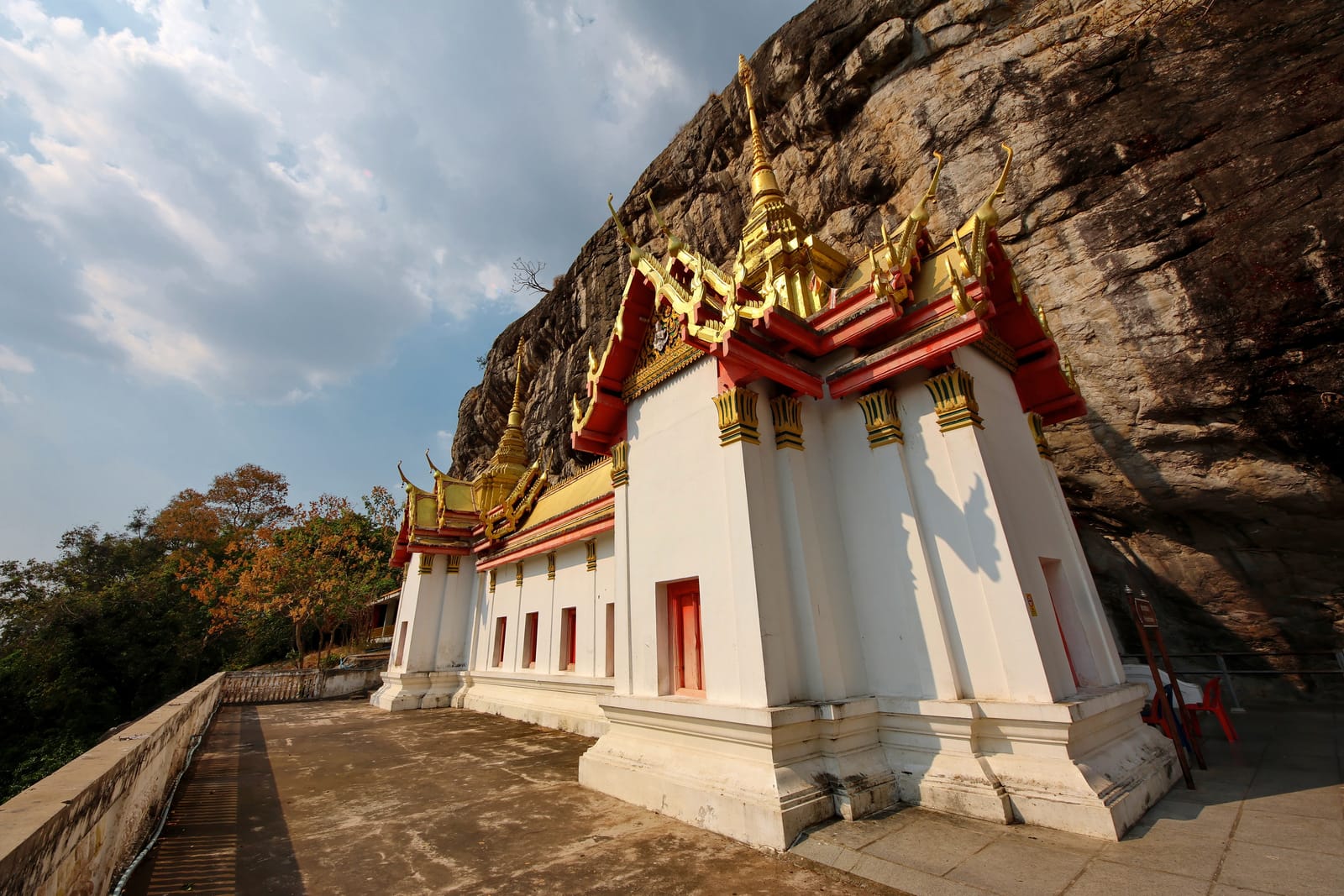
Wat Phra Phutthachai sits at the foot of Khao Pathawi hill in Nong Pla Lai sub-district, Mueang district — not far from central Saraburi. Locals bring merit-making groups here, and visitors from out of town come for three things that are genuinely hard to find in one place: the Phutthachai image, a red mark on the cliff believed to be the shadow of the Buddha; the Buddha footprint on the summit; and prehistoric rock paintings left on the rock wall by people who lived here thousands of years ago. Everything is in the same compound — you can walk from one to the next.
The Buddha Shadow Image on the Cliff
The feature that gives the temple its name is a red ochre mark on a rock outcrop of the cliff face — roughly 5 metres tall — that resembles an aura or halo around a seated figure. According to legend, the Buddha paused here and left this impression of his presence. The temple has built a pavilion and sala around the spot so worshippers can approach it directly. The image has faded with age, so you need a moment to let your eyes adjust — but once you see the outline, it's easy to understand why people keep making the journey.
How to see the image clearly
The shadow is a faint red stain, and it shows up best in angled light — early morning or late afternoon. Step back from the cliff a little and let your gaze sweep slowly across the rock rather than staring at close range; the shape of the halo becomes much more obvious from a slight distance.
Want more out of Saraburi? Book tours & activities
Booking online ahead on Klook or GetYourGuide is usually cheaper than the gate and skips the queue. Pick only the experiences you actually want — prices and availability are shown live on each site.
The Buddha Footprint at the Summit
Higher up the hill, a right-foot Buddha footprint is enshrined at the peak — another pilgrimage point for Buddhists across the country. There are steps with handrails for those who want to walk up, and a road that vehicles can use to park close to the top. Walking is recommended if you're able: the path passes rest salas with open views over Saraburi town. Those with limited mobility can drive up and park near the shrine.
- Stairway to the summit — walk up to the footprint shrine and viewpoint; handrails fitted along the route, no need to rush
- Hilltop viewpoint — wide view over the forest surrounding the temple and Saraburi city beyond; best photographed on a clear day
- Vehicle road — a road runs to a parking area near the footprint shrine, suitable for elderly visitors or anyone who cannot manage the stairs
Prehistoric Rock Paintings
This is the part most visitors don't know exists. Wat Phra Phutthachai has a prehistoric rock-art site under a natural overhang, with paintings estimated to be around 3,000 years old. The images are in red ochre — applied by dipping plant resin or bark into pigment and pressing it onto the stone. The overhang stretches about 106 metres across and stands some 20 metres above the ground. It was once a living and activity space for ancient communities. The Fine Arts Department registered it as a historic monument back in 1935.
The paintings fall into several groups: people hunting and moving in procession, animals including cattle, dogs and chickens, hand stencils pressed against the rock near the entrance to the Phutthachai area, and geometric symbols — triangles, curves and line patterns. Archaeologists have compared them to the prehistoric paintings at Pha Taem in Ubon Ratchathani; together they are evidence of Stone Age life built around hunting, foraging and ritual.
Human Figures & Processions
Figures carrying weapons that appear to be hunting, and lines of people in procession — a direct window into prehistoric daily life
Animal Paintings
Cattle, dogs and chickens — both wild and domestic animals — some located on the western side between the hermit's cave and the Phutthachai image
Hand Stencils & Symbols
Hand prints pressed onto the rock near the Phutthachai entrance, plus triangles, curves and other line-based symbols
How not to miss the rock paintings
The paintings are very faint and scattered across different sections of the overhang. Ask a temple staff member or a local on site to point out the locations first — it makes a huge difference. And do not touch the rock surface or scrape it with anything; these are thousand-year-old monuments.
Opening Hours, Getting Here & What to Know
- Opening hours — open for visits and worship every day, approximately 07:00–17:00
- Entry fee — no admission charge; donations welcome
- Getting here from Bangkok — drive north on Phahon Yothin Road (Highway 1) toward Saraburi; signs appear before you reach the town centre; journey time roughly 1.5–2 hours
- Parking — large car park on site, with shops and toilets available
- Watch out for monkeys — there is a troop of monkeys living around the temple; keep valuables secured, don't walk around with food bags in hand, and don't feed them outside designated areas
Dress for a hill walk
If you plan to walk up to the Buddha footprint shrine, wear comfortable shoes, bring water, and aim for the morning or late afternoon when the sun is not at its strongest. The midday heat on the steps is noticeably harder going.
Combining It With Other Stops in a Day
Wat Phra Phutthachai sits on Saraburi's temple circuit. Seeing all three main areas takes around 1–2 hours, leaving plenty of time to continue elsewhere. It pairs naturally with other temples and nature spots nearby in a single day.
Wat Phra Phutthabat Ratchaworamahawihan
Saraburi's most revered temple, housing an important Buddha footprint — a short drive away and a natural pairing with this visit
Waterfalls in Muak Lek
If you have time in the afternoon, head toward Muak Lek for a waterfall and some relief from the heat
Saraburi Local Food
Wrap up the day with local dishes — noodles, sweets and regional snacks available throughout the town centre
Plan a full day in Saraburi — temples, local food and nature in one loop
See the Saraburi Travel Guide →