🔄 Updated 21 Jun 2026
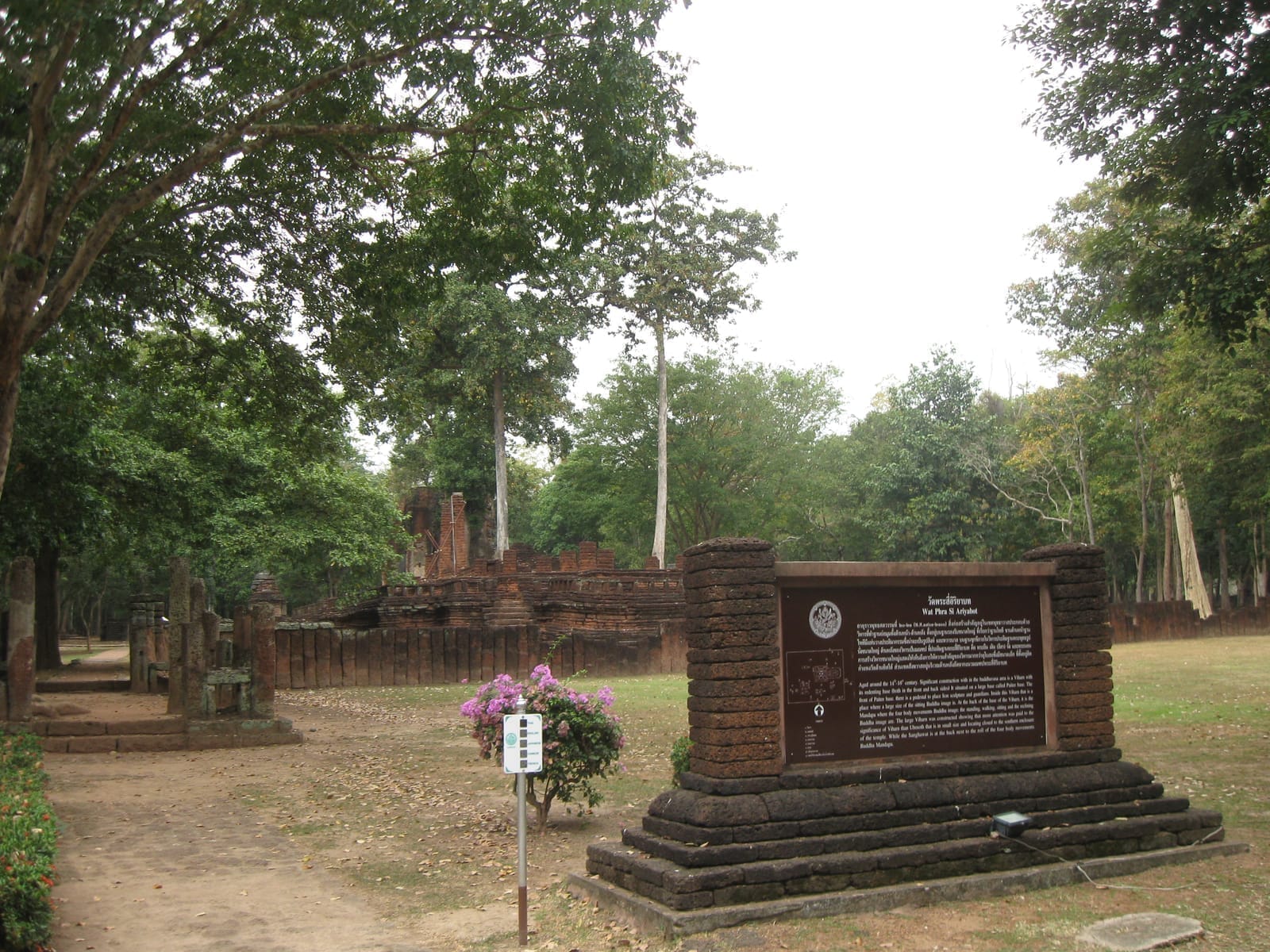
Kamphaeng Phet Historical Park splits into two main zones: the area inside the old city walls (Wat Phra Kaew, Wat Phra That) and the Aranyik zone, a stretch of forest temples just north of the walls where meditation monks once practised. Wat Phra Si Ariyabot sits in this Aranyik zone, not far from the park office, and most people visit it in the same loop as Wat Phra Non and Wat Chang Rop.
What makes this temple stick in your memory is the square mondop (four-faced shrine) of the postured Buddhas at the back of the grounds. The base is built up about 2 metres in laterite, and each side of the mondop once held a giant stucco Buddha facing a different direction — all four postures that give the temple its name. Time has worn most of them down. The standing Buddha survives in the best shape, while the other three are now just outlines you piece together with a bit of imagination.
What are the four postures, and which way does each face?
"Iriyabot" means the four basic postures of the body in Buddhism. This temple built a Buddha image in all four around a single mondop — a layout you don't see often. It's thought to be the work of Kamphaeng Phet craftsmen in the Sukhothai school, dating to roughly the 15th–16th centuries CE.
- East — walking posture (Lila) a Buddha shown in mid-stride, a nod to setting out to spread the teaching.
- West — standing posture the best-preserved of the four; you can still make out the face and the lines of the body. This is the star of the temple and where everyone takes their photos.
- North — reclining posture (Saiyat) a reclining Buddha, now reduced to the outline of its base.
- South — seated posture a Buddha seated in meditation; enough traces remain to show where it once was.
How to read the Buddhas more enjoyably
Try walking a full clockwise loop around the mondop, one side at a time. Start at the best-preserved standing Buddha on the west side, then take in the other three that survive only as outlines. It makes the craftsmen's idea — fitting all four postures into one spot — click much faster.
Want more out of Kamphaeng Phet? Book tours & activities
Booking online ahead on Klook or GetYourGuide is usually cheaper than the gate and skips the queue. Pick only the experiences you actually want — prices and availability are shown live on each site.
The standing stucco Buddha: the temple's photo spot
The standing Buddha on the west side is the lasting image of Wat Phra Si Ariyabot — stucco over a laterite core, so tall you have to look up at it. It photographs best in the early morning or late afternoon, when the low, angled light brings out the texture of the stucco and the laterite surface. Midday sun is harsh and too hot.
For a good shot, try standing below and tilting up to capture the height of the base, or go wide to fit in the whole mondop with the surrounding trees for the full Aranyik forest-temple feel. Just don't climb onto the base or touch the Buddha — it's a fragile ruin.
How to make the most of it: pair it with nearby temples
The nice thing about the Aranyik zone is that the major temples sit close together — a short drive apart, or even within cycling distance. Stop at Wat Phra Si Ariyabot and you can tack on several more in the same loop.
Wat Phra Non
Right next door, known for its huge single-piece laterite columns and the base of a giant reclining Buddha. An easy walk on from Wat Phra Si Ariyabot.
NearbyWat Chang Rop
A bell-shaped chedi on a base ringed with stucco elephant figures — another highlight of the Aranyik zone.
Inside the wallsWat Phra Kaew–Wat Phra That
Inside the old city walls, a short drive away. Good to add on so you cover both zones in one day.
Hours, entry fees, and how to get there
- Hours — the park is open daily, roughly 08:30–16:30. The Aranyik zone gets strong sun, so come in the morning or late afternoon.
- Entry fee — charged separately per zone: around 20 THB for Thais and 100 THB for foreigners. Bringing a car into the Aranyik zone costs around 50 THB.
- Getting there — the Aranyik zone is just north of the old city walls, a few kilometres from town. Driving or riding a motorbike is easiest, or you can rent a bicycle and ride around the zone for the atmosphere.
- What to bring — comfortable walking shoes, water, a hat or umbrella. The paths are dirt and grass with patches of shade here and there.
Straight talk
Wat Phra Si Ariyabot is an archaeological ruin, not an active temple with resident monks or much in the way of facilities. The charm is in the quiet atmosphere and the history. If you like wandering slowly through old ruins, you'll enjoy it; if you're expecting a flashy check-in spot, it might feel a bit plain.
Want to see all of Kamphaeng Phet — the ruins, the cafes, and the food?
See the Kamphaeng Phet travel guide →